MY DEAR FRIEND (1),
It gives me genuine pleasure to respond to your kind letter. I have nothing to add to your remarkable book on Jewish Cabala. It ranks first by virtue of the highly eminent and well-deserved appreciation given by the late Mr. Franck of the Institute, the most authoritative man to pass judgment on this subject.
Your work complements his, not only in erudition but also in bibliography and exegesis of this special tradition, and once more, I consider this fine book definitive.
But knowing my respect for tradition and, at the same time, my need for universality and verification through all current methodological procedures—furthermore being acquainted with the results of my researches—you do not fear that I might broaden the subject, and on the contrary, you kindly request me to do so.
Indeed, I have accepted the books of Jewish Cabala only under inventory assessment[*], however interesting they may be. But once this inventory was made, my personal researches have focused on the prior universality from which these archaeological documents proceed, and on the principle as well as the laws that may have motivated these facts of the human spirit.
Among the Jews, Cabala came from the Chaldeans through Daniel and Ezra.
Among the Israelites prior to the dispersion of the ten non-Jewish tribes, Cabala came from the Egyptians through Moses.
Among the Chaldeans as among the Egyptians, Cabala formed part of what all metropolitan Universities called Wisdom—that is, the synthesis of sciences and arts reduced to their common Principle. This Principle was the Utterance or the Word.
A precious witness of pre-Mosaic patriarchal antiquity declares this Wisdom lost or disrupted about 3,000 years before Our Lord. This witness is Job and
(1) Letter from Saint-Yves to Papus[*]. ↩
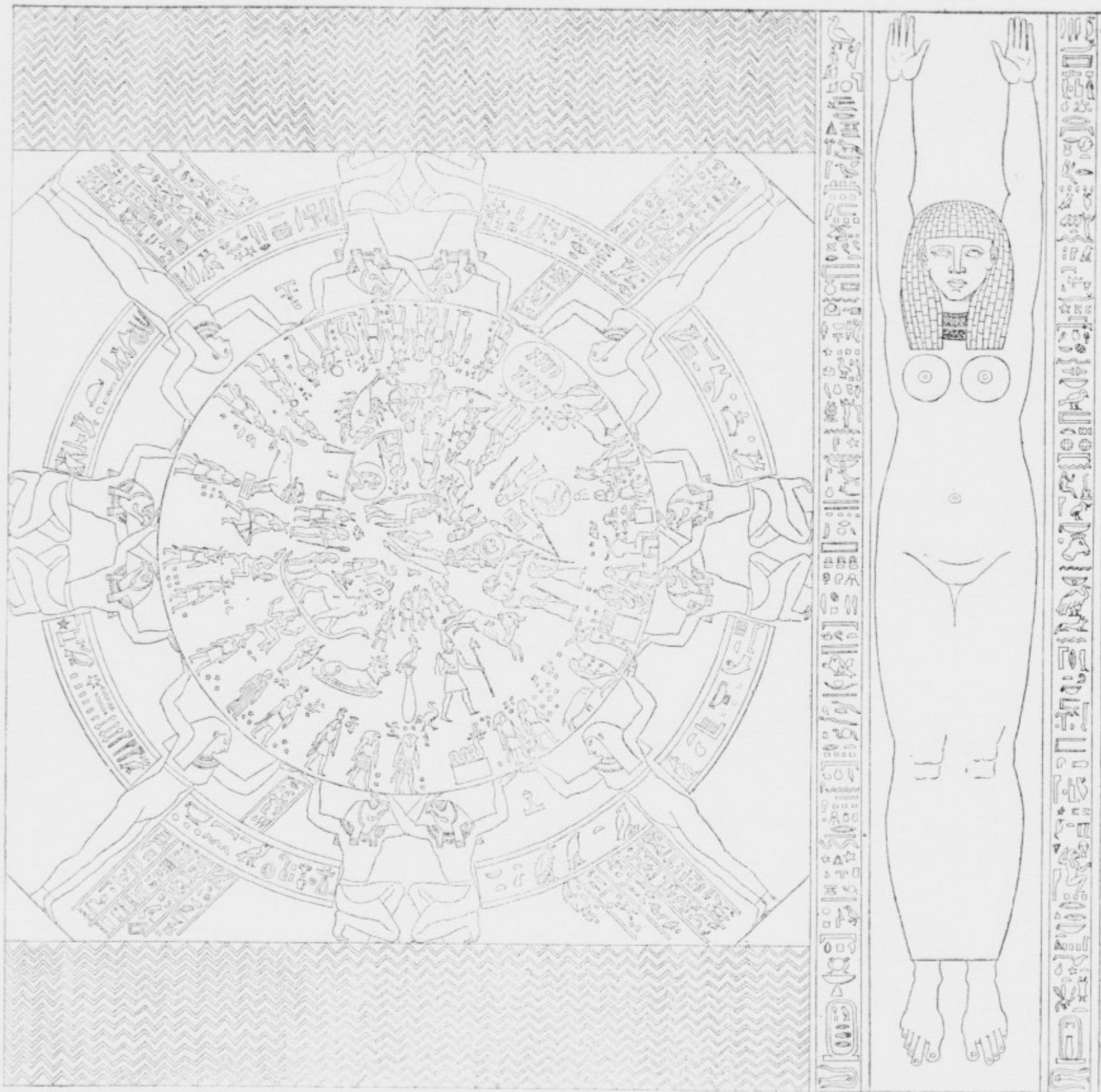
The zodiac known as the Denderah Zodiac
1. The Lion. 2. The Virgin. 3. The Scales. 4. The Scorpion. 5. The Archer. 6. The Goat. 7. The Water-Bearer. 8. The Fishes. 9. The Ram. 10. The Bull. 11. The Twins. 12. The Crab.
The Figure at Right represents Nature.
the antiquity of this book is autologically signed by the position of the constellations it mentions: “Where then is Wisdom, where does it dwell?” says this holy patriarch.
In Moses, the loss of prior unity, the dismemberment of patriarchal Wisdom, are indicated under the names of division of Tongues and Era of Nimrod. This Chaldean epoch corresponds to that of Job.
Another witness of patriarchal Antiquity is Brahmanism. It has preserved all traditions of the past superimposed like the different geological layers of the earth. All who have studied it from a modern viewpoint have been struck both by its documentary riches and by the impossibility for their possessors to classify them satisfactorily, both chronologically and scientifically. Their divisions into Brahmanic, Vaishnavite, Shaivite sects—to name only these—further add to this confusion.
It remains no less true that the Brahmins of Nepal trace back to the beginning of the Kali Yuga the rupture of the ancient universality and primordial unity of teachings.
This primitive synthesis bore, long before the name of Brahma, that of Ishva-Ra, Jesus-King: Jesus Rex Patriarcharum, as our litanies say.
It is to this primordial synthesis that Saint John alludes at the beginning of his Gospel; but the Brahmins are far from suspecting that their Isoua-Ra is our Jesus, King of the Universe, as Creative Word and Principle of human Utterance. Were it otherwise, they would all be Christians.
The forgetting of Patriarchal Wisdom of Ishva-Ra dates from Krishna, the founder of Brahmanism and its Trimurti. Here again, there is concordance between the Brahmins, Job and Moses, regarding both the fact and the epoch.
Since this Babel-like time, no people, no University has possessed anything more than fragmentary remnants of the ancient Universality of divine, human and natural knowledge, reduced to their Principle: the Word-Jesus. Saint Augustine designates as Religio vera this primordial Synthesis of the Word.
The Rabbinic Cabala, relatively recent in its written form, was known thoroughly in its written or oral sources by the Jewish adepts of the first century of our era. It certainly held no secret for a man of the worth and knowledge of Gamaliel. But neither did it for his first and preeminent disciple, Saint Paul, who became the Apostle of the risen Christ.
Now, here is what Saint Paul says, First Epistle to the Corinthians chapter II, verses 6, 7, 8:
“We speak wisdom among them that are perfect: yet not the wisdom of this world, nor of the princes of this world, that come to nought;
“But we speak the wisdom of God in a mystery, even the hidden wisdom, which God ordained before the world unto our glory;
“Which none of the princes of this world knew: for had they known it, they would not have crucified the Lord of glory.”
All these words are weighed like gold and diamond by the carat, and there is not one that is not infinitely precise and precious. They proclaim the insufficiency of Jewish Cabala.
Having thus illuminated the universality of the question that interests you, let us concentrate this light on this nevertheless precious fragment of ancient Wisdom, which is or may be Jewish Cabala.
First of all, let us specify the meaning of the word Cabala.
This word has two meanings, depending on whether it is written, like the Jews, with Q (Qoph), that is, with the twentieth letter of the Assyrian alphabet, which bears the number 100, or with the C (Kaph), the eleventh letter of the same alphabet, which bears the number 20.
In the first case, the name signifies Transmission, Tradition, and the matter remains thus undecided; for as is the transmitter, so is the thing transmitted; as is the traditor, so is the tradition.
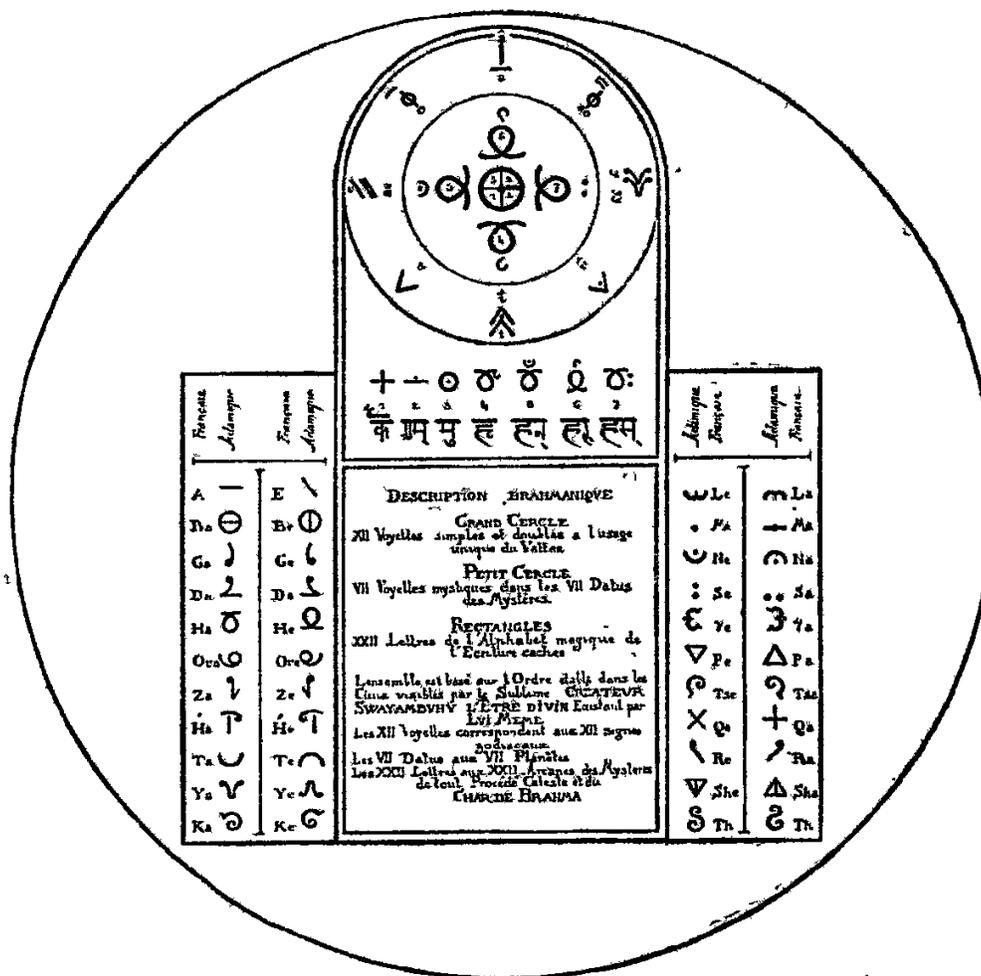
The Watan or Adamic Alphabet
We believe the Jews transmitted fairly faithfully what they received from the Chaldean scholars, along with their writing and the recasting of earlier books by Ezra, himself guided by the great Master of the University of the Magi of Chaldea, Daniel. But from a scientific viewpoint, this advances the question not at all. It merely pushes it back to an inventory of Assyrian documents and so on up to the primordial source. In the second case, Ca-Ba-La signifies the Power, La, of the XXII, CaBa, since C = 20, since B = 2.
But then, the question is resolved exactly, since it concerns the scientific character attached in patriarchal antiquity to alphabets of twenty-two numeral letters.
Should these alphabets be made a racial monopoly by calling them Semitic? Perhaps, if they truly are a monopoly, not otherwise.
Now, according to my investigation of the ancient alphabets of Ca-Ba-La, of XXII letters, the most hidden, most secret which very certainly served as prototype, not only for all others of the same kind, but for Vedic signs and Sanskrit letters, is an Aryan alphabet. This is the one I was so happy to communicate to you, and I myself received it from eminent Brahmins who never thought to ask me for its secret.
It is distinguished from other so-called Semitic ones in that its letters are morphological, that is, they speak exactly through their forms, which makes it an absolutely unique type. Moreover, careful study has led me to discover that these same letters are the prototypes of zodiacal and planetary signs, which is also of utmost importance.
The Brahmins call this alphabet Vattan; and it seems to date back to the first human race, for, through its five strictly geometric mother-forms, it signs itself, Adam, Eve and Adamah.
Moses seems to designate it in verse 19 of chapter II of his Sepher Barashith. Moreover, this alphabet is written from bottom to top, and its letters group together to form morphological or speaking images. The pandits erase these characters on the slate as soon as the gurus’ lesson is finished. They also write it from left to right, like Sanskrit, thus in European fashion. For all the preceding reasons, this prototype alphabet of all Kaba-Lim belongs to the Aryan race.
One can therefore no longer give alphabets of this kind the name of Semitic, since they are not the monopoly of the races thus named, rightly or wrongly.
But one may and must call them schematic. Now schema signifies not only sign of the Utterance, but also Glory. It is to this double meaning that one must pay attention when reading the above passage from Saint Paul.
The Sanskrit Alphabet
Vowels
अ a आ â इ i ई ī उ u ऊ ū ऋ r̥i
ॠ r̥i लृ l̥i वृ v̥i ए e ऐ e ओ o औ o
Consonants
| Gutturals | क ka | ख kha | ग ga | घ gha | ङ nga |
| Palatals | च cha | छ chha | ज ja | झ jha | ञ ña |
| Cerebrals | ट ta | ठ tha | ड da | ढ dha | ण na |
| Dentals | त ta | थ tha | द da | ध dha | न na |
| Labials | प pa | फ pha | ब ba | भ bha | म ma |
| Semi-vowels | य ya | र ra | ल la | व va | श wa |
| Sibilants | श sha | ष sha | स sa | ह ha | क्ष ksha |
| Aspirates | ह ha | क्ष ksha | त्र tra | थ th | क्ष ksha |
| Double | ग ga | घ gha | क्व kva | क्व kva | क्व kva |
It also exists in other languages like Slavonic. For example, the etymology of the Slavonic word is Slovo and Slava which mean utterance and glory.
These meanings already elevate us high. Sanskrit will corroborate this altitude. Sama, which is also found in languages of Celtic origin, signifies similitude, identity, proportionality, equivalence, etc.
We shall see further on the application of these ancient significations.
For now, let us summarize what precedes.
The word Cabala, as we understand it, signifies the Alphabet of the XXII Powers, or the power of the XXII Letters of this Alphabet. This type of alphabet has an Aryan or Japhetic prototype. It may rightfully be designated under the name of alphabet of the Utterance or of Glory.
Utterance and Glory! Why are these two words juxtaposed in two ancient languages as distant as Slavonic and Chaldean? This stems from a primordial constitution of the human Spirit in a common Principle, at once scientific and religious: the Word, the cosmological Utterance and its Equivalents.
Jesus, in His last most mysterious prayer, casts, in this as in all things, decisive light upon the historical mystery that concerns us here:
“O Father! Crown me with the Glory I had before the World was!”
The Incarnate Word alludes herein to His Work, to His direct creation as Creative Word, Creation designated by the name of divine and eternal World of Glory prototype of the astral and temporal World, created by the Alahim upon this incorruptible model.
That the creative Principle is the Word, on this point Antiquity speaks with but one unanimous voice. To speak and to create are synonymous in all languages.
Among the Brahmins, documents prior to the cult of Brahma represent ISOu-Ra, Jesus-King, as the Creative Word.
Among the Egyptians, the books of Hermes Trismegistus say the same thing, and OShI-Ri is Jesus-King read from right to left.
Among the Thracians, Orpheus, initiated into the Mysteries of Egypt toward the same era as Moses, had written a book entitled the Divine Word.
As for Moses himself, the Principle is the first word and subject of the first sentence of his Sepher. It does not concern God in His Essence, IHOH, who is named only on the seventh day, but His Word, creator of the divine Hexad: BaRa-Shith. Bara signifies to speak and to create; Shith signifies Hexad. In Sanskrit the same meanings: BaRa-Shath.
This word BaRa-Shith has given rise to countless discussions. Saint John bears it like Moses, from the very beginning of his Gospel, and says, in Syriac, the Cabalistic language of XXII letters: The Principle is the Word. Jesus had said: I am the Principle.
The exact meaning is thus fixed by Jesus Himself corroborating all prior Universality, pre-Mosaic.
What precedes explains why the Universities of true antiquity considered the creative Word as the Incidence of which human Utterance is the exact Reflection, when the alphabetic process exactly fits the planisphere of the Kosmos.
The alphabetic process, armed with all its equivalents, then represents the eternal World of Glory: and the cosmic process represents the World of the astral heavens.
This is why the King-Prophet, echo of all patriarchal Antiquity, says: Cæli enarrant Dei Gloriam. Or in French: The astral World recounts the World of divine Glory. The invisible Universe speaks through the visible.
Two things remain here to determine: 1° the cosmic process of the ancient Schools; 2° that of the corresponding Alphabets.
For the first point, III mother Forms: the center, the radius or diameter and the circle; XII involutive signs; VII evolutive signs.
For the second point, to which the ancients accorded first rank: III constructive Letters; XII involutive; VII evolutive.
In both cases: III + XII + VII = XXII = CaBa, pronunciation of: C = 20, B = 2, total 22, Q.E.D.
Thus, the twenty-two letter alphabets corresponded to a solar or solar-lunar Zodiac, armed with an evolutive septenary.
These were the schematic alphabets.
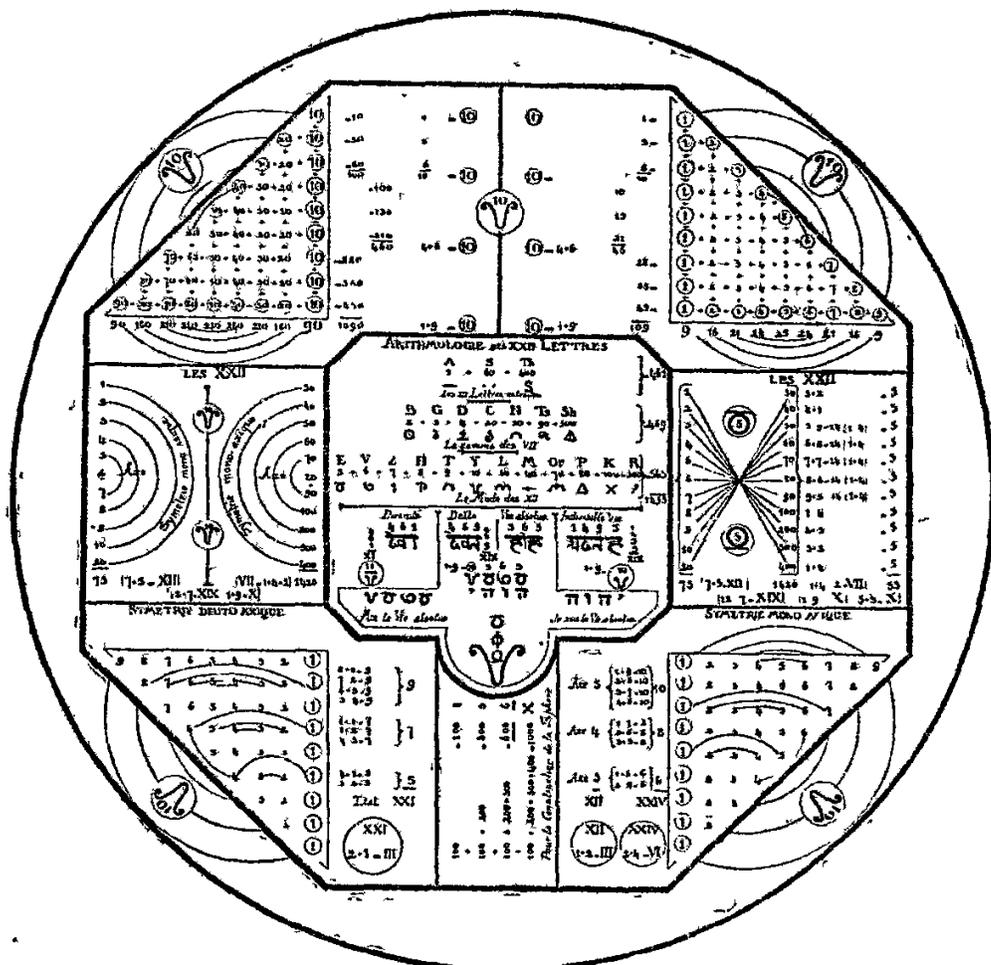
Alphabet of XXII (See Book II)
The others, following the same method, became by 24 letters the hourly counterparts of the former; by 28 letters, their lunar counterparts; by 30, their solar-lunar monthly counterparts; by 36, their decanal counterparts, etc.
In the twenty-two letter alphabets, the Royal letter, the Emissive of departure, the Remissive of return, was the I or Y or J, and, placed upon the first inscribed equilateral triangle, it was to form autologically, with two others, the name of the Word and of Jesus IShVa-(Ra), OShI-(Ri).
Conversely, all peoples who embraced the naturalist and lunar schism took as their Royal letter the M, which governs the second elementary trigone.
The entire Vedic, then Brahmanic system was thus regulated after the fact by Krishna, beginning with the Kali Yuga. Such is the key to the Book of the Wars of IÊVÊ, wars of the Royal I or Y against the usurping M.
You have seen, my dear friend, the thoroughly modern proofs—that is, of simple observation and scientific experimentation—by which the most ancient tradition has been simultaneously restored and verified by me. I shall therefore say here only what is strictly necessary for elucidating the historical fact of the Cabala.
According to the patriarchs who preceded them, the Brahmins divided human languages into two major groups: 1st Devanagari, languages of the Celestial City or of civilization restored to the divine cosmological Principle; 2nd Prakrit, languages of wild or anarchic civilizations. Sanskrit is a Devanagari language of forty-nine letters; the Veda likewise, with its eighty letters or signs derived from the point of AUM, that is, from the letter M.
These two languages are cabalistic in their particular system, of which the letter M forms the point of departure and return. But they have been, from their origin, and remain to this day, articulated upon a temple language of twenty-two letters, whose primitive Royal letter was the I.
All rectifications become possible and easy through this key, to the greatest triumph and glory of Jesus, Word of IÊVÊ, in other words of the primordial Synthesis of the first Patriarchs.
Present-day Brahmins attribute a magical virtue to their twenty-two letter alphabet; but this word signifies for us nothing but superstition and ignorance.
Superstition, decadence and super-station of archeological elements and more or less altered formulas, but which an in-depth study can sometimes, as is here the case, reconnect to a prior teaching, scientific and conscious, neither metaphysical nor mystical.
Greater or lesser ignorance of the facts, laws and principle that motivated this primordial teaching.
Moreover, the Vedic-Brahmanic lunar School is not the only one where science and its solar synthesis, the religion of the Word, have degenerated into magic. It suffices to explore a little of terrestrial universality beginning from the Babel-like epoch, to see an increasing decadence attributing more and more a superstitious and magical character to the ancient alphabets.
From Chaldea to Thessaly, from Scythia to Scandinavia, from the Kouas of FO-HI and the Musnads of ancient Arabia to the Runes of the Varangians, the same degeneration may be observed.
The truth, in this as in all things, is infinitely more marvelous than error, and you know, dear friend, this admirable truth.
Finally, as nothing is lost in terrestrial Humanity any more than in the entire Kosmos, what has been still is, and bears witness to the ancient universality of which Saint Augustine speaks in his Retractations.
The Brahmins cabalize with the eighty Vedic signs, with the forty-nine letters of Devanagari Sanskrit, with the nineteen vowels, semi-vowels and diphthongs—that is, the entire massorah of Krishna superimposed by him upon the Vattan or Adamic alphabet. The Arabs, Persians, and Soubbas cabalize with their lunar alphabets of twenty-eight letters, and the Moroccans with theirs or Koreïsh.
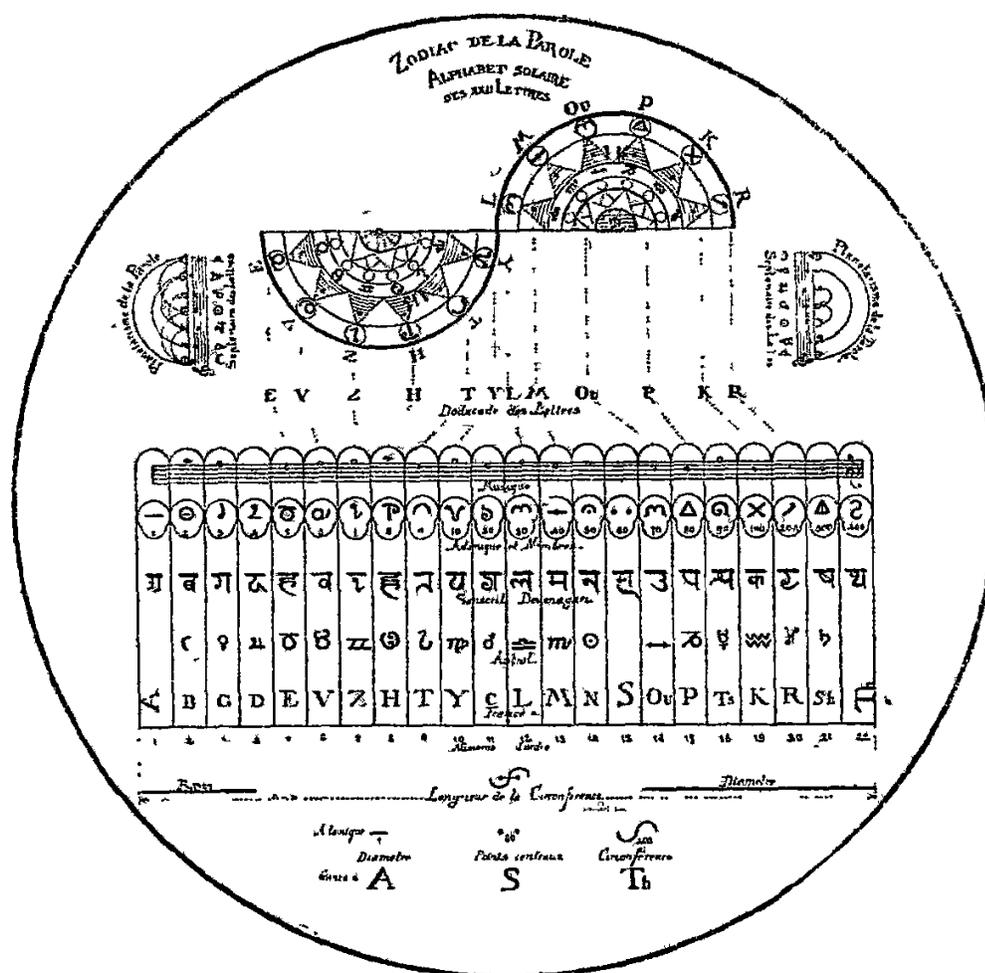
The Manchu Tartars cabalize with their monthly alphabet of thirty letters. The same observations apply to the Tibetans, the Chinese, etc.; the same reservations regarding the alterations of the ancient Science of cosmological equivalents of the Utterance.
It remains to be known in what order these XXII equivalents must be functionally arranged upon the planisphere of the Kosmos.
You have before your eyes, dear friend, the model conforming to that which has been legally deposited under the name of Archeometer.
You know that the keys of this precision instrument, for use in advanced studies, were given to me by the Gospel, by certain very precise words of Jesus, to be compared with those of Saint Paul and Saint John.
Permit me now to summarize in as few words as possible.
All religious Universities, Asian and African, provided with cosmological alphabets—solar, solar-lunar, hourly, lunar, monthly, etc., use their letters in a cabalistic manner.
Whether it concerns pure Science, Poetry interpreting Science, or divine Inspiration, all ancient books written in Devanagari languages and not Prakrit can only be understood through the Cabala of these languages.
But these must be reduced to the XXII schematic equivalents, and those to their exact cosmological positions.
The Cabala of the Jews is thus motivated by the entire prior constitution of the human Spirit; but it needs to be archeometered—that is, measured by its regulating Principle, controlled upon the precision Instrument of the Word and its primordial Synthesis.
I do not know, dear friend, whether these pages will meet your affectionate expectations. I could only summarize entire chapters in a few lines.
Kindly excuse their imperfections, and see in what precedes only a testimony of my goodwill and old friendship.
January 10, 1901.
T-22 — Translator’s Note: Letter from Saint-Yves to Papus. ↩
T-23 — Translator’s Note: Inventory — existing books. ↩