Before undertaking the study of the Archeometer, it is important to clearly establish the particular character of this discovery. The Archeometer is a construction tool, not a pre-built house. Before erecting a house, one sees each trade bring its working tools: the mason brings his trowel; the architect, his compass and ruler, and so forth for each trade.
The Archeometer is a tool possessing this special quality — it is the same for all arts; it is simultaneously the key to the musician’s sonometric scale, the painter’s scale of colors, and the architect’s forms.
It is essential to firmly establish this fundamental distinction, which makes this synthetic instrument precisely an instrument, not a ready-made adaptation. It does not provide a pre-constructed house, but rather a means to construct many according to new rules. It is therefore not a reward for laziness, but on the contrary, an invitation to work with new means. It leaves each artist his full originality while providing a scientific foundation. It is a tool with special qualities that we shall summarize as best we can:
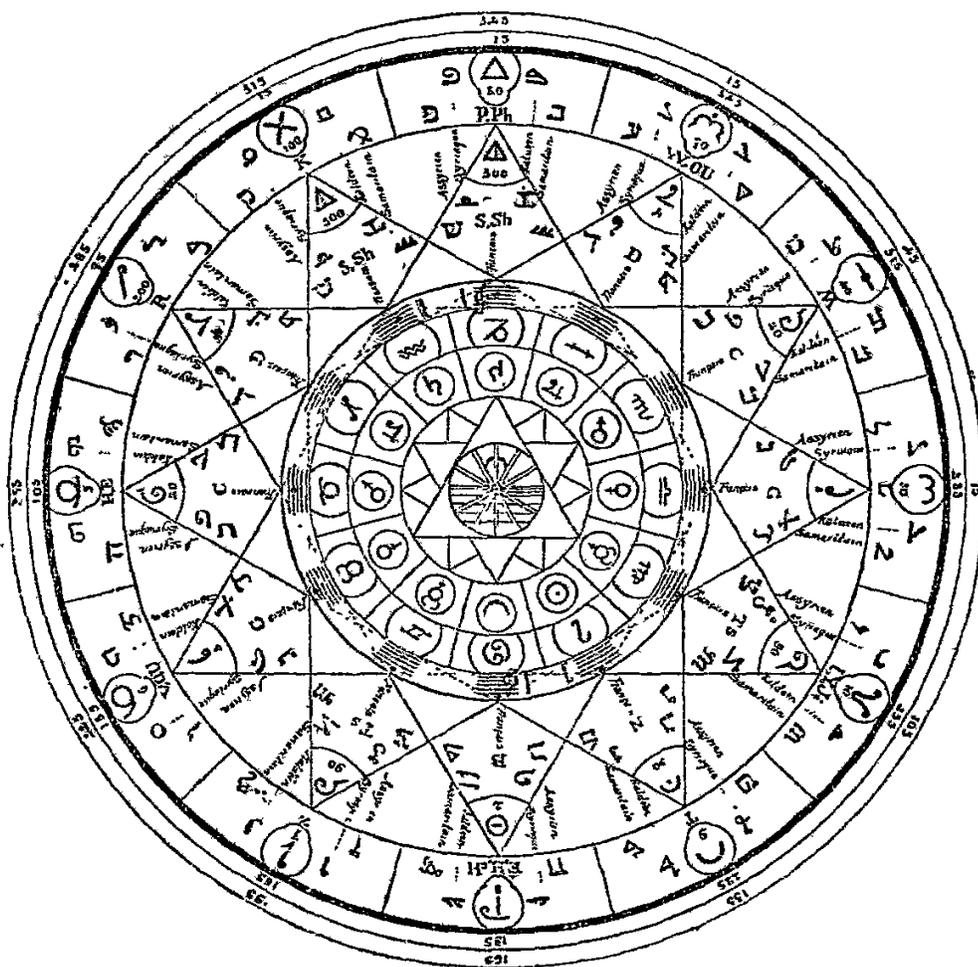
The Archeometer
- 1° It is the same for all Arts;
- 2° It brings all Arts back to a common Synthesis while simultaneously providing the key to religious and scientific adaptations of antiquity;
- 3° It reduces all measurements to current metric units: the meter and the circle; one thousand millimeters and 360 degrees.
I
The Archeometer is a tool common to all arts; the painter sees in it composite colors derived from the three primitive colors — yellow, red, and blue — arranged around a 360-degree circle, such that white is always theoretically reconstituted by two colors opposite at 180 degrees. Thus, with the Archeometer, one can determine a scale of at least 360 hues, each with a number rather than a fanciful name. This number allows one to determine not only each hue but also its composition relative to the primitive colors. The musician finds in the Archeometer the relationships between notes, colors, forms, and letters, and furthermore, the sonometric scales that reduce the two series — the verbal series and the physical series — inversely proportional to the standard meter, with the note D-flat equals 100,000 or one meter; this figure of 100,000 representing the multiplication of 625 by 160. (For details and adaptations, see later the study of the archeometric standard.)
The architect finds in the Archeometer the key to a universal Canon, enabling the construction of forms based on a name, an idea, or a specific color; thus establishing close relationships between a building’s height and width on one hand, and its industrial, religious, or aesthetic adaptation on the other.
But what will most astonish contemporary artists is the Archeometer’s adaptation to literature. The relationships between letters and colors, glimpsed intuitively by Rimbaud and his imitators, are scientifically determined by the Archeometer; moreover, this instrument establishes the relationships between words, ideas, colors, and forms.
If this instrument is useful to creators of new adaptations, it assumes an entirely special character regarding the study of ancient sciences. The seeker of hidden things and the historian are given possession of the tool used by ancient initiations for all their adaptations to art and scientific revelation. A few words of explanation are necessary here at once.
The ancients, indeed, had taken as their general key of adaptation the Heavens and their constitution. Thus, were all earthly archives to disappear, it was always possible to reconstruct the instrument that formed the basis of all arts and sciences by tracing the constitution of the Heavens on papyrus or a wooden tablet. This is why knowledge of ancient Astrology is indispensable to true seekers, as well as to historians worthy of the name. The Heavens were divided by the ancients into twelve great divisions corresponding to each of the twelve Zodiac Signs. These divisions formed astrological houses, within which the stars moved: these stars had positive or negative domiciles — that is, diurnal or nocturnal — in each of these houses. If one remembers that for the ancients, each Zodiac Sign had a letter, each planet likewise had a letter, so that the Heavens were constituted by a veritable moving alphabet where planetary letters presented themselves before each fixed zodiacal letter; there were therefore names inscribed in the Heavens that we shall rediscover in all great religions: Ichwa-ra or Jesus-king, Mariah or Mayah, Maha-Maya or the Virgin of the great celestial Waters, have their names written in letters of fire in the Heavens since the constitution of the first terrestrial elements. The same holds for the names of Pho, of Shiwa, of Brahma, etc.
… We must strongly emphasize this dual character of the Archeometer. It is a tool that must renew all modern art in the hands of genius artists on one hand, but it is also the witness and key to all ancient Science, of which occult sciences are a deformed remnant. Occultists generally consider the Archeometer only from this latter viewpoint, and the generally childish commentaries made thus far about this admirable instrument of adaptation bear almost exclusively upon its latter aspect. Now, Astrology indeed provides the key to ancient Science, and it will be one of Saint-Yves d’Alveydre’s great merits to have restored the relationships between letters, colors, and planets. Yet this instrument would remain but a summoner of intellectual graveyards had its author not made it the means of synthesizing and regenerating all future intellectuality.
II
This tool is the same for all arts; it establishes their synthesis and determines their interrelations.
The same 360-degree Circle provides us with: 1° a dual numerical scale; 2° the relationships between colors and forms, musical notes, and letters of ancient sacred alphabets. As we have just stated above, it synthesizes these artistic keys with the data of ancient Astrology, which is the true key to all religions and sacred sciences of antiquity. Thanks to the Archeometer, the heavens cease to be mute; they speak, they pronounce names — and these names are those of all religious revelation throughout time, as we have just indicated. Saint-Yves d’Alveydre devoted a substantial portion of his work to this study of religious adaptations, which we can only hint at here.
III
As will be seen upon glancing at the color illustration of the Archeometer, everything is inscribed within a 360-degree circle, divided by triangles into twelve 30-degree sections. One will note the two numerical scales: one from 0 to 360 degrees and the other from 360 to 0 degrees. Several adaptation models will be found in the course of this work; these models are necessarily incomplete, though they form valuable indications — for while an author may be specially competent in one art, it is understood that even with a prodigious mind, he cannot be equally competent in all arts and all known sciences. We must further add that when the Marquis de Saint-Yves’s heirs, Countess Keller and Count Alexandre Keller, did Dr. Encausse the great honor of choosing him to oversee the publication of the Archeometer, Saint-Yves’s work was far from finished. It required several months of delicate research and labor; it required assembling all the brilliant author’s collaborators to finalize his work. One will see how extensively Saint-Yves had focused on music, his art of predilection. One will also see how significant the architectural data proves to be. Each of these sections was reviewed by one of Saint-Yves’s collaborators, whose names may be found in the list of the Friends of Saint-Yves.