The Cosmological Archeometer
Revealer and Regulator of Higher Studies
Detailed Description
The Archeometer and Architechny
The Archeometer is thus the precision instrument of higher sciences and their corresponding arts, their cosmometric protractor, their cosmological standard, their regulator and homological revealer.
It brings them back to their single universal principle, to their mutual concordance and to their synarchic synthesis.
This synthesis, which is none other than the genesis of the principle, is the very Word, and it autographs its own name upon the first triangle of the Archeometer: SOPh-Ya, Wisdom of God.
But to make understood all possible applications of the Archeometer as experimental revealer and regulator of this genesis and synthesis would require entering into endless developments.
It would require inventorying the entire nomenclature of the quadruple hierarchy of substances, facts, and consequently of divine, angelic, human and natural sciences and arts.
Moreover, it would require indicating, while entering into the universality of consequences, all equivalences and all correspondences of these hierarchies.
We shall reach the same demonstrative goal by a swifter path—that of fact alone, of experience in all its scientific truth and consequently in all the conscientious integrity one must demand of oneself in so grave a matter.
This fact is art—but art considered as the creative and conscious utterance of science itself, no longer as the individualist manifestation of anarchy, fancy, fashion or imitation.
This is why we concentrate the Archeometer’s applications upon that Art which may become the most direct expression of Science returned to its principle—upon the art that synthesizes all sciences in action, all arts, all crafts and industries—in a word, the entire hierarchy of human labor.
This art is Architechny.
The masterwork of Architechny being the Religious Edifice—summary of the Principle of Law and of social fact—we shall apply the Archeometer to the science of religions.
Being potentially required to erect Christian cathedrals, Brahmanic pagodas[*], Buddhist or Chinese temples, Zoroastrian fire temples or Muslim mosques, the architect will see upon the Archeometric Regulator the exact position of each of these religions within Religion—this word being used in its sense of scientific Synthesis and of Wisdom in the ancient meaning of the term.
The Archeometer will experimentally prove itself to be both Revealer and Regulator of Higher Studies—the Revealer of the Revelation foretold at the beginning of the 19th century by the Count de Maistre.
The Archeometric Principle being the Utterance, the architect will first use the double zone of letters, and this will simultaneously provide him with all its equivalences in sonometric numbers, colors, notes, musical modes, and consequently morphological forms.
He will only need to pass from the World of Glory to that of the astral Heavens to obtain the cosmological correspondences resulting from the preceding angelic and divine ones.
Crown of 360 degrees or 36 decans
The number 36, in decimal Sanskrit letters, is written: GO.
In the Veda, it signifies Heaven itself. The number 360, in Adamic numerical letters, is written: ShaS. It signifies the sexennial power 6 × 6—that which precisely corresponds to the measurement of the circle by the hexagon.
We shall later see the importance of this relation to the very Principle. The latter has, as its characteristic, the Trinity determining its direct instrumentality in sexenniality: 3…6; the equilateral trigone determining the hexagonal star.
This double circular protractor with inverse progression, regarding degrees, has a function of considerable practical verification—as facts will later attest—particularly concerning colors, the luminous Equivalents of the Utterance: Rays and colors.
Let us recall here, for the record, that the Gospel of Saint John, read in Aramaic Syriac, states: “The Principle is the Utterance, the Word.” In patriarchal Greece—or rather in Slavic Balkans—Orpheus, according to traditions collected by the Church Fathers, had left among his numerous canonical books a work entitled: The Utterance or the Sacred Word. Likewise in patriarchal Italy, that of the Etruscans.
One need only explore antiquity somewhat across all parts of the world to find certain traces of the importance of human Utterance, considered as a reflection of the divine Word.
Undoubtedly, from India to China, from Slavdom and Scandinavia to ancient America, from Syria and Chaldea to Egypt, erudition can only reach the superstitious and magical remnants of the ancient science of this primordial Utterance and its alphabets.
Yet these very relics bear witness to this lost science.
To its ancient alphabets of XXII letters,
| I | II | III | IV | V | VI | VII | VIII | IX | X | XI | XII | XIII | XIV | XV | XVI | XVII | XVIII | XIX | XX | XXI | XXII |
|---|---|---|---|---|---|---|---|---|---|---|---|---|---|---|---|---|---|---|---|---|---|
| Diatony of the Hexad | |||||||||||||||||||||
| Vattlan Alphabet and Numbers | |||||||||||||||||||||
| Sanskrit Devanagari | |||||||||||||||||||||
| Astral Alphabet | |||||||||||||||||||||
| Latin Letters | |||||||||||||||||||||
| A | B | G | D | E | V | Z | H | T | Y | C | L | M | N | S | W | Ph | Ts | K | R | Sh | Th |
Circumference Length
Radius
Diameter
Arithmology of the XXII Letters
1495 — यदनह, the Indivisible Being
469 - 4 + 6 + 9 = 19 _ 1 + 9 = 10 - Y _ 565 - HOH _ Y . HOH = YHOH, the Absolute Being יהוה
Circumference Length
Radius
Diameter
| Diameter | Central Points | Circumference | |
|---|---|---|---|
| Vattlan | — | . . | ~ |
| French | A | S | Th |
Law of π
22 ÷ 7 = 3.1428
0.1428 × 22 = 3.1416
Solar Cosmology of the XXII Letters
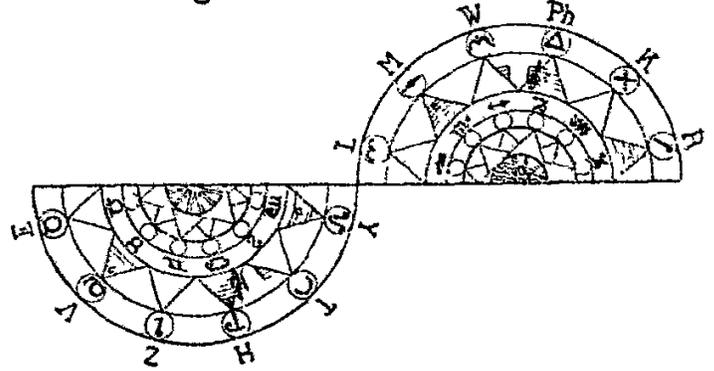
Circumference Length
Radius
Diameter
The Syrian Church attributes a liturgical value to each letter—a divine functionality, a hieratic significance.
In this respect, this religious University stands closer to true ancient science than the magical interpretations accessible to the erudition of decadent antiquity.
The Alphabets
Among ancient alphabets predating the anarchistic Greco-Latin civilizations, we classify those with 22 numeral letters as typical equivalents of the Utterance.
We name them Solar and Solar-Lunar, with the understanding that these astral names are merely signs of correspondence between the World of Glory and the astral World.
It is through forgetting this distinction—taking effect for cause, consequence for Principle—that certain ancient Universities fell into the worship of astral Powers, Angels and demons; into Sabaeanism, even into fetishism; and that, a century ago, Dupuis plunged lower still into the crudest astronomical materialism.
We classify as Lunar the alphabets of 28 letters, as Zodiacal Horary those of 24, as Zodiacal Monthly those of 30, as Decanic those of 36, etc.—always under the aforementioned reservations, and relating all these numbers to XXII as the Standard.
The alphabet of the first Patriarchs is that which we employ upon the Archeometer, for the following reasons.
It is morphological—that is, more than geometric; and through its rigid or flexible forms at will, it depicts the object it names, or names its form, according to rules unnecessary to expound here.
The Zodiacal and Planetary Signs derive from it, as does the construction of the sphere or planisphere containing these signs.
Consequently, the cosmological function and position of each letter are determined by its formal kinship with the astral signs, whose placement is itself determined astronomically.
It follows that since letters position themselves thus and not by human hand, their placement, their binary and ternary groupings, all their interrelations are autological rather than anthropological. We join to these, upon the Archeometer, the Syrian, Assyrian (so-called Hebrew), Samaritan and Chaldean alphabets—all Solar or Solar-Lunar, with XXII literal and numerical equivalents.
So that when the resemblance between the Archeometric letter and its corresponding Zodiacal sign leaves some visual uncertainty, this is dispelled by the analogous letter in other alphabets—principally the Samaritan.
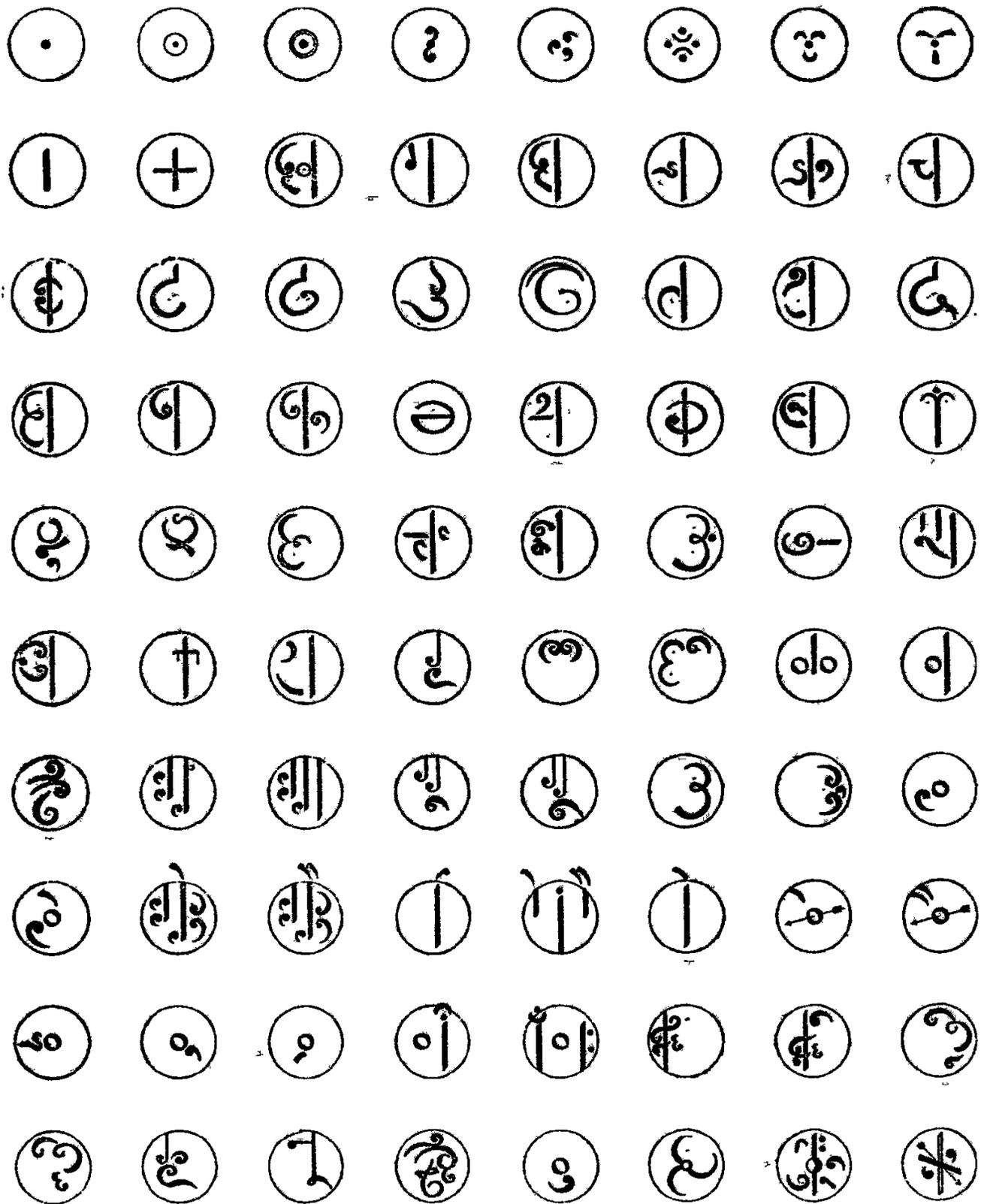
Morphological Alphabet of the First Patriarchs
Here then is the graphic of the first Patriarchs’ alphabet, employed upon the circular escutcheons and angles of the Archeometer’s trigones.
The description contained therein is that of the Brahmins and not our own.
The Brahmins make great mystery of this alphabet, which is certainly the Aryan prototype of all those of this kind—called Semitic but better termed schematic.
Its exceptional quality lies in being morphological—prototype of Vedic and Sanskrit letters—and in most certainly linking the Brahminic University, so ancient, to the primordial Universities of the first Patriarchs.
It derives from the point, the line, the circumference, the equilateral triangle and the square; and though the Brahmins name it “Vattan,” it signs itself: “Adam, Eve and Adama” through these five forms, mothers of morphology:

— : Adam; O : Eve; □ : Adama.
The astral, zodiacal, and planetary signs undoubtedly derive from this alphabet, as do most of the more or less altered letters and numerals that have come to us from a pure common source, through diverse and more or less muddied streams.
It follows—we repeat this deliberately—that since each letter’s position is determined by that of the zodiacal or planetary sign derived from it, the Archeometric Utterance is autological, as are all its equivalents.
This schematic alphabet is referenced by Moses in verse 19, chapter II of his Sepher Berashith.
The words “magic” and “arcane,” used by the Brahmins in their above description, inevitably awaken in the Christian scientific mind two synonyms:
Superstition and ignorance
Superstition: the decadence and super-station of archeological elements and more or less altered formulas, which a thorough study can sometimes—as is the case here—link to an earlier, scientific and conscious teaching, neither metaphysical nor mystical.
Ignorance, greater or lesser, of the facts, laws, and principle that constituted this primordial teaching. Never have magic and arcana more solicited minds toward the vertigo of all unknowns and all abysses than during eras of disbelief, anarchy, and decadence: India, Egypt, Chaldea, Persia, Greek Empire, Roman Empire—and this precisely from the very need for faith, principle, and restoration. But what will save European Christendom is the rectitude, the integrity that Science imposes upon conscience and vice versa, whether concerning Religion, Art, or Life.
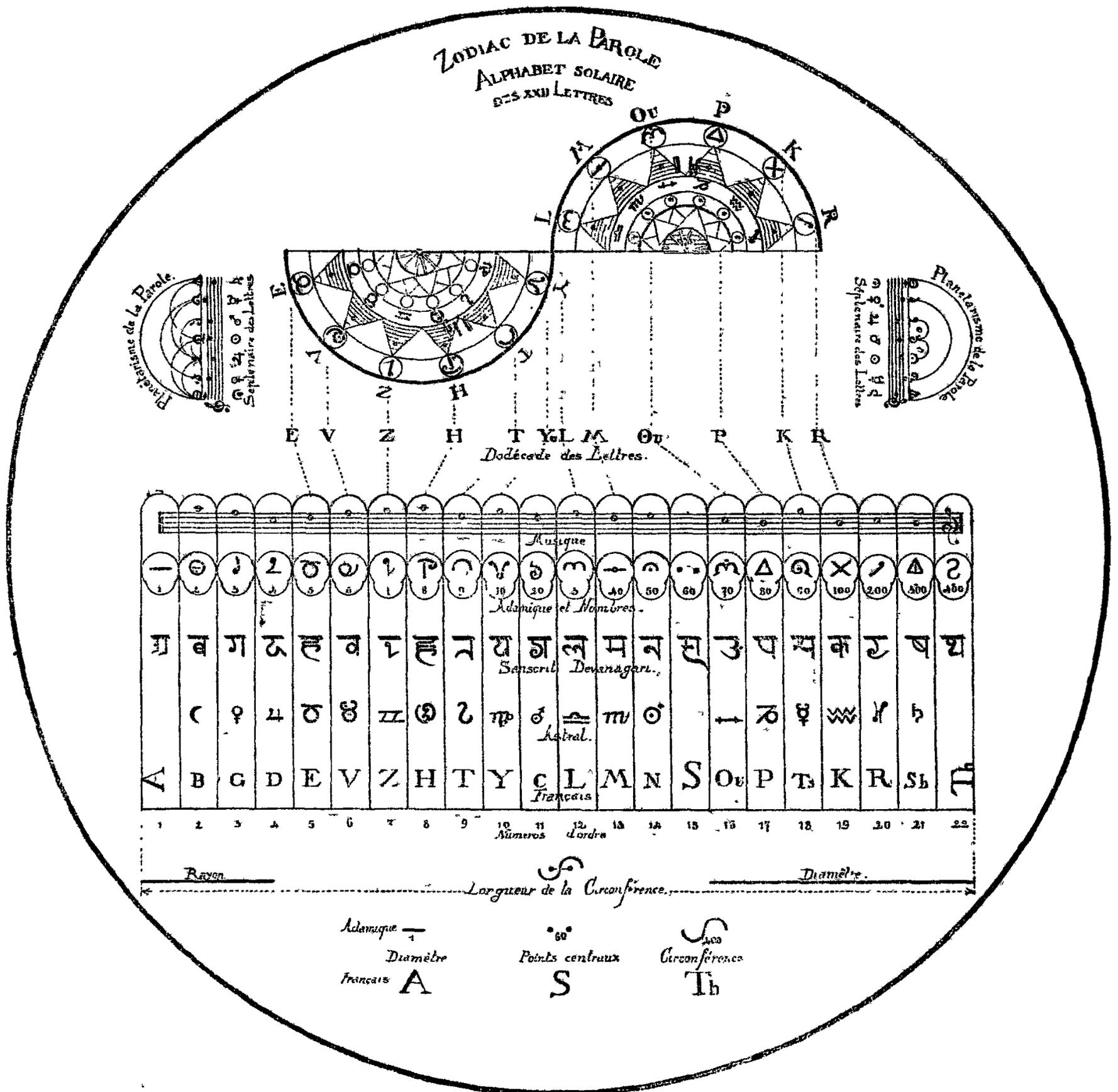
Zodiac of the Utterance — Solar Alphabet of the XXII Letters
The Brahminic description above thus reveals a time of decadence: that of the universal Empire of the Patriarchs, begun with the Kali Yuga, nearly four thousand years before the Christian Era.
This is why we have taken the opposite approach to the very precise yet inaccurate indication contained in this description.
It attributes to zodiacal and planetary correspondences the added vowels—or rather their aggregate of vowels and superimposed diphthongs.
But this quasi-prehistoric Massorah[*] originally pertained only to the solfeggio of hymns. Now, the alphabet of 22 letters that we have substituted for these Solfeggio signs contains within itself all the vowels comprised by its organic series and its cosmological-solar and luni-solar numeration.
The number XXII, in Adamic letters, is written: Ka-Ba. If one adds to this name the letter La, which signifies Power, one obtains the Power of the XXII.
Such is the famous ancient Kabbalah, of which the Jews possessed only the Babylonian superstition—the decadent, sterile, magical Quabalab.
The Science of the XXII, on the contrary, is a true Science, in the full rigor and integrity of the term. It is the Science of solar cosmological Utterance, creative and infinitely fruitful, as shall be seen.
Saint Paul makes a manifest allusion to it: First Epistle to the Corinthians, chapter 1, verses 7, 8, 9.
Saint John speaks of it even more manifestly at the beginning of his Gospel, referencing the first word of Moses’ Genesis: The Principle (1).
We must add here that since Yodhisthir, the point of departure and return of the cosmological series of letters has been transposed by the Vedic-Brahminic University—from the letter Y, first of the Triangle of Jesus, to the letter M, first of the Triangle of Mary; from the Substance called Earth of Immanence to the Substance called Living Waters or of Emanation.
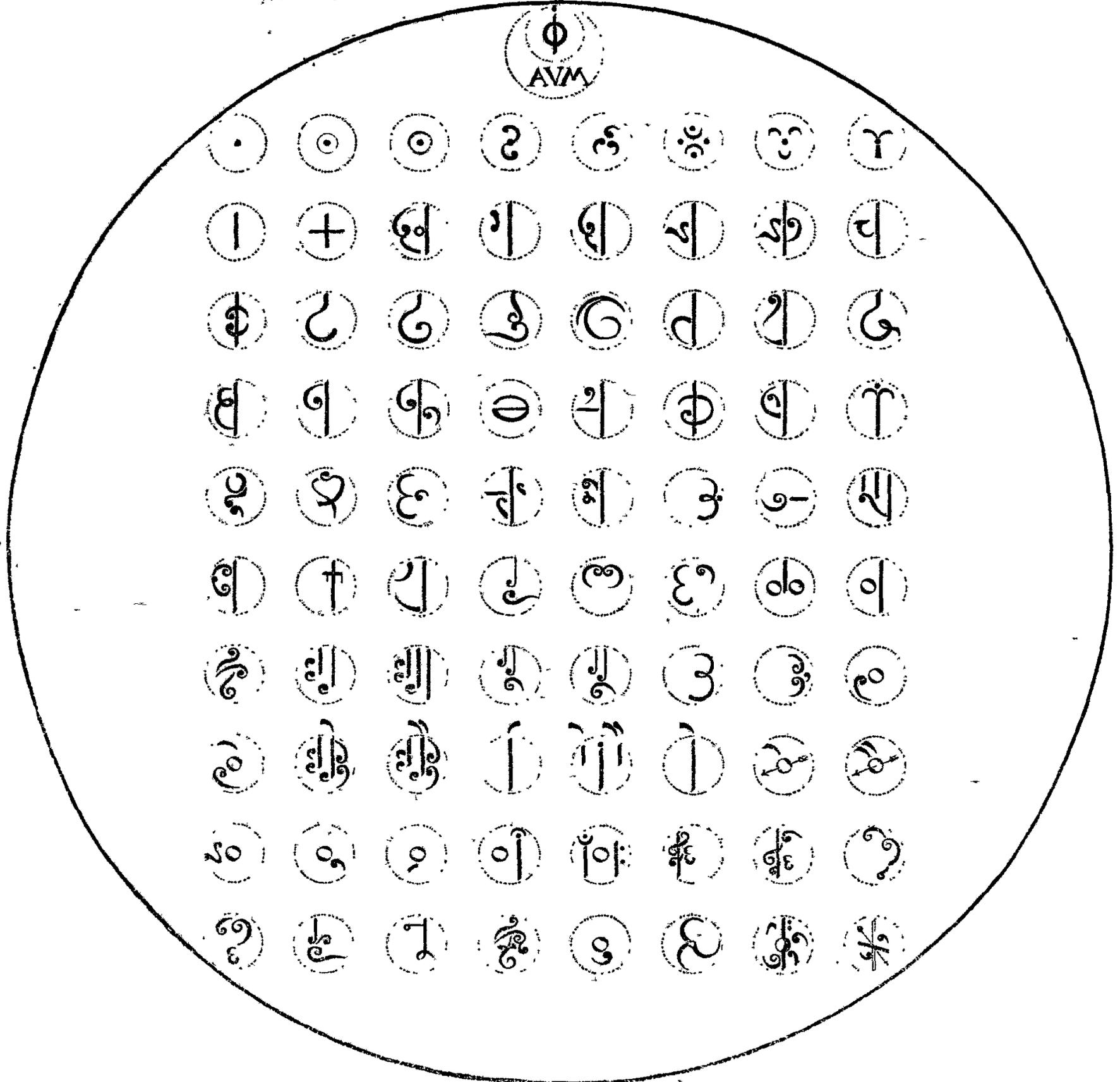
This transposition, which characterizes Brahmanism, appears entirely systematized in the accompanying table of Vedic signs derived from the point of AUM, AVaM—which the Brahmins also treat as a great mystery (See p. 153).
Lunar alphabet: Vedic signs derived from the point of AUM
After having deeply studied for several years the oral teachings of their most learned pontiffs, we have therefore also rejected their transposition from Y to M, basing this on our personal study of their mysteries and on very precise indications contained in the Gospels and Epistles.
(1) See La Théogonie des Patriarches by Saint-Yves. 1 handsome vol. large quarto. ↩
Construction of the Archeometer as a double semi-circular protractor, with all equivalents of the Utterance, the Sanskrit letters corresponding to the Adamic.
Here is how we have employed the XXII letters in constructing the Archeometer. Of these XXII, III give the centers of each semicircle, the diameter, and the circumference presented as a double semicircle.
The Gospel contains this key: “I am the Aleph and the Thau,” which has been translated into Greek as: “The Alpha and the Omega.”
This translation shifts the mystery from the real to the mystical, the Greek language being a Sudra, Prakrit or mongrel tongue, not archeometric.
In Assyrian script called Hebrew, the A consists of a crossbar and two points ·/·.
In Adamic morphological script, the bar indicates the radius or diameter, and alone constitutes the letter A; in the same script, the two points indicate a doubled center and the letter S; the Th indicates a doubled circumference in two inverted semicircles thus: ℤ
This is why, considering the Aleph as a doubled diameter, its two points as centers, the Thau as a double semicircle, we have assigned these three morphological letters to the Construction of the figure that bears the name ‘Zodiac of the Utterance’ as a double protractor.
Here is this form: ℤ (1).
It is the Brazen Serpent of Moses, to which allusion is also made in the Gospel. It is the Orphic Caduceus.
These three Adamic letters A, S, Th, these two Assyrian letters A, Th, thus signify the Triple Divine Power constituting the Universal Type; the Circle signifies the Infinite; the Center, the Absolute; the Radius or diameter their manifestation, their interrelation.
Thus, of XXII letters, III pertain to the constitutive Power. The remaining XIX refer to the distributive Powers of universal harmonicity and organicity.
Of these XIX, XII are involutive, VII are evolutive, in the World of Glory or of the Word, and consequently in that of the astral Heavens.
In other words, XII letters are zodiacal, VII are planetary—or rather VI planetary evolving around a solar one—which Jews and Greeks were unaware of.
It remains to determine the point of departure and return for involution and evolution.
To ascertain this, one need only sum XIX, yielding 1 + 9 = 10. Now, 10 is the equivalent of the letter Y, first in the name IEVE and of Jesus the Word, IShO, YPhO.
(1) See Fig. page 150. ↩
Here now is the design of our articulated dual-protractor construction of the Archeometer.
Arabic WAVM ١١١١ 177 SHADAI Hebrew
At the base of the figure, one will note an ancient ratio of 7 to 22 = 3.1428571, approximating the number π transmitted by Euclid, though empirical and uncertain.
Zodiacal Crown of the Utterance
Beginning with the letter Y, I or J, every 30°, the zodiacal crown of the Utterance comprises the letters: L, M, W, Ph, K, R, E, O, Z, È, T.
V H
The homologies of these letters, at 180° apart—that is, at the two extremities of the diameter—are: YR, — LHa or LHe, — MŌ, — WZ, — PhÈ, — KT, and conversely RY, — EL, — OM, — ZWou, — ÊPh, — TaK.
This yields two hexads of autological names—radical or monosyllabic root words.
IR, IRâ, means in Sanskrit: Utterance, the Divinity of Utterance.
La or Le means: King of the Heavens, Lord of Swarga or Paradise, Indra, one of the twelve Adityas, and likewise the inner master, the soul, the conscience.
MŌ, root of MŌX and MŌXA, means: Deliverance, salvation, liberation from bodily bonds and life’s miseries.
WZ, or OUZ, recurs as US and means, in the Veda: Ardor and luminous splendor.
PhÊ, Pa, the Governing Power,
KT. The letter K signifies the Soul; the letter Ta signifies Ambrosia, the immortal essence.
Inversion
RY or RâJ, To be king, to reign.
EL, AL, To contain (Hebrew). Salvation, glorification, exaltation.
ŌM, the AŪM.
ZWou, SWa, Goods.
ÊPh (Hebrew), That which covers and protects, guarantee, security.
TaK (Hebrew), To bear, to sustain; (Chaldean), Seat, throne.
To gradually accustom the architect to reading these signs and their equivalents, we shall take from the Zodiac of the Word the letters indicated by the angles of the first two Trigones—that of Jesus and that of Mary.
Here we shall limit ourselves to homologous letters—those whose colors reconstitute the white ray and which consequently form binary couples, combinations wherein each element is 180° distant from the other.
The utility of the Crown of Degrees will thus be verified, alongside the autology of the zodiacal crown of letters.
We have previously justified our choice of the letter I, Y or J as the point of departure and return for the harmonic and organic series of the Utterance and its equivalents.
The equivalents of I are: the emissive and remissive blue ray, the number 10, the sonometry and resulting harmonic forms, the sign of Virgo, the Wisdom or Queen of the Heavens of the ancient Patriarchs, the thrice-great Mercury at the feet of Virgo, the thrice-great Raphael of the ancient Patriarchs, the Vedic-Brahminic Buddha, etc…
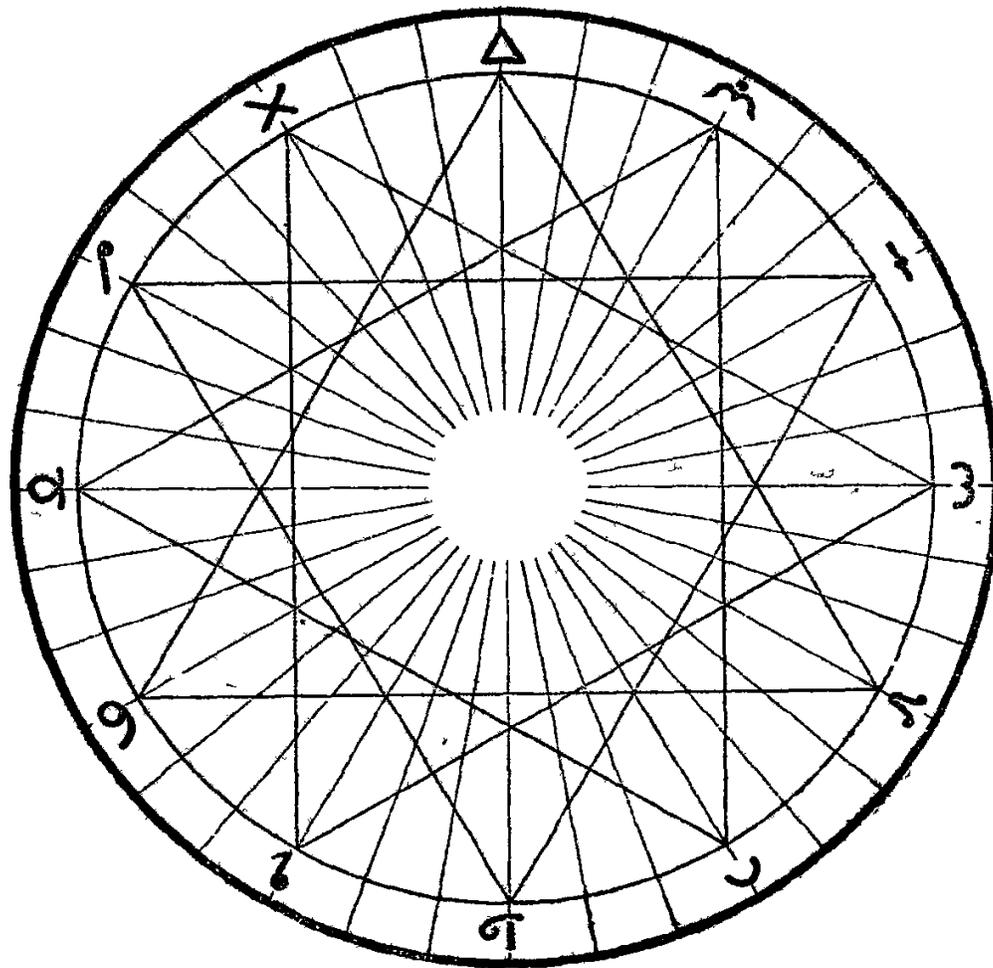
The 12 zodiacal letters.
The homologue of this letter is R, whose correspondences the reader will find for themselves on the Archeometer.
This binary combination yields an Archeometric radical name, a monosyllabic autological root.
We need only open a Sanskrit dictionary—we adopt this Devanagari language, language of Divine City or Civilization, because it was articulated upon an archeometric temple language: the Adamic whose alphabet we have chosen.
Thus shall the Word itself declare whether we were right against our Brahmin friends in taking, as the starting point of Creative Utterance, the letter I rather than the letter M.
IR, IRÂ, means in Sanskrit: “Utterance, the Divinity of Utterance.”
The response is divinely conclusive. Without departing from the base of Jesus’ Trigone, we shall refer to the letter O, whose equivalents are:
The color red, the tongues of fire of the Holy Spirit, the red Dove, the number 6—sonometric generator of the perfect minor chord we call the internal organic, likewise generator of the beauty forms resulting from this chord—the sign of Taurus, the sign of celestial Venus and of Ionah. The binary combination is given, at 180° distance, on the inverted base of Mary’s triangle, by the letter M, first in that name and in that triangle.
We leave the reader to discover for themselves the equivalents of the letter M, and we open the Sanskrit dictionary.
ÔM, the Brahmins’ “AÛM,” the esoteric Koranists’ “AVAM,” the “AM,” the “Ave Maria” of the first Patriarchs and of Christians today.
By meditating with the Archeometer in hand upon the recombination of the white ray through complementary or rather homologous colors O and M, and by observing the homologies of these two letters’ other equivalents, Orientals shall know scientifically the origins of their AÛM. They shall know why this Name, when sanctified and precisely pronounced at the appointed hour, launches their life into the other life—that of the Trigone of Living Waters—and toward the central, enharmonic source of Light.
We shall now take the letter Ph or P, that of God’s Gate and of the Angels. Its equivalents are: the photogenic yellow ray, the Christmas of Glory, of the astral Heavens and of the incarnate Word, the number 80, its musical sonometry, the beauty morphology generated by this sonometry, Capricorn and its angel, Saturn and its angel, etc.
The homologue is Ê or H—the violet ray, the number 8, the note la, the musical and morphological sonometry of 8, the lower Gate of the Kingdom, the superterrestrial Gate of man, the descent and reascent of souls in earthly generation and celestial regeneration, the throne of the Angel Gabriel, the angel of the Annunciation and of the Ave Maria, the angel of the sign of Cancer and of the Moon.
Upon the vertical of the Solstices of the World of Glory and the astral World, the white ray reconstitutes itself at the archeometric center through the North-South combination of yellow and violet. This coupling yields the letter couple PhÊ, Pa-H.
Let us open the Sanskrit dictionary: Pa-H, “The Power that governs organic life.” We have seen that this power seizes this universal governance by passing from the triangular letter P, Δ, to the triangular letter armed with a bisector representing the World’s axis: Δ, Sh.
These direct responses leave nothing to be desired. But as divine Reason, far from fearing human reason, wishes to possess it wholly in the plenitude of its admiration and adoration, we shall revisit each of these binary words and interrogate their inversion.
YR yields RY; — RY, in Sanskrit, yields RĀJ: to be King, to reign.
By joining both senses—direct and inverted—we thus have: the Word, the God of Utterance, the King of the eternal Kingdom.
ŌM yields MŌ in Sanskrit, MŌx, MŌxa, “Deliverance, salvation, liberation from bodily bonds and the miseries of physical existence.”
Combining both meanings: the AŪM, “the Expansion of the soul of life in adoration, the impregnation by the living waters of celestial life, giving a foretaste of salvation, deliverance, liberation from bodily bonds and the miseries of physical existence.”
PaH or PhĒ yields, in Hebrew, ÊPh, the Providence that guarantees, protects, and shelters in Security.
Combining both meanings: The Governing Power that rules life, protects it, shelters it, and ensures it, when this life restores itself to itself.
Having assisted the reader in interrogating these homologous letters upon the Star of the Solstices of the Word, we shall limit ourselves, concerning the Equinoctial Star of the Angels, to conducting the same experiment along the horizon line.
Let us therefore position ourselves between the two angles I and M of Jesus’ and Mary’s Trigones.
There we shall find the letter L, upon the Trigone of divine Ether. Its equivalents are: the azure green, the number 30, its musical and morphological sonometry, the Archangel Saint Michael, the horizontal and Western Gate of the Angels, of the ALaHIM appointed to provide all mental, loving, or corporeal life with its nourishment and elements, the Autumn Equinox, the sign of Libra and Judgment, nocturnal Venus, etc…
The homologue, at the starting point of the Trigone of Fire, letter E or H, has as its equivalent the Lamb of God, Agnus Dei, the Agni of the Vedic-Brahmanists, the Paschal Lamb of the Jews, divine Love unto the absolute sacrifice of Self, Easter, the Crucifixion of the incarnate Word and His Resurrection on the 3rd day, the orange-red hue of blood, the Spring Equinox, the number 5, its musical and morphological sonometry, the sign of Aries and the Lamb, nocturnal Mars or the Centurion, the Sun upon its throne, etc…
The recombination of the white ray between azure-green and orange-red yields the letters LaH or LH or again Le.
The Sanskrit dictionary responds: The King of the Heavens, the Lord of Swarga, the Master of Paradise, one of the twelve Adityas, naming him “Indra,” which we accept as an epithet of Jesus, but nothing further.
It adds, passing from Theobiology to the Ontobiology of man: The inner Master of the soul, the conscience.
Conversely, Hebrew gives: EL, AL: Salvation, Exaltation, Glorification. Combining both meanings:
“The inner Master of the soul, the Lord of human conscience, crucified for its salvation, exalted and glorified with His primal glory as the Word, is the Lord and King of Paradise.”
Planetary Crown of the Utterance
The same experimental proof, sought from the planetary crown of the Utterance, would yield other responses equally marvelous.
For now, we shall limit ourselves to the preceding examples, which conform to the law of homologies and the rule of their binary combinations, for reading Archeometric Mantras[*] of this order.
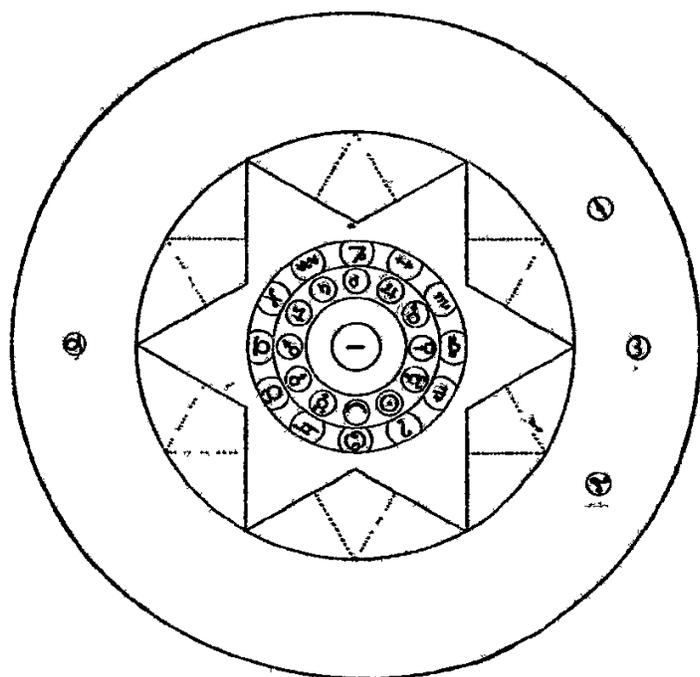
Planetary and zodiacal.
To further certify the exact autology of the Archeometer, we shall take, from each angle of Jesus’ and Mary’s Trigones, the binary combination of the zodiacal letter and the planetary letter of the angle, then their reversal or inversion.
We shall use only the Sanskrit language and standard dictionaries, to once more prove the Aryan reference of the Archeometer to the ancient patriarchal Universities.
At the starting point of Jesus’ Trigone, the two letters Ya Tsa yield the word Ya Ça.
Ya Ça means: Emission of Glory and splendor.
ÇI, reversal of the preceding word, means: Remission, rest, sleep.
Thus, for the angle of the letters’ point of departure and return, there is perfect concordance between this binary combination and that which we have characterized as homological.
Ph Sh, the two letters of the Northern angle. They coincide with Capricorn and Saturn, at the point of Christmas, our December 24th, Midnight, when the sun begins to ascend the Ecliptic and generate the new year. Now, in Sanskrit:
PæSha means the month of December-January, absolute confirmation of all we have said regarding Archeometric autology.
Pa means: Power; Pâ means: Savior.
Sha —: Paradise.
SaP, reversal or inversion of the preceding letters, means: To adore.
Let us join the meaning of the astronomical World to that of the World of Glory, and we have:
At the starting point of the first astronomical month, there is revealed to adoration the Power of the Savior, the King of Paradise.
Having let the letters of the angle corresponding to the Father speak, and those of the angle corresponding to the Son, let us interrogate the angle corresponding to the third Person of the fundamental Trinity.
OG yields OGa which means the Power that unites and reunites, the Force that fecundates and multiplies. In Latin, Augere, to increase.
GO, inversion of the preceding word, means (in the Veda): all that tends toward union, all that is good. But, no less remarkable regarding the astronomical meaning of the December-January month, the word GO also yields in Sanskrit the zodiacal astronomical meaning of the sign corresponding to the letter O: Taurus, Ox.
MaKa, word formed by the two zodiaco-planetary letters of Mary’s Trigone’s starting angle, means: Sacrifice; MaGa, Happiness and sacrifice.
KaMa, means Love, desire, the will of which Love is the principle.
RD, at the second angle of Mary’s Trigone, forms the name RaD which means: To give, to grant.
DR, DaRa, that which bears, contains, and possesses. But here again, an astronomical meaning is given by DRu: that which flows, liquefies and dissolves, or runs swiftly in water, corresponding to the sign of Pisces.
HB, at the southern angle of Mary’s Triangle, yields: the word HÉBÉ who pours drink for the gods, in Orphic mythology derived from the Vedic-Brahmanic.
In Sanskrit, this name decomposes into Ka, Ethereal Water or Vaporous Air, and Ba, urn, which astronomically accords with Cancer—a water sign—and with the correspondence between the Moon’s course and the state of all sublunary fluids and liquids.
BH, inversion of the preceding word, yields BaHu, the Hebrew BoHu, fluid mass, whence BaHuKa, cistern, which again accords with the astronomical meaning of the sign.
Morphological and Arithmological Letters
I term as zodiaco-solar those organic Alphabets of XXII Letters, such as liturgical Syriac, the Assyrian of the Jews, Samaritan, etc. I have chosen this type of alphabet because it is scientifically regular as a process of letters and corresponding numbers, to which any empirical or vulgar alphabet may also be reduced. And within this alphabetic type, I have selected the most ancient—the Adamic—unknown in Europe but preserved by the Brahmins under the name Vattan. I adopted it because it is exact, not only as a process of letters and numbers, but also as a process of Forms. It is a morphological Alphabet, or more precisely one that speaks through its Forms, all generated from the Point, the Line, the Angle, the Circle, and the Square:

The sciences and arts relating to the application of Forms to Uses—Architecture, Statuary, Ornamentation of every kind—will find in these Letters, restored by me to their exact points of Correspondence upon the pantographic Cosmometer, a speaking morphology.
In Architecture alone, a new genre—the Speaking Style—derives from this through Correspondence with the Colors of the Pantograph.
This Style consists in the use of Iron or any other metal and of colored Glass—Iron serving not only as Framework but also for the speaking Setting of walls made of colored Glass, just as Gold, Platinum, and Silver serve for the setting of precious stones.
We shall see later why, from the Alphabet of XXII Letters, I extract three Letters:
— A, in number 1, • • S, in number 60, Ɔ, Th, in number 400, that is: the Generative Ray, the Points, and the Sign uniting the Zones.
There remain XIX Letters—XII Modal, VII Diatonic. I have drawn up a table of the following morphological Correspondences: 1° between the XII Modals and the XII Zodiacal Signs; 2° between the VII Diatonics and the VII Planetary Signs.
Comparison shows that these astral Signs derive from these Letters, and this fact alone refers them to a patriarchal University era preceding Paganism, Sabaeanism, Anthropomorphism, and Zoomorphism. This is why I call these XXII-Letter Alphabets zodiaco-Solar, and those of 28, 29 and 30 Letters—such as Musnad and Coreïsh—zodiaco-Lunar.
T-31 — Translator’s Note: A pagoda is an Oriental temple. ↩
T-32 — Translator’s Note: Massorah — a critical work on the spelling and correct reading of the Hebrew Bible, compiled by Jewish doctors. ↩
T-33 — Translator’s Note: Archeometric Mantras — a term coined by Saint-Yves to designate readings made on the scales of the Archeometer. ↩