Archeometry of the letters of the Sanskrit Alphabet, in their relations to the XXII Adamic letters and their distribution into:
- III. Constructive
- VI. Evolutionary
- I. Central
- XII. Involute
I. A. — Expresses in Veda and Sanskrit, active Tendency, direction, defined aim.
It represents in Aum, Vishnu, the Penetrator. This fact indicates an ancient archeometric reference, the morphological value of the Adamic A being the Ray, and implying all ideas, all facts relative to the Ray in the hierarchy of all sciences. The application of this letter to the Aum is prior, like this hierogram itself, to the Trimurti or Trinity Brahma-Shiva-Vishnu. It is noteworthy that the A attributed to Vishnu gives him first place in the Brahmanic Triad. But in pronunciation, A + U = O, which refers the Aum to the 3 rd angle of the first Trigon of the Archeometer, while basing it on the first angle of the second Trigon, that of MaRiE. We shall return later to this so important word, which in verbal hermeneutics is the counterpart, I do not say the equal, of the archeometric IHOH.
SANSKRIT ALPHABET (Devanagari characters)
Vowels
| 1st | अ | a | 8th | ॠ | r̄ |
| 2nd | आ | â | 9th | ऌ | l |
| 3rd | इ | i | 10th | ॡ | l̄ |
| 4th | ई | î | 11th | ए | é |
| 5th | उ | u | 12th | ऐ | æ |
| 6th | ऊ | û | 13th | ओ | ô |
| 7th | ऋ | r | 14th | औ | ɔ |
Consonants
| Gutturals | 15th | क | ka | 16th | ख | kha | 17th | ग | ga | 18th | घ | gha | 19th | ङ | ṅa |
| Palatals | 20th | च | ca | 21th | छ | cha | 22th | ज | ja | 23th | झ | jha | 24th | ञ | ña |
| Cerebrals | 25th | ट | ṭa | 26th | ठ | ṭha | 27th | ड | ḍa | 28th | ढ | ḍha | 29th | ण | ṇa |
| Dentals | 30th | त | ta | 31th | थ | tha | 32th | द | da | 33th | ध | dha | 34th | न | na |
| Labials | 35th | प | pa | 36th | फ | pha | 37th | ब | ba | 38th | भ | bha | 39th | म | ma |
| Semi-vowels | 40th | य | ya | 41th | र | ra | 42th | ल | la | 43th | व | va | |||
| Sibilants | 44th | श | śa | 45th | ष | ṣa | 46th | स | sa | ||||||
| Aspirate | 47th | ह | ha | ||||||||||||
| Vedic letter | — | ळ | la | ||||||||||||
Numerals
| १ | २ | ३ | ४ | ५ | ६ | ७ | ८ | ९ | ० |
| 1 | 2 | 3 | 4 | 5 | 6 | 7 | 8 | 9 | 0 |
Various Signs
Dependent vowel signs (shown on a neutral base ◌):
| ◌ा | â | ◌ि | i | ◌ी | î | ◌ु | u | ◌ू | û | ◌ृ | r |
| ◌ॄ | r̄ | ◌े | é | ◌ै | æ | ◌ो | ô | ◌ौ | ɔ |
Modifiers:
| ◌ं | anusvâra — m |
| ◌ँ | anunâsika — n |
| ◌् | virâma |
| ◌ः | visarga — s |
| ऽ | avagraha (apostrophe) |
As in Greek, A, in Sanskrit and Veda, signifies Unity and Universality. It is also augmentative and privative, magnifying and admiring. Its primordial value is found
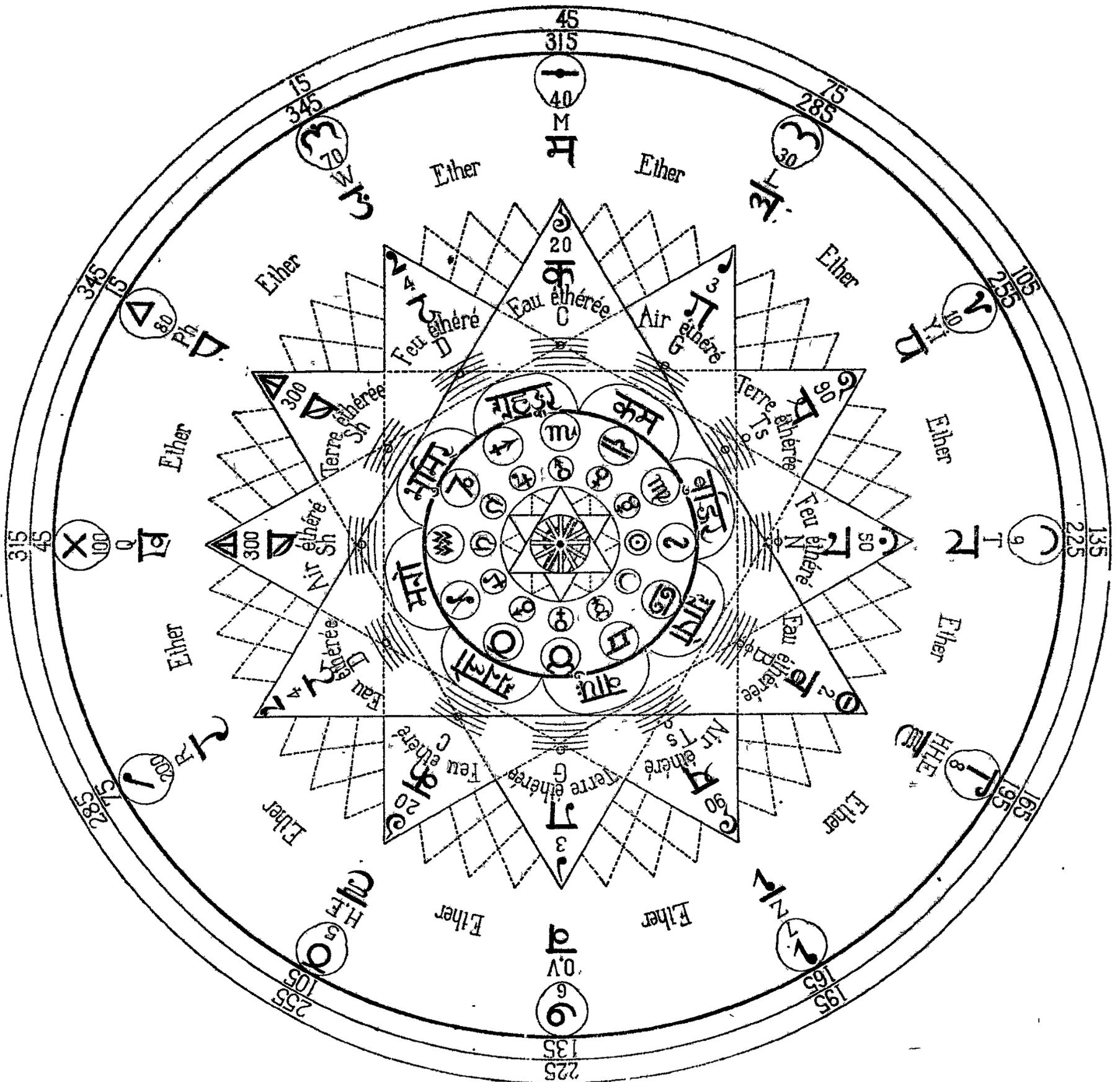
(Archeometer and Sanskrit) The four Elements and the Ether.
in Axa, Turning Circle, Radiant Wheel, Chariot. Hence Axara, the Invisible and the Absolute. Combined with I or J, it expresses in AIA the first Being, in AJA, the Goat as
leader of the flock. In AY, Governing Movement, to go. In AYA, the achieved Finality, that of the Principle in motion, Success, good Fortune.
Combined with the solar letter Na, it expresses the solar March from one solstice to another.
As privative, in ADITI, it signifies indivisible Nature.
As augmentative, in ADD, close Union.
As first Opening and first direct Emission of the vocal apparatus, it signifies the Radiation of the Utterance: AH, he has spoken. For the same reasons, as first Opening of the luminous Equivalent of the Utterance, it expresses, in AHA, the Day. — Ā expresses in ADI Principality and Principle, preeminence and primordiality.
The primitive idea of Radiation is found again in AYU, Rapidity, sustained March, lasting Movement and Duration.
II. Ba. — Signifies Base, as a term of depth, Vessel, localizing and circumscribed Receptivity, conditional Place and Medium of Existence, Place and Medium of Embryogenesis, Body, Habitation, Possession, Having, as organic auxiliary of Being. Hence BA, Star and Constellation, B Ī Earth. These names apply to these objects only when considering them as Places and Media of embryogenized Existence. This is why this letter was dedicated by the most learned patriarchal Templars to BAR-UN, the Spirit of solarized protoplasmic Waters. This is why it remains dedicated in the Veda and Sanskrit to Varuna, although the change from B to V erases the correspondence.
Restored as I have just done, the archeometric reference is evident and bears the mark of the primordial Synthesis of the Word. Indeed, on the Archeometer, the planetary letter Ba occupies the bottom, the South of the Trigon of psychic Living Waters and not the North, as in the Vedic-Brahmanic lunar System.
III. Ga. — Signifies aggregative, organic Movement, resulting not from Matter, but from the Number that transforms it into specific Substance and regulates it. Ga expresses all Harmony in Movement, from that of the Heavens to that of Voices, to that of specific Forces and atoms constituted into Bodies or Forms. The same Root Letter depicts all collective Bodies endowed with Harmony and organicity, a Society hierarchized by Laws, an astral or human Army, etc.
These meanings are found in GA, in GANA, in GANI. GA is dedicated to GANESHA, whose Adamic spelling is GAN-IShA. This is why, moreover, the Founders of the Vedic and Sanskrit Language made GANESHA an epithet of ISh-VA, later inverted into SHIVA.
The fact we have just brought to light thus demonstrates a very ancient reference of the letter Ga to the first Trigon, that of the Northern Solstice, before its inversion to the Southern Solstice by the Vedic-Brahmanic University. GAN-IShA signifies the Lord of universal Harmony and Organism, Ga, connected to the solar center of the two Visible and Invisible Worlds by the central letter Na.
One can see on the Archeometer that Ga is the divine planetary letter of the zodiacal O, final term of the first trigon, that of the Word-Jesus, I-PhO, I-ShO.
Ga is also dedicated to GANDHARVA, Vedic epithet AG-NI. AG of AG-NI = 1 and 3
in 13, half or octave of 26, the latter being the sum of the numerical letters of the Name IHOH; 26 = 20, whose equivalent is the letter Ka, plus 6 whose equivalent is the letter O. In Adamic KO, in Veda and Sanskrit, KaVi, signify God-Creator through his Utterance or through his Word. KaVi, the Divine-Poet, is one of the epithets of Brahma. This latter fact has no possible archeometric reference regarding Brahma. Indeed, Brahma has as arithmological equivalent 248 whose radical by octaves is 31, but the same number 248 contains neither 26 nor 13 in any of its progressions. It is quite otherwise with the relations of AG-ni and Ka-Vi, of 13 and 26 with IHOH, and with Him alone. And in this case the Archeometry of the Word reveals the origin of the references that the Veda and Sanskrit no longer contain in the Brahmanic System.
The Octave, the internal Symmetry, the virtual Half of 26 is thus 13, where we find again the organic Ga, either in 1 and 3, 13 = AG, or in 10 + 3 = IG.
The two hierograms AG, IG combined with the solar letter N form AG-NI, IGN-ISh. In both cases, the meaning is: 1° in the Veda, the central organic Fire of God; 2° in Etruscan, the central organic Fire of the Lord. This Fire, internal Nature of God, acting in His Word, is the divine Love, the creative Love. Our God is a consuming Fire, said Moses. Before him, the first Zoroaster had claimed this Fire of the first Trigon, contrary to the Water of the second Trigon upheld by the Vedic-Brahmanic University.
In this as in all, the Archeometer of the Word is thus the scientific Revealer of its Mysteries. It projects their light even into the most unfathomable darknesses of all substance, including the human Spirit. It has just shown us the undeniable connection of the Vedic-Brahmanic system to the primordial and eternal Religion of the creative Word and the incarnate Word.
In Hindu Mythology GANDHARVA and the GANDHARVAS are the harmonic Numbers, the arithmological Equivalents of the Letters, the Powers, the Angels of the Utterance of the Word. They preside in the celestial GaNa, in the universal Organism of the Fluid or Divine Heavens and the Astral or Physical Heavens, over the essential and formal Harmonies that regulate the Substances, the Forces and the Constitution of fluidic or ponderable Bodies, super-etheric, intra-etheric or sub-etheric.
The Music of Sounds and Perfumes is one of the atmospheric Correspondences of these Equivalents. Hence the use of these two Languages, these two Musics, the Acoustic and the Olfactory in all Cults of the universal Religion of the Word throughout all its orthodox Forms and all its deformations by Schisms. Orthodox means in Archeometry: Exact in science, in Religion, Conforming to the Wisdom that unites Science and Religion in an indissoluble Synthesis.
The celestial Ga-Na of the Vedic-Brahmanic University comes from the Ancient Patriarchs. It is the GAN of Moses, the GAN-BI HEDEN. Before him it was the GANA-AYODANA of the Aryas of the Proto-Synthesis. This word expresses the Celestial or Paradisiacal Zion, the Divine City of Divine and Human Treasures, the Celestial Social State with its terrestrial correspondence on all Stars; it is the Triumphant Church and the Militant Church united in an indissoluble Yoga, in an indissoluble Yova, through all their correspond-
ences to the One and Universal Principle of the Archeometer. This Principle is the Word, its Act is the Utterance.
At the Nadir of the GANA, its antipode of darkness is in Veda and Sanskrit, the
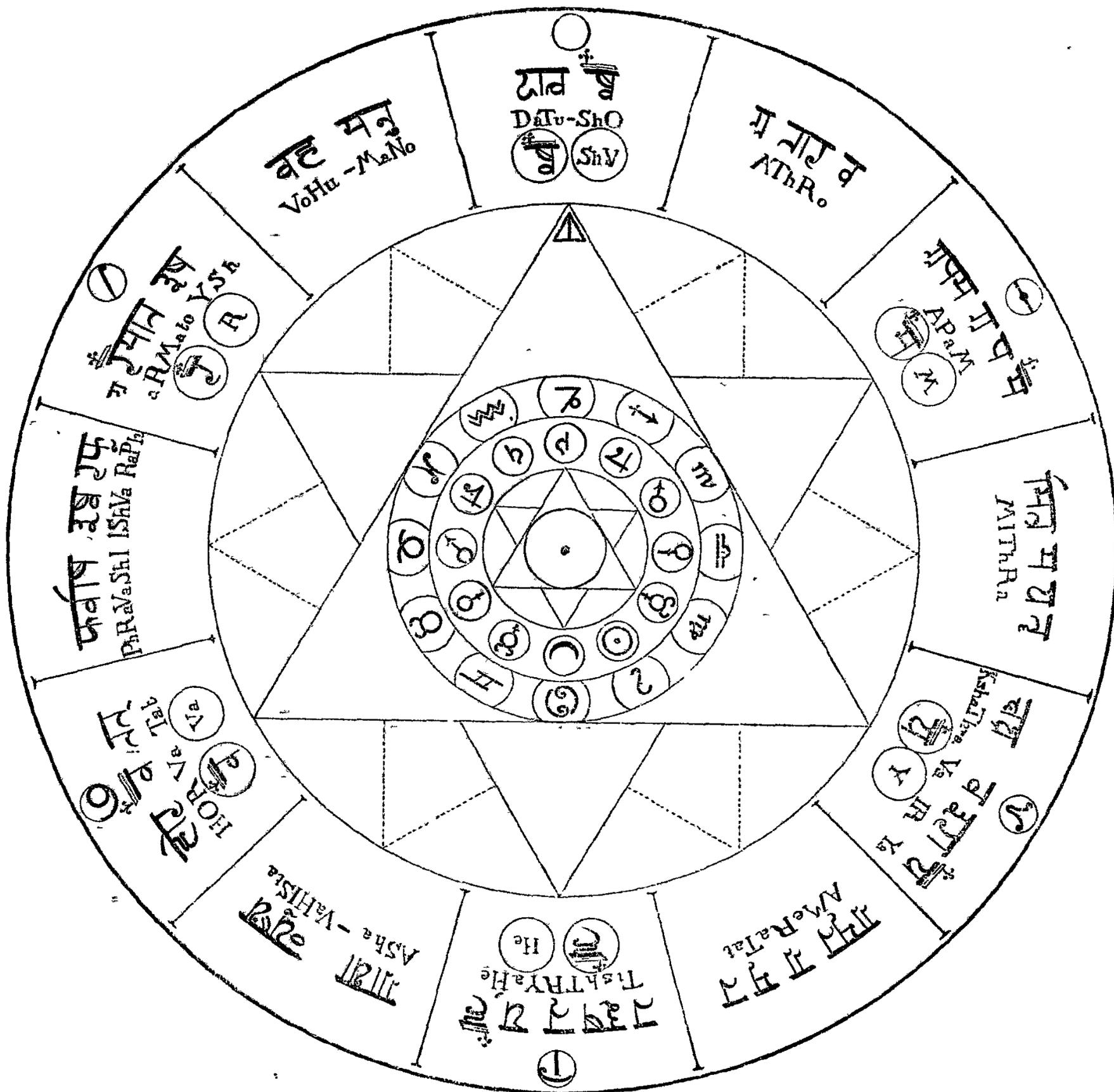
GAHANA, the Inorganic, the Inharmonic, the Anarchic City, the Infernal Civilization of evil Spirits, in this World as in the Other.
This infernal City, whose specification passed from the Patriarchs to the Vedic-Brahmins, is the GEHENNA of Moses.
IV. Da. — Expresses distributive Divisibility, Division and Donation, Sharing and Distribution, Diffusion and Dispensation, substantial Providence and Preservation of Beings.
This root is found in the sacred word Sha-DA-Y which passed from Adamic to Veda. The ShaDI and ShaDÊ of Moses come from the same source and bear upon the same root. It is noteworthy that in this word, written in Adamic as ShADAI, the sum of Numbers equals that of the Letters of the Sacred Name of Jesus, IShO, 316.
ShADA-I signifies the Providence of God, God giving Himself. The same hierogram is found in the Cosmogony of the first Zoroaster: DA-TU-ShO, the Donor of Oneself, God sacrificing Himself in Creation, in Preservation and in Redemption of Beings.
Dayê and Dê express, in Veda and Sanskrit, the Divine Vigilance of Love, its clear-sighted Tenderness, its active Pity, its Purveyance or Providence, its Light, its Charity.
Passing from Theogony to Androgony, the same root-word retains these transposed meanings. This is why DA also expresses Woman and Lady from the double perspective of Human Providence constituting Family and Society. As for Hebrew dictionaries, they are far from having preserved the hierarchy of divine and human meanings, unlike Veda and Sanskrit. Hence it is very difficult to follow through their interpretations the always archeometric thought of the Inspired of the Word, from the pre-Mosaic Patriarchs like Job, to the Founder of Israel, from Moses finally to the Prophets and to the Barith Ha Kadoshah, otherwise called our holy Gospel in Hebrew.
Thus DA retains only the value of a demonstrative pronoun, and DAD of breast or bosom.
Among the ancient Vedic-Brahmins, DA was dedicated to the cosmogonic Spirit holding the Bow of Sagittarius. Here, the Seal of the Archeometer of the Word and of the Proto-Synthesis of the Patriarchs is even more manifest on the Vedic-Sanskrit imprint of the letter Da than on that of the three preceding A, Bá, Ga. We have legitimately connected the latter to their true archeometric position: one A, to the Ray; another Ba to the southern solstitial angle of the Trigone of Living Waters; the third Ga, to the Fire angle of the first Trigone, that of the living Earth, the divine and non-Astral Earth of the Word-Jesus. Da places itself by Da-Nu in its archeometric location. It is, on the Planisphere of Glory, the Planetary whose zodiacal is the Adamic U, prototype and verbal angelic Power of the astral Sagittarius. And this Bow is the U of Da-Nu. The kinship of this hierogram with DaNa, the Aryan protogram of He-den, proves once more with what fidelity Moses collated the Tradition of the Patriarchal Church, through all the Templar Universities of his time, to restore it to its point of Orthodoxy on the Sphere of the Principle: SPhaR BRA-ShIth. It is not insignificant to
say here that SPhaR means Book only as Scroll, and Scroll only as derived from Circle. SWaR, in Sanskrit, signifies the Sphere or celestial Planisphere. Moreover SPhaR gives as arithmological equivalent 340, which, expressed as letter for number, 300 + 40 = SheMa, signifies at once: Archeometric Sign, Heaven of the Utterance or of Glory and God Himself in His Autography and Autology.
V. Ê. — E, È, Ê, HE. Simple E is less used in Veda and Sanskrit than in its double form Ê, where it is Dwi-Yoni of A + I. This fact proves an elongation relative to the primordial archeometric Language.
Ê signifies Call and Vocation.
Ha offers in Veda and Sanskrit several archeometric meanings: cause, as generating Power of effect, and, as such, Heaven, Divine Earth or Paradise, the Being and the direct substance of Being.
To these theogonic meanings are added the following androgonic ones: vital, essential Love, the sexual Union of Lives without bodily contact, Creation without procreation, Happiness. These meanings descend degree by degree to the carnal, but the psychic and biological predominate over the physiological.
HaY borrows from Y the meaning of passionate movement, joyful reverberation, rendered honors, bursting enthusiasm.
HO in HoVa says: Sacrifice and Oblation of Love.
HI signifies leaping forth from oneself toward another, emitting one’s virtue, one’s power, and all these meanings derive simultaneously from the archeometrics of HE and Y.
HU expresses ecstatic Love and sacrifice to Divinity.
Ê combined with the suffix Ka, in ÊKA, signifies imparity, and, because of this fact, Unity considered under a certain aspect, the One, the Same, in relation to the other, Auya. Here we recognize the source of one of Plato’s fundamental ideas. This fact denotes a very ancient archeometric reference. The masters of Brahmanic and Buddhist Universities may easily verify this on the Archeometer by following this brief demonstration:
A + D, 1 + 4 = 5 = E; Ka = 20; EKa = 25. We are thus dealing here with 5, the numerical value of the letter E, functioning as unity, whether in Itself or in 25. In the ancient Patriarchal Universities, whose synthesis of PhO-HI still bears the archeometric mark, 5 and its numeration signified the extensive Power of Unity. 5 was the typical extensor corresponding to radiant Heat.
25 was the Dilator, 50 the great Extensor, 55 the great interferential Dilator. These meanings, which remain without scientific basis in the post-diluvian Ancient Orient, recover their primordial value when verified against the touchstone of the second Criterion—that is, Western Observation and Experimentation. In Sonometry, from the dual perspective of speaking Numbers and inversely proportional digits of the vibrations they provoke in fluidic or ponderable Bodies, the meaning of 25: 24/25 for speaking or musical Arithmology, and
25/24 for the functional Arithmetic of vibrations. Any marked natural tone, whether simply or through harmonic multiplication of the number 25 functioning as a sonic unit, will yield its sharp on the string at the number 24. The same applies to any flat tone: it will yield its natural under the same arithmological conditions.
Since the Music of Numbers governs the successive or simultaneous Harmony of the dual Universe, from the whole down to the minutest details, one will easily understand, after what precedes, why the Patriarchs—grand masters of the Proto-Synthesis of the Word—accorded to Ê + Ka or to 25 a special functional significance for this Number when taken as a function of Unity.
Now, if one examines on the Archeometer the position of the zodiacal letter Ê at the point of the vernal Equinox, and its planetary Ka, one will see that the two combined have as Equivalents the word ÊKa and the Number 25. Thus is marked by the Word Itself and explained the Mystery of vital and radiant heat in the dual divine and physical Universe. It is because of this heat that the Triangle of Fire is signed with the three zodiacal letters HOuT, which in Veda signify the Fire Huta, and also HOuT and HOuD, the Ram and the Lamb. D marked with a dot below is equivalent to a T bordering on Th and Z. Thus, this triangle of igneous Substance is autological like all others. In the astral world, ÊKa, 25 is Mars in Aries; but it is also the YoGa or YoVa of the sun upon its Throne.
We shall return to this meaning when speaking of the Central Lord, the solar Word, the Lumen de lumine, concerning the Passover and the Crucifixion of the Lamb of God, the AG-NI of the IHOH. We shall not leave the letter Ê without noting that AÊ-La signifies the Son, the Envoy of ILâ, the holy Utterance, the pure substance of God’s holy Earth.
ÊLa-Ka also expresses the Ram under a different acceptation from HOuT and HOuD.
ÊVa signifies, in Zend, complete acquiescence to God’s will; the same meaning in Sanskrit in AEVa and ÊVaM, which express the idea of “So be it,” like the word Aum, contracted into OM, whose secret pronunciation involves twice the letter that concerns us: HOMOĤ. I provide the letters but do not indicate how they must be articulated for this Amen of the Patriarchs to grant the pure religious soul, in the very depths of his life, the biological response of the universal Soul. I say the universal Soul, the ATH HaADaM dependent on the ROuah ALHIM. For the Names of the Son and the Father have other archeometric correspondences relative to the supreme degrees of ATH in the ATH of the Word. It is this theogonic degree that Our Lord Jesus Christ refers to when He says: I am the ATH, the Aleph and the Tau.
VI. AŌ. — 14th letter in the Sanskrit alphabet and 4th double letter, diphthonic or Dwi-Yôni: A+A+6, = Ā+U. It is the Guna of Ō or the Vridhhi of U or Ū.
Most words containing AŌ thus have U, Ū at the Root, which traces the etymology back to simple or double U.
Va, 43rd letter and 4th semivowel of the Sanskrit alphabet. It is the buccalization of the vowel U, pronounced Ou. It is a labial trill of the orbicular breath Ou. It
often converts to the letter Ba. The archeometric reason for this is that the musical Equivalents of the notes corresponding to Ou and Ba are in the sonometric ratios of 8/10 and 5/8, that is, of external modal or major third, and internal conjugal or minor sixth, regarding speaking numbers. The specific relations of these two verbal Powers in the theogonic World of Glory follow the same correspondence in Psychogony and Psychology, at all degrees of the hierarchy of ATh. The same correspondence extends to the arithmological relations of physical Forces and Substances. In the astral world, it is found between Venus and the Moon.
Contrary to modern Astronomers, Venus is a Moon of the Sun, and its Rotation around the central Star is analogous to that of the Moon around the Earth. Only recently was it finally demonstrated that Venus’s day equals its Year. Moreover, this Planet underwent a change, a transposition with its neighbor Mercury—a change of color, size, figure, and course. The Archeometer has maintained its primordial position, whose alteration would have occurred around the 19th century before Our Lord Jesus Christ.
Varro, ever so scrupulous in his investigations, synchronized this transposition and catastrophe of Venus with the Flood marked by the corresponding archeometric letters: OGyges.
The foregoing explains in the absolute Reason and Utterance of the Word the meanings that follow. Va refers to O in the Sanskrit significations of fluidic Power in motion, swirling or cyclic, such as atmospheric current, wind, breath, which always accompany the Force, Power, Action, and Manifestation of the ROuaH.
Conversely, the word Va in Vas refers to Ba when it signifies Dwelling, passing from the fluid Element to the liquid Element of Ba.Thus Varuna written as Baruna signifies Water, the Ocean, which aligns with the archeometric position of Ba and its Zodiacal in the Water Trigone.
For the same reasons, Vax is substitutive in Veda for Ox or Oux, ox or bull, a word that itself is equivalent to the Power of breath and consequently to Chest Vaxas, in Irish Ouch. The zodiacal Va, joined to its planetary Ga, retains in Sanskrit in Va-Gnu and in VaCh its verbal archeometric meaning, and signifies the Being who speaks.
Joined to the vowel I or its buccal J of the first Trigone, VâJ signifies in Veda preparing the Way for the Gods, adorning their sacred Enclosure, paying them homage.
Orbiting around the solar center Na, the orbicular Va expresses in VaN the Sound wave, the reverberation of the arithmological constitutive sound of all things. It is 6 multiplied by 50, thus evoking the 300 of Sh. As derived from O, Ou, and U, VaN signifies in Veda the total oblation of self, Adoration, Desire, passionate Prayer. It is the root of the Latin Venerari. This absolutely archeometric meaning regarding the third letter of the first Trigone and its astral correspondences leaves no
doubt as to the absolute original purity of the latter, as well as the relations they express between the similar Faculties of the human Soul and universal Souls at their various degrees. But when VaN in Va-Na signifies in Vedic and Sanskrit Dwelling, House, Water as organic media, Wood, Forest as habitat, the letter Va no longer refers to the letter O as above, but to the letter B.
Conversely, in Va-Ni, Fire, there is conjunction of the specific movements of the two vowels forming the base of the first Trigone and the solar center Na; likewise in Va-Nî, Woman, Wife, revered Companion in the Holy Spirit of Life, Angel of the Hearth. Joined to the northern zodiacal of the first trigone, Va, in Va-P, expresses the idea of Genetic Force at all degrees of Generative Power: Paternity, Specification, Insemination.
Joined to the solar center Na, this root signifies Divinity, VaPu-Na, as Donor of Life and Substance specified according to Species, which is one of the characteristics of the Word, I-Pho.
VaPu-Na also signifies knowledge, as Donation of the Word and its Science, through universal Phenomeny, and of its Wisdom, directly, or to Life itself. The beauty of these correspondences, the luminous clarity of their depth, leaves nothing to be desired; they proceed, to the highest degree, from the names of the Son through the intermediary of the Holy Spirit of Life. These correspondences conjoin the mode of Truth with that of its verbal expression which is Beauty, making the letter Sh of the holy Name I-Sho resound.
VaPuSh signifies, indeed, the Beautiful, splendor of the true, the morphology of the true, its graphic name of Form, as logical Equivalent of Essence or Substance. Hence the meaning of Manifestation, Incarnation, admirable Corporization, whether fluidic or ponderable, according to environments. Joined to the letter Y, the Emissive and Remissive of the first Trigone, Va envelops it harmoniously; VaY signifies rhythmic Movement, Age, Epoch of life, and in a more restricted sense, Youth, the Flower of age. VaSh in VaÇ and VaÇa, divine Will, Regulator of the Whole, whence, the Grace that answers, supreme Authority, the Va ÇI, one of the eight attributes of ShIVa, inversion of ISh-Va.
The archeometric correspondence with the first Trigone remains unaltered in the foregoing, despite the inversion. It comments from all viewpoints on the Method of the Incarnate Word: Fiat voluntas tua. This Method at all degrees of Life, Science and Art is the only true one. And when man opposes it with his Fiat voluntas mea he engenders Death in himself, Falsehood and Ugliness. For man is the creator of nothing, in whatever Order it may be, and he has the value of Principle neither in Life, nor in Science, nor in Art. Life for him is only existence through reproduction, and the Principle of this Existence, as its Finality itself, is in the Will alone of the Producer, the only one living through Himself. Likewise, the human Spirit is not the Principle of Science nor of Art; it is only their Reflection. The Incidence of this Reflection, Science and Art, belongs to God alone and to his Will, as supreme Reason of all things and as Manifestation of this Reason: that is to say as
Word and as Utterance. God alone is the Knower, God alone is the Artist, as He is the only Living One.
Man has only the power to take cognizance of Science, of Art, of Life, and to assimilate them by similitude, that is to say by Obedience to the Will of God in all things, by Observance of the Laws of his Word and his Utterance, in any matter whatsoever.
Does the so-called knower create the Laws of the facts he observes and experiments with? Laws and facts exist before any human observation.
Does the so-called artist create the Laws of Harmony which, according to their equivalents, are constitutive of all Art? By a psychological faculty of his Life in correspondence with a psychogonic Power of the Word, the Artist feels these Laws like an unconscious sleepwalker. He can account neither for any one of them nor, a fortiori, for their harmonic enchainments in the divine Reason which alone constitutes them.
At a still lesser degree must the Philosopher be ranked in the category of unconscious Cogitators. I say cogitators because the Artist is more vital than mental, and, as such, he is nearer to the Word and less essentially a liar than the individual mind that takes itself as Criterion of certainty. The philosopher tosses around personal abstract arguments, without facts or laws! The artist unconsciously stirs facts and laws whose Reasons he does not know. These two mental and psychic races are thus profane and profanatory by essence, as long as the sabbath of their unconsciousness lasts, and the political Races they engender are the worst of those that can revolutionize and govern human societies. It is that their anarchy says, in all things: let my will be done.
VaÇiu, he who has the Will, the power, the empire.
Vas, to Dwell, to sojourn, to clothe oneself, to settle: derives from Bas.
Vas, to Love, to accept: derives from OS.
Vasishttha, deriving from Vasi, is an epithet of Fire and of Agni. It is also one of the seven stars of the Great Bear.
Vasu, Good, wealth, Gold. Agni, the Fire, the Sun, Ray of Light.
Shiva, Kuvêra, also express the Vasus, a class of Vedic Divinities. This word Vasu which signifies alternately Water and Fire, offers these contradictions only by the transposition of the letter O to the letter B and reciprocally. It also signifies Tree in general. This meaning is remarkable in that it attaches at once to the planetary B of the Water Trigone, and to the zodiacal O of the Earth Trigone.
Vegetal power possesses as its special force polarized electric Fire, acting simultaneously in humid Air and Earth. If one observes and photographs an electric spark, one will see that it takes on the form of a typical arborescence, referring as much to the vegetal world as to the circulatory and pulmonary tree of higher animals.
It is noteworthy that in ancient Chinese, the signs referring to archeometric letters which correspond to Cancer and the Moon contain, through their meanings, those of Arborescence and the Tree.
Vasudâ, signifies Earth.
Vasuprâna, signifies Agni, the Fire, as Principle of the 8 Vasus.
Vasula, a God in general.
Vasusthali, the City of Kuvêra.
VaS-Ta, He-goat.
VaS-Tu, Vedic: City, goods, riches, possessions, properties, nature, characters.
Vah, To carry, to bear away, to transport, to carry away.
VaHa, all that carries and bears away; vehicles. Wog, Scandinavian; Way, English; Vehia, Etruscan; Via, Latin.
Vahui, Agni.
Vâ, To blow like the wind.
Vâc, To speak, to sing; speech, language, discourse; the holy Utterance; Vedic: The Hymn. Sarawastî, Latin: Vox.
Vâja, Final prayer of sacrifice: which accords with the meaning by which we read the first archeometric Triangle, starting at I ascending to the angle of the Northern Solstice and returning to I passing through O. Based on the solar central letter Vâ-Na expresses evaporation of the humid Element into the aerial phlogiston, whether it be the Sea, vegetation or perfumes.
Vâyavî, the Region of wind moving from West to North and from North to West, which conforms to the archeometric movement of the letters O and Y.
VâYu, the Wind, dynamic Air, vitalized Air, vital Air.
VâShPa, Hot vapor.
VâSava, Indra.
VâSu, Vishnu, the Soul of the World.
Vâha, Ox.
VI, Bird, the region of wind, the atmosphere, the eye.
Vijaya, Victory, achieved success, chariot of the Gods returning to its starting point; Yama, Arjuna.
Vijâyê, To be born, to derive one’s origin from, to give birth.
Vigêvainî, To resurrect, to live again.
With the solar letter N, Vinaya, obedience, discipline.
Viniyôga, Charge, function, office, participation in something.
Vipavya, Purification.
Vipaçiu, a Saint.
Vibava, Power, might, supernatural power, final deliverance.
Vibâ, Light, Radiance, ray, beauty.
Vibî, Free from fear.
Vibu, Excellent, Eminent, Almighty, Master, Lord: Brahmâ, Vishnu, Shiva.
Viya, the Air that moves, and that which moves in the Air.
Vivâha, Marriage.
- Viç. To go toward, to begin, a man in general. Entrance.
Viçipa, Palace, Temple.
Viêçsha, Distinction, Excellence.
Viçwa, the Universe, the All, Name of certain divinities called Viçwa-Dêvas, Lithuanian Wisas, Viwçà, Psau, the devouring Fire, Agni, the Sun, the Moon.
Viçwa-Nâtha, Shiva, the Protector of the World.
— -Ráj, the Universal Master.
— -Madâ, one of the seven tongues of Agni.
— -Sahâ. — —
— -Athman, Vişnu, Brahma, the Soul of the World.
— -Vasu, Vedi c, the Gandharva of this name, or Agni.
Viçw-Êça and Viçw-Êçwara, Shiva, the Lord of all things.
ViçuĀ-Sa, Faith, confidence, Consolation.
Vish, To accomplish.
Visha, Myrrh.
Vishaya, sensibility, every object of perception proportional to the natural environment and the species of Beings.
Vishâ, Intelligence in act within Sensibility.
Vi-Shêvê, To honor, to serve.
Vish-Nu, the Penetrator, Agni, Sourya, one of the Vasus, Vishnu, the God who incarnates.
Vih, Vedi c, Traveler.
Vihâ, in Heaven.
Vi, Movement, progression, to go, to obtain, to desire, to conceive, to give birth.
Vija, Origin, cause, truth, algebra, seed.
Vijasû, fertile Earth, living Earth.
Vinâ, A kind of lute with two soundboxes and usually 7 strings.
Vinâsya-Nârada, Inventor of the Vinâ.
Vrishâ, the sign of Taurus, Vishnu, as reproductive Principle.
Vê, for Oûy, To cover, to envelop, attached by a knot.
Vêga, Rapid movement of the Spirit and feeling.
Vên, To know, to embrace, to take, to understand, to desire, to love, to favor, to adore, to praise. Almost all these words are Vedi c.
Veça, Entrance, house, garment, ornament, adornment.
Viac, To embrace by one’s Extent.
Vyâna, one of the five vital Breaths, that which is diffused throughout the body: the others are: Apâna, Udâna, Prâna, Samâna.
Vyûha, Battle order, disposition, structure.
Vyê, To cover, to envelop.
Vyôman, Heaven, atmosphere, Temple or place consecrated to the Sun.
VII. Za. — Does not exist in Sanskrit but belongs to Veda, which proves a proximity between Veda and Vattan or Adamic and a divergence between the latter and Sanskrit.
Za, equivalent in ancient Slavic to the Lithuanian Sz. It expresses what cleaves the air in a straight line, like a javelin, zigzagging like lightning, running like a stag; the horse, the horseman. This letter is dedicated to the Azwins, in Sanskrit Açwins, the two Vedic Centaurs or Horsemen, prototypes of the Orphic Castor and Pollux. In this fact lies a trace of archeometric correspondence of Za to Gemini.
The corresponding letters in Sanskrit are: Cha, Chha, Çà, Sa and rather Cha, 20 th letter and first Sanskrit palatal: indicates in Chakra, Circle, wheel, disk, Orbit, circular movement uniting; but we say with reservations that this letter pertains more to Ka than to Za.
Chax, To speak, to say, to make seen.
Chaxas, Spiritual master, epithet of Vrihaspati.
Chaxushya, Beautiful, pleasant to see.
Chaxus, Eye.
Chan, To sing, to emit a sound, to resound.
Chal, To move.
Chakra, Aoidos, Bard singing in Châkrika.
Chây, To look, to notice, to honor, to render worship.
Châraka, Traveler, companion on the road, horseman. In Châla and in Châsha there is allusion to the color blue, the blue Jay, the kingfisher.
Chi, To gather.
Chîr, To speak.
Chôxa, Singer, Beautiful, pleasant.
Chha, 21 st letter and 2 nd palatal.
Chha, Clear, distinct, moving, wavering.
Chhêka, Urban, Civil, Polite.
Ça, 44 th letter and 1 st sibilant of the Sanskrit alphabet, holds a middle ground between Ka and Sha.
Ça, Çiva, Happiness, good omen.
Çak, Power.
Çakti, Power, active energy, feminine energy.
Çak-Ra, Powerful is a Vedic epithet of the Açwins.
Çachî, Eloquence, Wife of Indra.
Çapa, Oath.
Çanî, for Shani, Saturn and its Regent.
Çal, To run fast, to waver, to praise.
Çala, Dart.
Çalya, Javelin, arrow, post, limit, boundary.
Çâs, To order, to govern.
Çâsa, Prayer, rogation, hymn, Vedic.
Çila, Arrow, beard of wheat, ear, doorframe or architrave.
Çiva, Happy, favorable, the Phallus, the Veda, final deliverance, quicksilver.
Çîk, To shine, to speak.
Çil, To do, to adore, to honor, to meditate, to visit, to traverse, to possess, to be endowed with, versed in, skillful, apt, natural, character, disposition, virtue, morality, beauty.
Çuxi, Wind.
Çûuya, Sonority, hollow and resonant body, celestial Space, the Void.
Çôna, Intense scarlet, concentrated red, Fire.
Çyân-Anga, the Planet Mercury and its Regent.
Çlêsha, Union, embrace, association.
Çwan, Dog (dedicated to Mercury and Sirius), in Lithuanian, Szu.
Çwas, To blow, to breathe.
Çwâsa, Breath, wind, respiration.
Çwi, To swell, to grow, to enlarge.
Çwitra, Air, Ether.
Sa, 46 th and 3 rd sibilant, Wind, serpent, knowledge.
Sakarna, Having the organs of understanding, having Karna with oneself.
Sap, To follow, to honor, to adore, to serve.
Salila, Graceful.
Sas, To sleep.
Sah, Power, to be capable.
In general Sa means Whole, what binds and associates.
Sákam, With.
Si, To bind, to attach.
Si, Vedic, the Living Earth.
Swap, To sleep.
Surêçwara, The Lord of the Gods, Ishva-Ra.
Skanda, The Body, capacity, riverbank, the Prince, the King.
Skandha, Battle order, King, Prince, Aged and learned Man. In plural, the five objects or branches of Knowledge. The five immaterial Attributes of Existence, distinct from the Self and which unite at Birth. Rûpa, Form; Vêdanâ, Sensation; Sanjnâ, Idea; Sanskâra, Concepts, Conception; Vijnâna, analytical Knowledge, Buddhism.
Stri, Star, in Veda.
Spaç, To do, to accomplish, to join, to arrange, to dispose, to embrace.
Syônâ, Radiance of Light, radiant Sun, happiness.
Swa, His, Her, Its, To have, Property. In Lithuanian Saw.
Swaj, To embrace.
Swaja, Born of oneself, To draw from oneself, Son.
Swan, in Lithuanian, Zwanu, To resound, to echo, To adorn harmoniously.
Swayam, Myself, yourself, himself, oneself.
Swayambû, He who exists by himself, Shiva, where Svay is found; Vishnu, where it is not found as directly; Brahmâ, where it is not found at all.
Swar, Heaven, Ether, Paradise, Beauty, Radiance.
Swara, Musical sound, Saptaswarás, the 7 notes of the Octave. Swara, also means vowel or vocal sound.
Swavishaya, Homeland.
Swârâj, Indra.
VIII. É. — Is a rough aspirate midway between E and Ch, whether the vocal sound be closed or open, acute or grave. This 8 th letter of the Adamic alphabet can thus correspond to the 11 th, 12 th, 15 th, 16 th and 47 th letter of the Sanskrit alphabet, provided it retains its predominant character as vowel. It is thus not only Dwi-Yôni of A + I, like the 5 th Adamic letter, but also Dwi-Yôni of the Gutturals vocalized within it. It plays, in its kind, the role of O in its own, in the arithmological and sonometric ratio of 8 to 6, as can be read on the Archeometer. It is difficult to find in Sanskrit the clear distinction of meanings of these two vowels, but it is somewhat clearer in Veda, which proves once more that the further back one goes in the past, the closer one approaches the Synthesis of the Word.
All senses of specific unity attached to the 5th Adamic letter and its number must be set apart from the 8th, whose arithmological and morphological equivalents are the Ogdoad and the Octagon.
The letter that concerns us here signifies both Water and the Moon, which would suffice to establish its ancient archeometric references in the language of the Vedas. With this reservation, however, that while the zodiacal Ha marks the base of the Trigone of Waters, it is its planetary counterpart alone, Ba, which corresponds to the Moon. Joined to the central solar Na, it signifies both transitive Movement and Death. Joined to the first letter of the Trigone of the Word, it signifies both Movement and Sound as well as Fatigue.
In Hayana it is the Lunar Year.
In Ham it is again the expression of Movement.
In Hara, it is the action of Seizing, of Ravishing through separation and Division, it is Division itself in Arithmetic, and Knowledge through analysis—a most remarkable meaning regarding the archeometric position of this Letter, its correspondences and the Mystery of the Gate of Men, the Gate of Souls, of Astral Incarnation, of the passage from the World of divine Principle to that of natural Origins.
Hari, as signifying Yavana and the Moon, further corroborates this meaning, as does the complementary relationship of the yellowish-green ray to the violet ray.
Haridwâra, the Gate of Vishnu, is yet another confirmation of the above, Vishnu—the inversion of Ishva-NOu—being the divine Power that incarnates.
The same observation applies to Haripriya, as signifying Earth and the 12th day of the lunar fortnight.
Haribiy, the serpent Hariman, Time.
Hamya, Palace, Harman, Opening.
Ha, To leave, to abandon, to be lost, to be deprived of, pain, sorrow, grief, mourning.
Hâsas, the Moon.
Hima, the Moon, cold, snow, ice.
Huta, the Offering, the victim; (to be referred to the Fire trigone).
Hum, Remembrance, Assent, interrogation.
Héra, the Illusion produced by a Power from below.
Héli, the Sun; (to be referred to the equinoctial line).
Haema, Cold, snow.
Hôrâ, Rising of a zodiacal sign, the hour, 1/24th of the day.
Hwê, To call, to summon, to invoke—all these meanings are Vedic. The yellow and green of Hari, cited above, show the inversion of correspondences and the reversal of the Star of the Equinoxes of the Word, without having at the same time the Logic or Science to invert the equivalent rays.
This rupture of archeometric Correspondences thus dates back as far as the Brahmanic System, and all other ancient Universities of the Orient and Far East have, more or less, followed Vedo-Brahmanism in this path.
IX. Ta. — In Vedic and Sanskrit, Ta expresses the direct, ambrosial nourishment of intra-etheric and supra-etheric Beings—the Amri-Ta, prototype of the Orphic Ambrosia.
It is to the above Beings what the Lunar-Soma is to sub-etheric Beings. The latter is not merely Asclepias Acida, as believed, but a lustral water made receptive to a celestial Substance at the midnight of Christmas. This water is then buried with certain rites for a determined number of Lunations, in relation to the musical numbers of terrestrial Magnetism.
In our view, there is a relation, a correspondence between Soma and the Hierogram OM. Ta, on the contrary, refers to a solar substance serving as both Nourishment and Element for Beings inhabiting the fluid Heaven. The Mystery of this letter refers to the State of Man before the Fall and his divine mode of direct assimilation.
We shall later see how the most ancient Tibetan and Kalmyk traditions develop, with singular clarity, what Moses said almost hieroglyphically on this subject.
Sanskrit Ta also signifies the Tree of Life as Essence. If one observes on the Archeometer the letter Ta, the 9th, and the letter Ha (H), the 8th, one will see that Ta, designating the Tree of Life, is situated beside Ha, which designates the Tree of Knowledge. One Sanskrit meaning attributes to Ta the sense of Spinal Cord and consequently a more or less direct correspondence.
The Lion’s tail has Ta for its Symbol; its articulated semicircle forms a sinuosity anew.
Ancient Synthesis divided the dynamic Circle of the Year into two parts: one, starting from Christmas to reach Cancer, was called the progressive calorific year; the other, going from Cancer to Capricorn, was called the regressive year. But an interim period of 30° marked each of these extreme points—from Capricorn to Aquarius and, at the homologous opposition points, from Cancer to Leo. The Lion’s tail was regarded as the articular sign of the bifurcated year and its two Cosmo-dynamic Movements.
Positive traces of the above are found in the sacred Books of the Chinese.
Ta signifies Force, Conservation, Protection, the action of passing, transpassing, passing beyond—which does not mean to die but to be reborn. Liberation, virtue, sanctity.
TaT, To be elevated, to be on high, to undergo celestial attraction instead of terrestrial.
Tata, the Beyond, the After-Time, the Thereafter, the After.
Tattwa, the supreme Essence, absolute Reality, Intelligence, Spirit, the Soul in direct correspondence with the divine Nature of Beings and things, through their internal senses and not the illusory external ones.
Tathâ, in universal Conformity, in assent, in harmonic similitude; hence the restricted sense of yes, so be it, It is thus.
With the central letter: Tan, To deploy one’s Power, to realize, to execute, in the sense of an extension and increase of Life.
Tan, To believe, to have Faith, to produce the sound of the central Diapason.
Tanu, organic Subtlety, the Body, imponderable Morphology.
Tay, To emerge from one medium, to launch into another, to protect, to save.
Tara, To traverse.
Taras, Rapidity, ubiquity or instantaneous movement.
Tal, To found, to establish.
Tala, the Foundation of things, Essentiality, intimate nature, possession, the pressure of a lute’s strings.
Tavisha, Paradise, Heaven. In Vedic Tavishi, Force.
Tâna, Tone, tension, extension, sensitivity touching its Object.
Târa, The Penetration of perfumes, sounds, of all that is good, beautiful and lofty. The radiant State, the action of traversing. Star. In Zend, Çtâre.
Târaca, That which enables passage, which aids, protects, preserves, Pilot.
Târana, Boat.
Târîsha, Heaven, Paradise, the celestial Ocean traversed by Beings released from astral gravity.
Tishya, Happy, auspicious; applies to the month of Poesha, December-January, that of the summit of the first Trigone, and, by homological aspect, to the 8 th lunar asterism comprising the Delta of Cancer.
Tut-Tha, Fire. This is partly the name of the Fire Triangle.
Turîya, Fourth, the quarter, the universal Soul.
Tulâ, the Scales.
Tush, To be satisfied, content, to rejoice.
Tôsha, Satisfaction, joy.
Traya, Triad.
Tri, Three.
Trika, Assembly of three.
Tridiva, the triple Heaven, Paradise.
Trinçat, Thirty.
Twam, Thou, you.
Twâyu, United to thee.
Twîth, To pray, to illuminate; Light, radiance, beauty, splendor, speech, discourse.
X. I. — I expresses the initial impulse; joined to A in IA, this vowel signifies the universal Going and Returning.
I also means To begin, to go, to return, to rise, to set, in reference to a star. To be the subject and object, to pray and be prayed to. In Slavonic I, Ti. I is the root of the demonstrative article in Scandinavian and Latin IS.
IK, To go, to move. ISH, To desire. Ijya, Spiritual master, Offering, Sacrifice, Worship.
Iti expresses Assent, making a citation: thus, behold.
Ityêva, Thus.
Idda, past participle of Ind; Clear, evident, lucid, subtle; Radiance, light, splendor.
Ina, Master, Lord, Sun.
Indu, in Vedic, the Sôma, the Moon.
Indra, from Ind, the King of the Heavens, the Master of Swarga or Paradise, the Regent of the East, one of the twelve Adityas, one of the divisions or Yôgas of the ecliptic plane, the inner Master, the Soul, Consciousness.
Indriya, the 5 Senses of the soul and the physical Organs of these senses.
Indriyagrâna, the totality of Sensations, their common seat, the common Sensorium.
Indriyâgni, the Fire of the senses in the work of the Mysteries, the Energy and Synergy of sensitive modes contained by the central affective mode, in the common sensorium.
Ind, To kindle.
Inv, or Iv, To comprehend, to grasp, to envelop, Vedic.
Iba, Elephant.
Ibyá, Opulence, Wealth, Olibanum.
Iyâna, To Whom one asks: Vedic.
Irâ, Water dynamized by Heat, any spirituous liquor. The vivified Earth. The Word, the divinity of the Word.
Irâ-Isha, in Irêça, Vishnu.
Il, To go, To launch, to project, to sleep; ancient Scandinavian Illu.
Ilâ, Vedic: the sacred Offering. Holy land. Land of the sacred Enclosure. The mystic cow representing this Land, the holy Word, the Hymn, the daughter of Manu.
Illala, Bird.
Iva, As, like.
Ish, To go, to penetrate, to occupy, to bring forth, to make emerge, to love, to choose, to prefer, to establish a doctrine; in French: issir.
Ish, Vedic, the Offering.
Isha, the month Açwina, September-October.
Ishu, Arrow.
Ishya, Spring.
- Ishwa, the Spiritual master.
Ipsâmî, from Ap, To desire.
Ipsîta, the Desired.
Ir, To pronounce, to emit, to exhort, to promulgate, to launch.
Iç, Ish, To dominate, to command, to reign, to have power, to grant.
Iça, Isha, Master, Lord, Çiva in the feminine, the plow handle.
Içwâra, Sovereign Master, Lord, the Supreme Lord, God, Çiva, Kâma, Içwarîja, Power, Might, Sovereignty.
Ish, To glean ears.
Ishma, Spiritual, psychic desire, Kâma in the highest sense, the Rule of desire.
Ih, To strive toward, to tend to, to desire, to ask.
Iha, Effort, tendency, desire, pursuit.
Ya. — Ya, 40 th letter, 1 st semi-vowel, Union, renown, radiance, luster; Air, wind, Yama, in the feminine, Movement, Chariot, Pious meditation, Feminine sexual organ.
Yaj, To sacrifice, to offer the holy Sacrifice, To offer and offer oneself in sacrifice, to inaugurate with a sacrifice, to offer, to give, to procure.
Yaji, He who offers or defrays a sacrifice.
Yajush, in Vedic, the Prayer, the Hymn, the 3 rd Veda.
Yama, Sacred, holy, pure, venerable; in Greek, Agios; in Zend, the holy Sacrifice.
Yajniya, Destined for sacrifice.
Yatî, Ascetic, penitent; Union, junction passion, sentiment.
Yathâ, In accordance.
Yam, To contain, to direct with a bridle, with reins, to maintain, to preserve, to procure, to sustain, to make live, to go, to come; all these meanings are Vedic.
Yama, Twin, Gemini, pair, couple, repression. God of the Dead, Regent of the South, Son of Sûrya and brother of Manu; in Zend, Yima. The planet Saturn. Also expresses the idea of maintaining, containing, rendering justice.
Yava, the alimentary Substance, cereals, Barley, Wheat; in Lithuanian, Jawa; in Greek, Zéa. The same word indicates the correspondence of the alimentary Substance of Life with Nitrogen.
Yavaja, Niter.
Yvapala, Onion, as rich in ammonia.
Yavasa, Nourishment, Vedic.
Yaças, Yashas, Glory, Radiance, splendor.
Yacaścêsha, for Yashasha-Isha, the resurrective Death, the rapture into Glory.
Yâ, To go toward the goal.
Yâja, the sacred Offering of grains.
Yâtrâ, the Way, the Walk, the sacred Procession, the marching Army, the Assault, the manner of living, the means of subsistence.
Yâthâtathya, Conformity, reality.
Yâthâtmya, Natural, conforming to the Soul, specific or individual character.
Yâna, Action of going; Movement centralized by a direction; Assault, universal or particular vehicle, means of escaping transmigration.
Yâmagôsha, the Cock, in the feminine, the Yoke, the tolling of hours.
Yami, Night, vigil, the region of Yama.
Yâvayé, To scorn.
Yu, To join, to honor.
Yuga, Team, World Age. There are four: Krita, Trêta, Dwâpara, Kali.
Yuj, To join, to yoke, to provide, to equip, to unite through Yoga, To meditate, to reflect.
Yuj, the Sage who has contracted the divine union of Yôga, couple, pair, the Agwins.
Yud, To fight, warrior, war.
Yuvan, Young, young man, young girl; in Lithuanian, Jaunas; in Latin, Juvenis; in English, Young.
Yûba, the sacred Post to which the victim is tied, the Cross: Vedic, the trophy.
Yûsh, To wound, to kill.
Yôga, Union, junction, combination. Connection of things or ideas among themselves, acquisition of a good, of a quality. Covering, means. An astronomical Yôga, 1/27ᵉ or 1/28ᵉ of great circle, corresponding to a Naxatra or lunar asterism and serving to calculate the longitude of the Sun or Moon. The mystic union of the Soul with God, Ecstasy, identification with the absolute Being, Brahma. The subject of Yoga attributed to Pat-Anjali, Supernatural power acquired through magical or mystical means.
Yôgavâhi, Quicksilver.
Yôgin, Man endowed with supernatural power.
Yôni, Womb, vulva. Place of origin or production. Origin, mine, water.
XX. Ca. — In Vedic and Sanskrit, expresses psychic or dynamic Capacity, with a double movement of contraction and expansion: Intelligence in the Soul, the Soul in the Heart, the Heart in the Body and, consequently, the Body itself. Water in the atmosphere, wind in the air, fire in light, time in space, space in the intelligent power that constitutes it.
Ca is the psychogonic verbal Potential and, by correspondence, psychological, which chains infinities together. It seizes them to centralize and extend them after having combined them. Hence the assimilating meanings of mutual appropriation, reciprocal possession, and happiness. This letter is dedicated to Brahma, Vishnu, Agni, Kama, the Vedic Eros and Cupid. Of these correspondences, we retain the last two as purely Vedic.
Agni is the theogonic Love passing into the psychogonic state in the specifying universal Souls, and psychological in the specified Souls. The Vedic School assimilates it to solar Fire, but this confusion is far from exact. Solar Fire is a concentration of cosmic Fire, and the latter is but a physical force subject to the power of Agni. The essence of Agni is Ihoh in its contraction of KO, 26 in AG, 13, that is, from its creative Word to the Essence of this Word which is omniscient Eternal Love, for AG is the spiritual Fire of this divine and eternal Love and GNI is its Gnosis, the directly creative conceptive power.
Kama is the correspondence of Agni reflected from the first Trigone into the second. But whereas Agni suffers no mixture and devours through all fires, even that of Hell, all that is not its own purity, Kama—whose seat is the cosmic universal Soul—belongs to the 2nd Trigone whose 1st angle it occupies, and chains, in a half-divine, half-astral mixture, the World of Origins evolving in all mediums of plastic Waters.
AGNI thus belongs to Theogony, to the universal Soul of the World of Glory, to the Most Holy constitutive Trinity of this divine World, through the Word Jesus and in Him.
Kama belongs to Cosmogony, to the Soul of the astral Heavens, to the second instrumental Trigone of the first, to the executive Utterance of the Word and directly dependent on the Roah-Alhim, or the Holy Spirit.
Ka, Air, Wind, Water, Fire, Light, Head, Sound, Body, Soul, Intelligence, Time, King, Prince; property, wealth, happiness, pleasure.
Kaxa, Enclosure, enclosed space, rope, belt, objection, nourishment, emulation, opposition, parity, similitude, enclosed space, wood, forest, any climbing plant.
Kak, To laugh, to jest.
Kag, To do, to go, to cover.
Kac, To bind, knot, ligature, cloud,
Kacâ, Radiance, beauty.
Kacca, the Water’s edge, the shore.
Kaj, To be agitated by any excess of joy, sorrow, or exaltation of the soul.
Kan, To bind, to shine.
Kat, To go, to surround, to envelop, to cover, to rain.
Kata, That which is in action, in union, that which unites according to a curve, a hollow, hip, rump, season, burial place, bier, hearse, multitude, crowd.
Kati, Hip, rump, belt, coat, armor protecting the loins and hips.
Katu, Violent, impetuous, envious, strong, unpleasant flavor.
Kata, Note, musical sound.
Kad, To experience a violent feeling.
Kana, Small, weak, light, particle, atom.
Kati, How many.
Kath, To say, to tell, to converse, to cite.
Kathâ, Tale, narration, history, conversation, exposition, mention, commemoration.
Kad, To call, to weep, to moan.
Kada, Gift of Water, Cloud.
Kadâ, When? Lithuanian, Kadà; Slavonic, Kogda.
Kan, To shine, to see, to go, to move toward, to love, to desire, to rejoice: all these meanings are Vedic.
Kanyâ, Virgin, the Virgin, zodiacal sign, Radiance, the love of Ya.
Kati, Incense.
Kapha, Water’s foam, blood’s lymph.
- Kab, in Vedic, To color, to paint, to celebrate.
- Kam, Water, air, etc.
- Kam, To love, to desire, to will.
- Kara, the Hand, the ray of stars, the elephant’s trunk, royal revenue, tax.
- Karana, Organ of action, cause, reason, mode, function.
- Karna, the Ear, the rudder.
- Karma, the active Being and action, worker.
- Karman, the Act, the work.
- Kal, To sound, to resonate, to measure, to count, to number.
- Kalâ, Division of time, portion, part, interest on capital, menstrual flow, art, craft.
- Kali, Dissension, discord, war, the demon of these evils.
- Kalpa, Form, body, cosmological period, symbolic tree of Swarga or Indra’s Paradise.
- Kalya, Ready for anything, possessing all spiritual and corporeal faculties, auspicious, favorable, happy, dawn, etc.
- Kall, To produce a confused and muffled sound.
- Kavi, Learned, instructed, poet. The Sun as decorator of the World, Çukra, instructor of the Dactyas, Brahmâ, the supreme Poet.
- Kash, To experience the virtue of a thing.
- Kasha, Touchstone.
- Kashâya, Yellow.
- Kâma, Love, desire.
- Kâya, Natural constitution of an animate or inanimate object, assemblage, body and also the body of the Offering.
- Kâyastha, the supreme Soul, as residing in the body. Scribe. The caste of Scribes.
- Kâra, the Thing done, personality, act, work, imprisonment, bond, prison, etc.
- Kârttika, the Month when the Moon is full in the Pleiades, October-November.
- Kârttikêya, God of war, son of Shiva.
- Kârya, Final cause, finality, goal.
- Kârshaka, Plowman.
- Kâla, time, destiny, Death, Çiva as destroyer.
- Kâla, Black, action of blackening, the black viscera, the liver.
- Kâlânala, Kâlâgni, the fire at the end of the World.
- Kâlya, Dawn, agreeable discourse.
- Kâvâri, the Head, headgear.
- Kâvya, Çukra, also means in the feminine practical Science; in the masculine, a poem conforming to this science.
- Kâvya, Uçanas, son of Kavi, Vedic Richi, KOuSh of primitive times. In Zend, Kava-Uc; in Persian, Kâus.
- Kaç, To shine, to appear, to seem.
Kâçi, the holy City of Benares.
Kâçinâtha, the Patron of this city, Shîva.
Kâs, To shine brightly.
Ki, Vedic, to know, to see.
Kinwa, Plant ferment determining alcoholic fermentation, corruption, vice, sin.
Kit, To see, to know.
Kinnara, Genii, musicians attached to Kuvêra’s service.
Kim, Who, what, why.
Kiyat, How much.
Kil, To become white, cold.
Kila, Certainly, probably.
Kita, Hard, solid.
Kika, Poor, wretched.
Kira, Alimentary substance, meat.
Kîraka, Tree.
Kîl, To bind, to sew.
Kîla, Thin, flame, post, spear, needle, goad.
Kiça, Naked, sun, bird.
Ku, To sing, to celebrate.
Ku, the Earth.
Kuk, To take, to receive.
Kuc, To touch, to draw, to polish, to unite, to produce a shrill sound.
Kuça, Breast.
Kut, To be curved, or bent,
Kuti, Tree, mountain.
Kudi, the Body as envelope of the soul.
Kun, To speak to someone, to help, to give advice.
Kutapa, Fire, sun.
Kup, To be seized by violent feeling.
Kubja, Convex.
Kumâra, Young man, crown prince, horseman.
Kumba, Jug, Aquarius.
Kur, To sound.
Kura, Sound.
Kul, Contained movement, to count, to succeed, to be related or allied.
Kula, Artist, artisan, troop of animals of same species, family, house, soil, inhabited country, the body as dwelling of the soul.
Kulêçwara, Kula-Ishwara, Jesus-King, head of the universal family.
Kuva, Lotus.
Kuç, To embrace; Kuça, to intoxicate, to disorder.
Kusuma, Flower, fruit, flow.
Kush, To extract the essence of things.
Kushavu, the Fire, the sun.
Kuh, To admire.
Kuhu, new Moon, Vedic.
Kuj, Song of birds, murmur of wind and trees.
Kût, To burn, to advise.
Kûta, House, roof, summit, plowshare.
Kûd, To fatten.
Kûn, To contract, to bend.
Kûpa, Cavity, mast, tree or rock in mid-river.
Kûl, To run, to defend.
Kri, To do, to create, to adorn, to honor, to manifest; Irish, Caraïm.
Krika, Throat, gullet, larynx, passage, entrance.
Krish, To attract, to acquire.
Krishna, Dark blue, indigo.
Krri, To know, to learn.
Crit, To recount, to praise, to celebrate, to name, to call, to say.
Klip, To be in a certain state, capable of becoming, to occur, to attain, to participate in, to obtain, to distribute, to share; root Kalp, Kêt, to call, to invite.
Kêta, House, dwelling.
Ketas, Vedic, Understanding, knowledge, science.
Kêtu, Vedic, Form, appearance, sign, symbol, shooting star, Comet, the Descending Node, the Dragon’s Tail, the opposite of Râhu.
Kêp, To move, to go.
Kel, To move, to vacillate.
Kerali, Astronomy.
Kêli, Earth.
Kêv, To honor, to serve.
Kêça, the Head, hair, head of hair.
Koka, Wolf (Kuk), Water (Ka-Oka, epithet of Vishnu).
Kêta, Curve, hut, other.
Koti, Extremity, point, summit.
Kôna, Angle, corner, bow, point, stick, the planets Mars and Saturn.
Koça, (Kuç) Eggs, gold.
Kôsha, Any container, enclosing something, anything enclosed within a container, treasure, sheath, womb, testicle, egg, cup.
Koela (Kula) of good Family.
Knu, To make an inarticulate sound.
Kmar, Bent, arched.
Krâtu, the Power to act, the accomplished work.
Krad, To cry out.
Krap, To have pity.
Kram, To advance, to take, to seize.
Krama, Order, method, means.
Kwa, Where? in what place? to what degree, in what state.
Ksa, Gradual destruction, end of the world, lightning, field, peasant.
Ksana, Division of time, 8/10th of a second, favorable moment.
Ksattra, Man of the military caste, in Zend Ksathora.
Ksap, To throw.
Ksapâ, Night.
Xain, To suffer, to endure, the Earth; Xama, passion, strong, tolerant.
Xaya, Gradual destruction, ruins, end, death, damage, loss. Dwelling, abode, house, palace of the gods, divine abode; Irish, Kaí, house.
Xar, To flow, to spread, to perish.
Xal, To gather, to accumulate.
Xâ, Vedic, Earth.
Xara, Essence, juice, flux, salt, glass, crystal.
Xi, To inhabit, habitation, gradual destruction (curious connections found between Domus and damage).
Xétra, Field, sacred place, geometric figure, the body, matter, conquered land.
Xétrin, the Soul, the spirit.
Xéma, Good, happy, final deliverance, salvation.
XXX. La. — Sanskrit groups L, R, V among the semivowels, L as ethereal trill, R as fiery trill, V as aerial trill.
La expresses the Imponderable Element and the being moving within it. In Vedic and Sanskrit, it denotes the radical Fluid, lightness, subtlety, translation. It expresses the wing and the surge, elevation and aspiration, sublimity and elegance. But the Adamic sign of this consonant shows that it oscillates on an axis of symmetry and balances inversely proportional functions: liberation and freedom on one side, relegation, evacuating; vacuity on the other. It binds through solution and unbinds through dissolution. The Vedic-Brahmanic University assigns La to Indra, and this is accurate if Indra is understood as the verbal Power La, the one presiding over universal ether. The true mystical name of this power, linked to the letter of the Holy Spirit upon which it depends, is, in Adamic, Houva-La, Houva-AEL. It is the sacred chariot of the Rouah-Alhim. Its direct name is that of its triangle, the West Equinoctial, LâKaZa, Kaza-Ael. But the great Vedic-Brahmanic university Masters are beyond archeometry when they assign Indra governance of the East, for then the correspondence with La ceases, or at least is moved to the zodiacal 2nd division, 180° away, that is, to the point of homology or complementarity.
Indra, one of the 12 Adityas, is the King of Heavens, the Master of Swarga or Paradise. In this Mythology, it concerns natural force personified. Aditi, the undivided Nature in its entirety, is the Mother, whose 12 Adityas are the Sons. This harmonized nature, viewed from any transcendental perspective, is never more than a
temporal and physical product of a divine, eternal Power, which is the Utterance of the Word. It is the cosmogonic Reflection of the theogonic Word, and the Mastery lies in the Incidence, not the Reflection. This incidence has, as its collective, creative, and preservative power, the Rouah-Alhim. But the Alhim belong simultaneously, as the living Being of the Utterance of the Word, to the Eternal World of Glory and its incorruptible Substances, and to the Temporal World of the astral Heavens and corruptible substances.
Therefore, the mere fact that Indra is an Aditya makes him no more than a force, the ethereal Force subject to its corresponding power, to its Alhim, to its specific Archangel. Thus, there is confusion in Vedic-Brahmanic Mystagogy, and consequently, a substitution of the physical order for the divine order, the apparent for the real, the physiological for the biological.
This confusion, which always leads to this substitution, is the defining characteristic of Pantheism, inclining toward Polytheism, Sabaeism, astral Demonology, Idolatry, and then to pure Materialism. As for the attribution of governance of the East to Indra, it stems from the inversion of the first trigone from Zenith to Nadir, and the reverse exaltation of the second trigone.
Whether this inversion was deliberately performed on the Archeometer itself or occurred unconsciously through inspiration from below: the result is the same.
This alteration dates back to the beginning of the Kali-Yuga, when the solar dynasty Ishva-ra was erased in favor of transcendent naturalism, that of the second trigone, Mariah.
To this epoch corresponds the feminist schism of the Mahra-tas, the Matriarchy substituted for the Patriarchate, followed by the Anarchy of the Learned Sudras globally, from those remote ages to our own day. It was Krishna who pontifically regularized this revolution and imposed a concordat upon it. But every Concordat being a makeshift compromise between authority and reigning opinion is what the language of the Patriarchs and Prophets quite rightly calls a sacerdotal Adultery. These adulteries bastardize eternal Truth in the public mind, and, lethal to pure races, they beget only mental and governmental bastard races. Nevertheless, Krishna acted pontifically for the best, given the circumstances and customs with which he compromised. Was he wrong to rely on public opinion? In my view, yes; the religious man must not negotiate with this harlot; and failing to convert her is to become perverted with her. Be that as it may, Brahma was hoisted upon the trigone of Mary, in place of Ishvara. And yet, one cannot say that Brahmanism and its consequence Abrahamism are errors—they are transpositions of truth. Both have retained the archeometric imprint of the patriarchal Proto-Synthesis; both have received from this imprint, and through it, a powerful influx of the primordial Utterance, and one cannot be too grateful to them for it.
But each year calls for its synthetic Work, and the one in which we find ourselves opens the Era of promise, integral truth, and the glorification of the Word throughout the entire Universe. Considering what precedes, it is easy to understand, by
examining the Archeometer, how Indra, associated with La—the letter or verbal Power of the West—could have been assigned to the Regency of the East, as Yoga on the plane
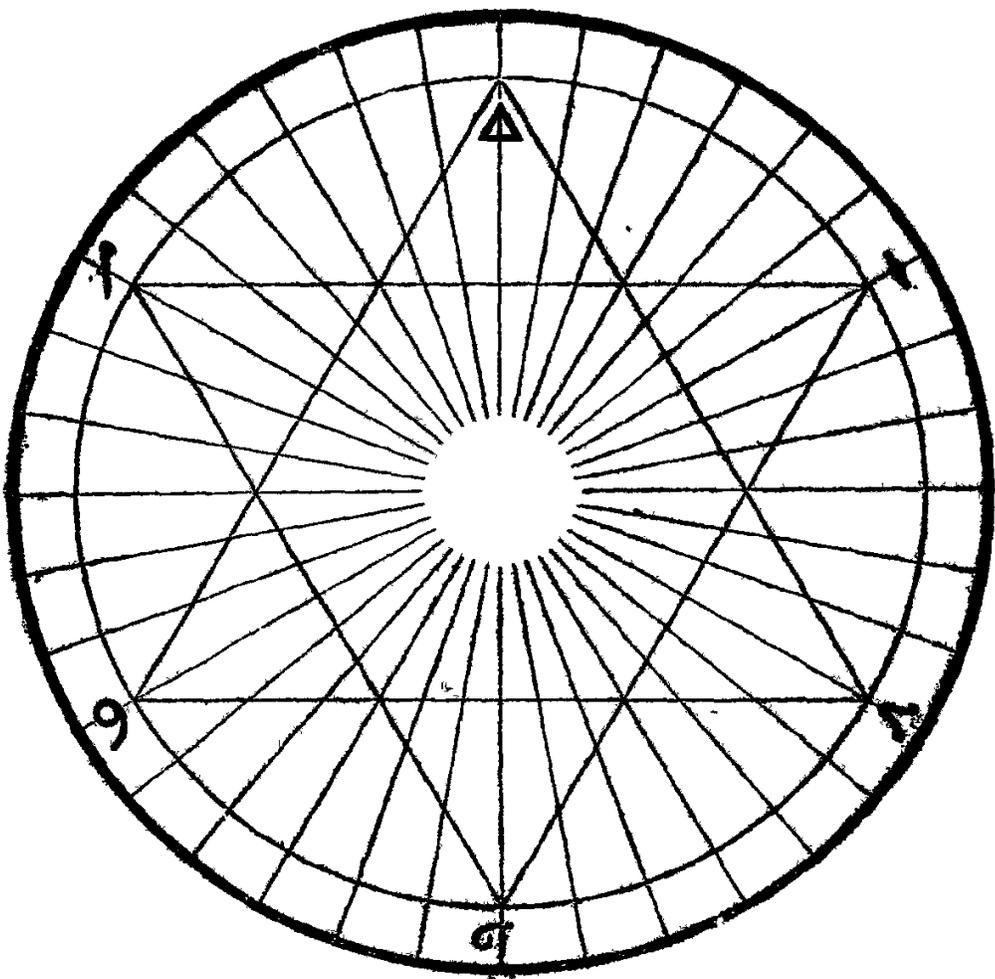
of the verbal Ecliptic, as a link in the zodiacal and duodecimal chain of Archangels or letters of the Utterance.
On the line of the Equinoxes of the Word, the Adamic letters H and L place themselves naturally—the first in the East, the second in the West—since, on one hand, H and Aries, and on the other, L and Libra, are identical characters. Read according to the ray or diameter that unites them and whose verbal value is the letter A, H and L spell ALAH. Thus, two trigones—the two equinoctial ones of Ether and Caloric—are bound together by this sacred word: ALAH. But these two equinoctial trigones are
themselves merely a horizontal, instrumental projection of the two solstitial trigones that constitute the theogonic and cosmogonic Hexad.
To connect the hexagonal Star of the Equinoxes of the Word to that of its Solstices, the ancient Patriarchs caused the first letter of the trigone of Jesus—the consubstantial of the Father and the Son, that of Eternal Wisdom, the universal Royal I—to resound. And afterward, that is, in direct subordination, they caused the first letter of the Trigone of Mary—the reflective mistress of the Eternal Living Waters, the letter M—to resound. The power of the equinoctial Star was thus evoked, whether by inspiration or deliberately, under its true divine or effective name, Alhim. This name is not a name but a lieutenant of the name, a pronoun. ALAH means He. Alahim means He, They, Him, Them.
Would one like absolute, mathematical proof that this hierogram is a lieutenant of the Word, which alone is the name, ShêMa, and even more, ShêMaM, the Name of Names? Here is that proof.
The Word is Y-PhO; Y is the consubstantial of the Father and the Son, and its numerical equivalent is 10. PhO signifies the Mouth, the Breath, the Organ of the living Thought of the creative Word, and its arithmological equivalent is 86.
Alahim has precisely this number 86 as its arithmological equivalent:
Thus, on the eternal Horizon of the double divine and astral Universe, Alhim functions as a Lieutenant, by reason of executive Instrumentality, pronominal to the name of PhO.
Read in the European manner, Alhim is MI-He-LA, the Militia and the Middle, the angelic Social State that, from the Heavens of the World of Glory, governs the astral Heavens and all they contain: Beings and Things. The Prince of this Principality, divided into harmonic Orders, the chief of these chiefs of order—each of whom is a living letter of the Word—bears the hierogram Alah, but it must be linked to the solstitial Hexad of the Word, and then it pronounces itself as MIHEL, which the Jews altered by transforming the letter of life H into Ka.
But neither Alah nor MIHEL is the Master of Swarga. The master of Swarga is Sw-ra, in Ishwa-Ra: it is Jesus-King; Alah, who is MIHEL, is merely the equinoctial lieutenant of the Word, the archangelic prince of the Principality of Angels and all their celestial orders, the Chief of Judges who holds over the East the sword of the living Fire H, and over the West the Balance La.
In all temples descended from patriarchal tradition, it was toward the West that Priests turned to invoke divine Justice, its living Letters, its legal Powers present from one end of the Ether to the other. This West is the Celestial one; and the Terrestrial shall increasingly feel the terrible judgment that the fidelity of the former pronounces upon the apostasy of the latter.
All of the foregoing shows how far removed the mythological Indra is from the real, living, and immortal Alah and MIHEL. The one is a pantheistic reflection through the imagination of poets, the other is the Light of that reflection in the creative Thought of the Word.
La, Indra, action of cutting, of removing.
Lâ, Gift offered or received.
Li, Solution, liquefaction.
Laka, Forehead.
Lax, To watch, to note, to mark with a sign.
Laxmi, Beauty, splendor, prosperity.
Lag, To adhere, to attach oneself to.
Lagu, Light, imponderable.
Laj, To appear.
Lad, To show, to make known, to agitate rapidly.
Lap, To speak.
Lab, To acquire, to obtain.
Lay, To go.
Laya, Union, abode, just time, equal measure, fusion, solution, dissolution.
Lam, To desire, to be exalted by joy.
Lava, To harvest.
Las, To gush forth, to shine, to embrace.
Lâ, To give, to seize, to take.
Lâpa, Speech, language.
Láb, Acquisition, obtaining, gain, profit.
Lâsa, Dance.
Li, Equality, identity, dissolution.
Lik, To engrave, to incise, to draw, to write.
Lika, Act of writing, writing.
Ligu, Heart, spirit.
Lip, To anoint, to paint, to write.
Liç, To go.
Li, To liquefy, to dissolve, to attach to oneself, to obtain, to adhere.
Lilâ, Pastime, voluptuousness.
Luk, which Cuts off, rejects.
Lut, To roll.
Lud, To trouble, to cover, to attach oneself to, to embrace.
Lup, To eliminate.
Lub, To desire with love; Slavonic Lûb; Lithuanian Lubju.
Lul, To agitate, to attach oneself to, to hold to.
Luh, To desire.
Lû, To destroy.
Lûth, To adorn.
Lêka, Trait, line, letter, character, God, Deity, drawing, missive.
Lêp, To go, to honor.
Lêpa, Function.
Lêha, Food.
Lêhija, the Divine Nourishment.
Lôk, To see.
Lôka, Sight, vision, the visible World, the Universe, a division of the World, Men, humanity, the World and Worldlings in contrast to the divine World.
Lôkapâla, King, sovereign; the 8 guardians of the World seated at the 8 principal corners of the horizon: Sûrya, Agni, Sôma, Roudra, Indra, Yama, Varûna, Kuvêra.
Lôc, To see.
Lôta, Prey, sign, tears.
Lôpa, Suppression, disappearance.
Loba, Greed.
Loma, Hair; Lômaça, ram, sheep, lamb.
Lôla, Trembling, vibrating.
Lôha, Iron, steel, metal, weapon, blood.
XL. Ma. — In the doctrine of the Patriarchs reconstituted and very succinctly summarized by Moses, with an Egyptian archeometric alphabet that the Jews have lost, the letter I or Y is the royal one of the XXII, the point of departure and return on the Circle of infinity.
In the Vedic-Brahmanic school that founded the Chaldean University as well as that of Iran, the royal I or Y was supplanted by M. Thus, at the starting point on
the first trigone; the first of the second trigone, the M of MaRiE, was substituted for the consubstantial of the Father and the Son, the first letter of the Word-Jesus IPhO-IShO. Even in the Temples where this substitution, this naturalist concession, had taken place, the ancient Orthodoxy yielded and faded away only little by little.
The names of the first two trigones were perfectly known to the Egyptian priests, as to their colleagues throughout the Earth, at the dawn of Brahmanism from which Abrahamism emerged. The 1st triangle was read as IPhO, IShO, and abbreviated as ISh doubled or IShIsh, and there was the concession made to the aggressive intolerance of the learned Sudras.
The 2nd triangle was read as MER. Moses subordinated the letter M to Y, the arithmological progression of 40 to that of 10. Nevertheless, he associates these two letters too often for this fact not to be of very great account when one wishes to delve into the scientific meaning of his Books.
When the Jews had completely lost the tradition of Moses, after violating his social constitution and successively massacring the first two castes he had instituted, the restoration of this tradition was impossible, due to the ignorance of the Jews, without the aid of a true metropolitan University. This aid was given to Ezra during the Babylonian captivity by the Grand Master of the Chaldean Magi, Daniel.
Ezra regularly received the grade of scribe, which in the Chaldean priesthood, as in the Egyptian, was equivalent to being a laureate of the Polytechnic School from which the general staff of that time was recruited. Daniel combined with this rank that of prophet or epopt, that is, Grand Master, not merely technical, but practical in the Mysteries.
To understand what follows, it is necessary to show the filiation of Brahmanism and Chaldeanism: these two words not signifying a people, but a learned sacerdotal body.
The Kashi-Dim were an order of learned priests, especially versed in Astronomy, and this order had come from the city of Benares, whose mystical and secret name they bore: Kashi in the language of 22 letters and Kaçy in Sanskrit.
It is unnecessary to recount here that this holy city was one of the principal learned metropolises to which all the patriarchal governments of the East and Far East sent the sons of prominent families belonging to the first two castes. The Patriarch of the Chinese who took the name of Pho-Y, the renovator of Iran who first took the name of Zoroaster, had been formed in this general staff school, while protesting against the Concordat that had given birth to Brahmanism and the cult of the Devas. Likewise, the group of Kashi-Dim issuing from these holy cities separated more or less from Brahmanism; and therein lies, on one hand the filiation, and on the other the difference, between the doctrine of Brahma and that designated under the name of A-Braham, which itself would separate from the Kashi-Dim submerged by the heterodoxy of the learned Sudras.
Daniel thus aided Ezra to reconstitute, not the religion, nor the universal social state of Moses, but a cult and a Jewish political state leaning more or less legitimately on a transcription of the 5 Mosaic Vedas. Ezra cannot be a
guarantor of this transcription, for a scribe, while having theological value, does not have theologal value, and a national politician even less so. But Daniel has theologal value as one inspired by the Holy Spirit, that is, as having verified in the living God the sacred things of which he speaks. This is why the transcription of the Pantcha-Vedam or the Pentateuch of Moses can be regarded as exact, although the writing and even the language are not the same, and the Grand Master of the Chaldean Magi reserved a certain key while giving many. The Writing is one of the numerous Chaldean alphabets of XXII Letters, and in this the patriarchal tradition is preserved. But this square alphabet, very close to the Cuneiform, is without scientific Morphology, although exact in its progression of Letters and corresponding Numbers.
Likewise, the Egyptian language of Moses is altered by monoliteral and biliteral elements, while its roots are treated as triliterals, which is like a veil drawn over the thought of Moses who veiled himself excessively, in the Egyptian manner.
In all the patriarchal Schools, the roots were monoliteral, that is, simple, or biliteral, that is, geminated, but never triliteral.Here, by roots we must understand pronounced or vocalized consonants, but above all the consonant itself, for vocal pronunciation changes according to human verbiage, whereas the mute consonant preserves the imprint of the divine Word. Nevertheless, vowels were rightly regarded as having root value and even word value in isolation. But without a learned university, and according to how they were pronounced by the vulgar, they risked altering the sacred meaning. Hence, the more the ancient Patriarchs dealt with barbarous peoples, the more they tightened their handling of written Utterance upon the consonant and the sign.
Pho-Y, by limiting himself to the sign, was no longer understood beyond a few centuries; and his 5 Vedas, his 5 canonical Books or Kings remain unintelligible concerning their true depth: especially the 1st King, that of Ya, called the Y-King. The same occurred with Moses, though to a lesser degree. The same holds for the 5 Vedas that Moses had consulted as well as the first 5 books of the 1st Zoroaster and the 5 Chinese Kings. The translation or transcription made under the auspices and inspiration of Daniel conformed to the above. It extinguished the vowels to preserve meaning from the barbarous jargon of the Jews. But since the text of verses to be chanted or recited in psalms required vocalization, he gave Ezra the vowel points that were the Neumes of the Chaldean sacerdotal University. These Neumes were themselves used without consonants in the chanting of hymns during the celebration of theurgic mysteries in Egypt and Assyria. And the Chaldean sacerdotal College itself received these Neumes from the Vedic-Brahmanic University. Finally, the latter had received them from the ancient patriarchal temples cited by Moses as antediluvian, under the names of NePhaL-IM and GhI-BOR-IM. For all to be consonant as in the past, present, and future, in the Unity of the Word and its primordial Utterance, it is necessary to know whether the Neumes belong directly to the Sanskrit language and its 49-letter alphabet, or to an earlier patriarchal language or a XXII-letter alphabet. One need only glance at the table of Vattan Letters
to see, above the XXII Letters, a zodiac of Neumes, and in the description of this table, the role of this Zodiac.
ARCHEOMETER AND THE CHINESE
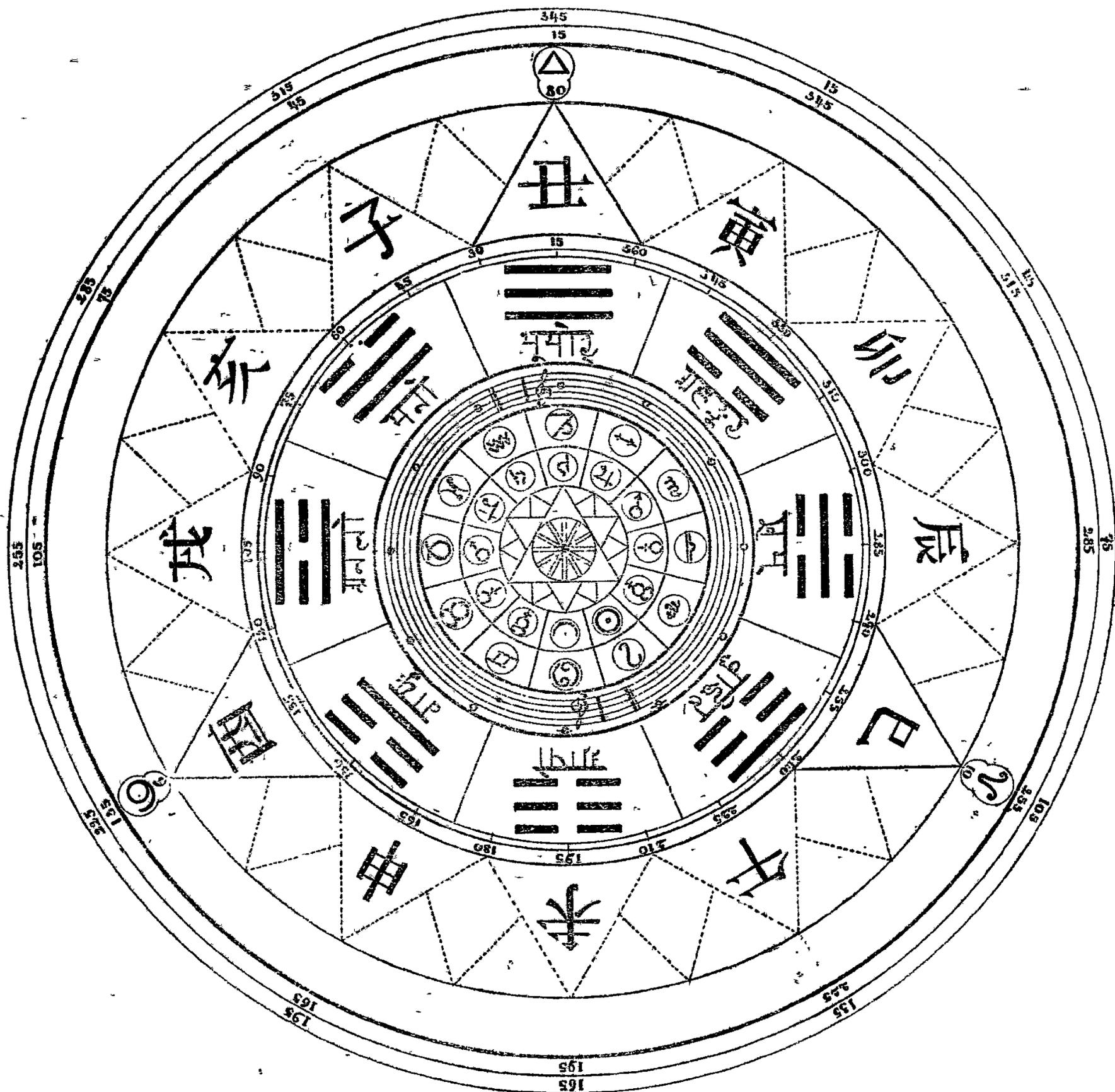
Trigrams of Fu Xi (Relations with Sanskrit).
The use of vowel points and the Neumes employed in the solfeggio of theurgic hymns must therefore be traced back to the antediluvian patriarchs of the white race from the North Pole. But I in no way vouch for the accuracy of the correspondences of these
vowels and diphthongs as presented in the very precise transcription of the Vattan alphabet table. Many positions therein are altered, owing to the lunar schism that presided over the compilation of the 80 Vedic lines, of which I also provide the table; and the key to these alterations is precisely the transfer of verbal royalty from the letter I to the letter M, from the triangle of Jesus to that of Mary.
The phrase, or rather the sequence of Sanskrit Datus that underlines the zodiacal circle of vowels, is their very hymn, the theurgic hymn that the highest-grade initiates of the Vedic-Brahmans alone pronounce while chanting, in the deepest mystery, and in the work of these mysteries. But, though bound to them by no oath, I do not provide the translation of this hymn, limiting myself to what can verify the soundness of the religion and science of the Eternal Word—that is, the wisdom of the creative Word and the Incarnate Word.
If I have finally been guided directly from the Bosom of God Himself and in His Spirit, concerning the sacred or religious verification, this in no way alters—quite the contrary—the scientific value of the facts obtained, taking this word, “scientific,” in the most vulgar, down-to-earth, positive, and modern sense.
From the foregoing, it follows that in this as in all things, concerning vowel points as much as the 5 Vedas of Moses and the patriarchal Tradition they contain—condensed to excess—the Jewish people, as a people, have never clearly understood the nature, origin, or meaning of the relics placed upon their shoulders. Of course, when I say the Jewish people, I do not speak of the first two castes they killed: that of the Sacerdotes worthy of the name, and finally that of the Alhim, the Judges, the Prophets, and the Saints who lived among this people and despite it.
It remains to be seen whether, despite Daniel’s authority, the loss of Moses’ sacred Language undermines the credibility that can be accorded to the 5 canonical Books transcribed under his name.
These books, in fact, bear traces of multiple redactions and diverse though sister languages. We shall shortly clarify this important point. Modern criticism—which must not be confused with modern science, philosophical or literary criticism—has indulged to satiety in the five books of the Pentateuch. With the methods that distinguish banal Sudra instruction, devoid of all education as of all religious mentality, the intellectual anarchists have made of these sacred books and their exegesis a vulgar mess for the use of the neo-pagan understanding presiding over secondary studies since the Renaissance.
In this chaos, Moses founders and is but a nebulous myth without any certain reality. As for the works attributed to him, little or nothing remains worthy of consideration by the Sganarelles, the Homais, the Diafoiruses, the Joseph Prudhommes, or Monsieur Jourdain and his Greco-Latin logic professor.
Even the Jews themselves have not escaped this sabbath of lay Clericalism, this revenge of the clerisy against the Mastery of the Clergy. It is
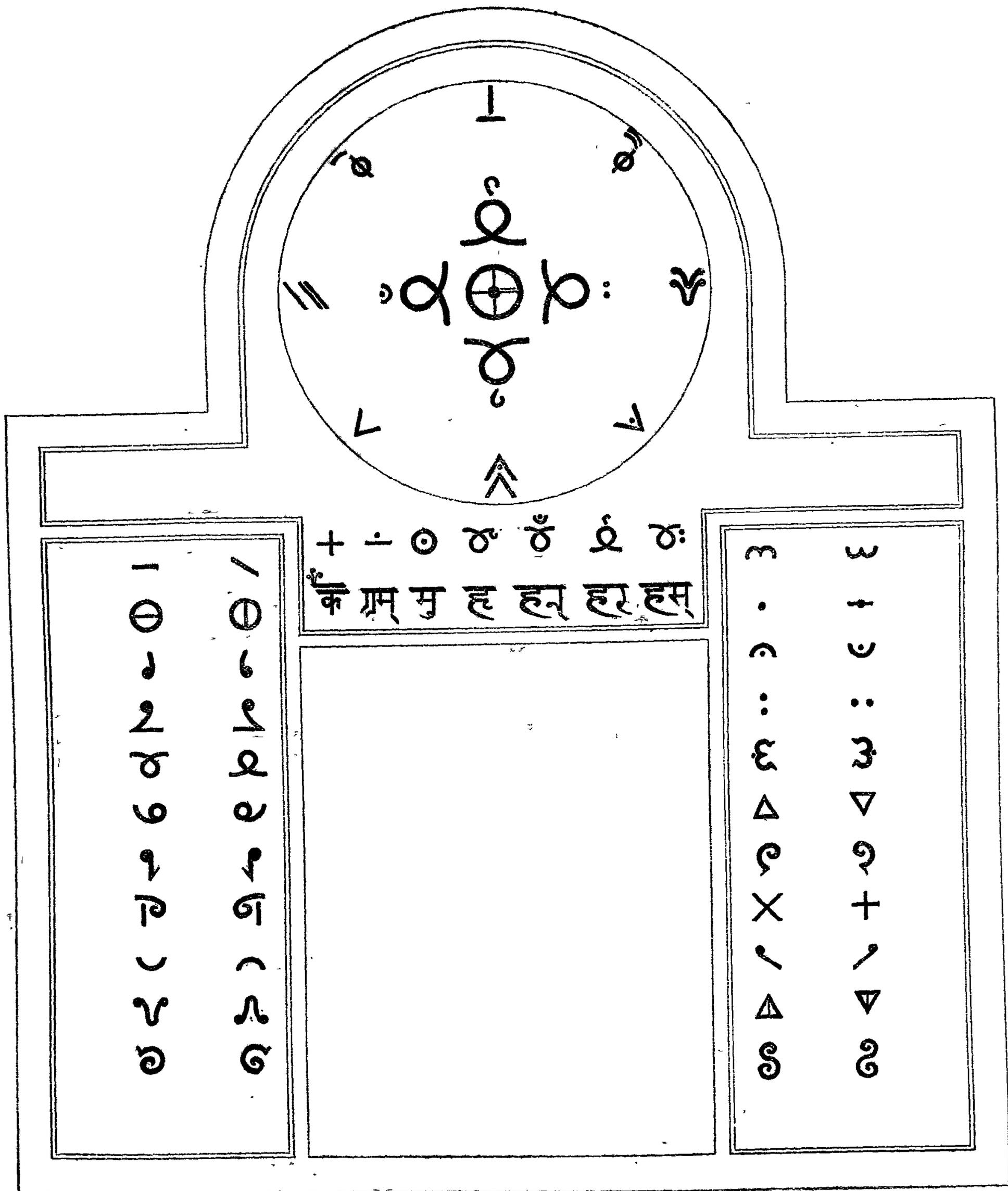
The Watan Alphabet and its Double Transcription.
true to say that this special mentality never thinks except from the belly, even when it appears to think from the brain. Its very incongruity serves as a means to exploit anarchy, vulgarity, and the ignorance of half-educated individuals who form the average opinion. And this exploitation is most fruitful since it leads to prebends that have supplanted those of the Church—to honors, offices, academic chairs, and the budget that waters them. But one wonders by what principle, demonstrably fair, these Sudras in social outlawry presume to measure the thought and works of ancient Sacerdotes.
To judge such men and such works, one would need to belong to the mental and psychic caste of the former and know the principles, laws, methods, ways of thinking, and writing that governed the latter.
Sancho Panza would have claimed to measure Sinais, Tabors, and Calvaries with the stick he used to beat his donkey. The yardstick of our modern literary and philosophical hucksters is something like their umbrella.
Among the discoveries of profound thinkers—and even more profoundly paunchy ones—there is one culminating point to which I shall limit myself for the moment.
They claim that in Babylon, two rhapsodies—two traditions without author’s name or definite origin—were poorly stitched together upon Moses’ back. And this is why, like a double harlequin’s cloak, there would intertwine in the Pentateuch the jargonized Jehovahism and Alhe-mism jargonized as Elohism.
This supposition has but one drawback—that of human verbiage in full anarchy, turning its back on the science of the Word and Sacred Utterance.
The Alhim, where Moses took care to subordinate the letter M to the letter I, are the Angels of the Word; the functional letters of the Principle of Utterance, the harmonic and organic Equivalents of its creative power. Daniel was not mistaken about this, any more than were his Egyptian orthodox masters or the Supreme Assyrian College that worked under his orders on the new edition of the Pentateuch.
In this work, a multitude of hieroglyphic phrases and words were unintelligible to the understanding of the Jewish Sacerdocy of that time. This is why the transcription often presents words, turns of phrase, and entire sentences bearing not the ancient mark of Moses, but that of the Kashi-dim of Babylon.
This is evident in many places, particularly in the first verse of the first book.
But this fact in no way alters the validity of the work.
The 22-letter alphabets inherited from the white-race Patriarchs were a table of equivalents common to all the university Temples of their Churches. And since this remains identical in its double progression of letters and numbers regardless of letter forms, the variation of spoken or written dialects matters little if the schematism is the same.
Now, it is always the same among all men of the ancient sacerdotal caste, and Daniel was one such man.
I shall limit myself to one proof among a thousand, since we are here concerned with the letter M.
Among these different meanings, Ma offers that of essential, suprastral water—not merely astral. This meaning is simultaneously ritual in Egypt, Chaldea, the Indies, Asia, Iran, etc.
Let us leave the African, Asian, and European continents and go to one of the remnants of the ancient antediluvian land—America.
In the language of Vatan—which is Votan in all dialects derived from this sacred tongue, throughout all Votanid dynasties—water is called ATL, root of the word Atlantean.
What relation exists between ATL and Ma? Here it is: Ma = 40. — A = 1 + T = 9 + L = 30, total: 40. This small example, which could be multiplied infinitely, shows that speech as science and art was carried somewhat further by the ancient sacerdoces than by modern professors, and that the latter—though they may sit enthroned at the summit of European public instruction’s anarchy—possess no qualification for judgment, but only for irreverence when they presume to speak and write at random about inspired scholars and the sacred books of Antiquity.
To attain such heights where empirical and wild verbiage fades to make way for the Word, where man’s vain cogitation disappears to give place to learned, conscious reflection respectful of divine thought—another mentality is required than the literary philosophy of bourgeois anarchists, pagans of Athens, Rome, the Renaissance, and its subsequent business venture known as the Encyclopedia.
Already the Jews were far from the religious thought of their master—they have proven it enough. But how much farther still are the modern disciples of Julian the Apostate or Marcus Aurelius—the simoniac renegades of the creative Word and the incarnate Word.
These are the false shepherds who lead to the abyss and carnage, to ruin and annihilation all that was Christendom; and the results of the governmental predominance they have arrogated to themselves, at the expense of the ancient social order, will increasingly devote them to divine wrath and the execration of all men of good will—all men of sacrifice and discipline: priests, soldiers, workers, at all degrees of labor’s hierarchy.
Not only the sacred books, Pentateuch and Gospel, which command faith in the Church of the Incarnate Word, shall emerge from the hands of these defilers more resplendent than ever, thanks to the humble methods of pure science. But the sacred books of all peoples preceding Moses shall also corroborate the primordial unity of the human spirit within the divine spirit—the prophetic glorification of the creative and redeeming Word by all pre-Mosaic patriarchs.
Among the numerous keys given by Daniel to Ezra and to the Synagogue that replaced the Alhim, the Judges, and the prophets instituted by Moses alongside the Sacerdocy, we must cite the Kaba-la: in Sanskrit, Lâ, the divine gift, KaBa of the twenty-two equivalents of the sacred speech of the Word, Kavi.
Yet here again, the obscure Jewish understanding found a way to render obscurely mythical what was clearly scientific in the higher teachings
of metropolitan Universities. The simple example cited above concerning the letter M and the word ATL proves that the Ka-Ba-La was anything but Jewish, and that this science of speech reduced to the Schema of the Word was practiced across the entire
globe before any Jew or Hebrew existed.
The case is entirely different with the Jewish Kabbalah. This belongs to them exclusively. It is an impure mixture of truths and errors haphazardly amalgamated without science or method, founded upon no demonstrably sound principle.
Babylon was the confluence of all intellectual currents emanating from the debased Universities of Egypt, Ethiopia, Arabia, the Indies, Persia, the Caucasus, and finally Syria.
A formless mass of polytheistic and demonic superstitions, an abuse—in every sense—of all inverted archeometric correspondences, a dungheap of often monstrous conceptions and practices, had mingled with the pure primitive KaBa-La. Nevertheless, through the jumble of Jewish Kabbalah, one can discern—and with the Archeometer in hand, precisely trace—all that derives from the pure and simple KaBa-La.
Since we are here concerned with the letter M—which the lunar and concordat Universities, along with anarchist Sudras, made their alphabetic royalty at the expense of the letter I or Y—we shall now examine one of the Kabbalistic keys given by Daniel to Ezra.
This key has never been understood
by the Jews, as Saint Paul makes sufficiently clear to them.
It is called Nicod bilo-soph, the Being, the Shemah Hibor—in other words, the Conjunctive Sign. The external or philosophical meaning is this: Nicod, the point; bilo, within; soph, the infinite—which, like all metaphysical definitions, signifies nothing or anything one pleases.
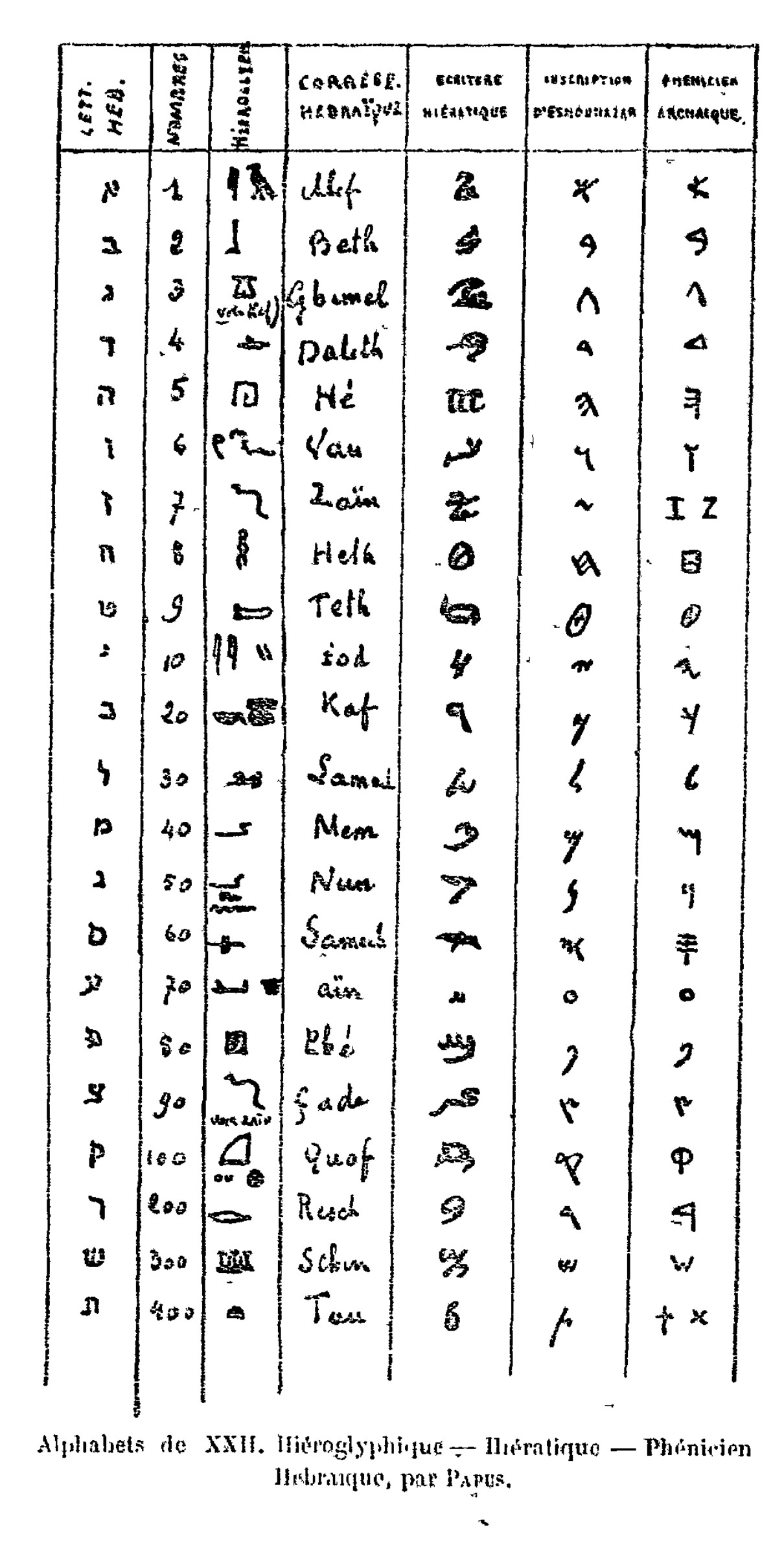
Twenty-Two Alphabets. Hieroglyphic — Hieratic — Phoenician Hebrew, by Papus.
Voltaire said: “Metaphysics begins when the speaker no longer knows what he is saying and when the listener no longer understands anything at all.”
There is truth in this definition by that philosophical ape and parrot of paganism. But Daniel was something other than a philosopher. He prophesied, with exact dating, the incarnation of the Word, His martyrdom, His crucifixion—things for which the Jews have never forgiven him. Moreover, in his secret teachings to the founders of their synagogue, he provided the scientific means to unmistakably recognize the Creative Word within the Incarnate Word: Ipho within Isho. Nicod signifies not the point, but the Yod, the Ya-Soph which should be written ShOPh.
It is therefore not about the point within infinity—that is, within the indefinite—but about the archeometric positioning of the letters Y, Sh, Ph and O, namely those of the fundamental trigon, that of the Word. Moreover, O is not merely the Shemah Hibor of Sh and Ph. It is the universal conjunctive sign, the letter common to the Father IhOh, the Son IphO, IshO, and the Holy Spirit ROah-Alhim.
Daniel’s indication, verified upon the Archeometer, thus precisely pronounces the name of the first triangle: Ipho, Word, Isho, Jesus.
This is not all—SheMa = 340 and simultaneously signifies Sign, Heaven, Glory—in a word, the theogonic world directly created by the Word.
One of these equivalents is SPhR: 60 + 80 + 200 = 340 = ShM.
SPhR signifies circle of Signs, Planisphere of the SheMa, Direct Book of the Word, its Seal within sacred Utterance, for the word Book in SPhR only means scroll in the vulgar sense because it expresses the function of the circle in the scientific sense. Now, the Nicod is by no means the central point—the letter I being the zodiacal Virgin-Queen. If one makes the letter I the central point (which is the letter N), the entire divine SheMa is overturned, and the name of IHOH ceases to be pronounced in its entirety—that is, to be manifested exactly by its Creative Word.
One may experimentally verify the foregoing upon our arithmological table of the twenty-two letters and upon the Archeometer armed with its four equilateral triangles. The definition of the Circle was made in patriarchal Universities by the inscribed equilateral trigone corresponding to the northern solstice, then by its reflection in the trigone of the southern solstice. This resulted in the hexagonal star, the Bra-shith or Creative Utterance of the divine Hexad. The Circle was thus defined or verbalized—not by the diameter, but by a real relationship between the Circle and the regular defining trigones.
The distance from one angle of the hexagonal star to the adjacent angle is the radius of the Circle. This definition by the radius and by the hexagon is one of the keys of ancient science—and it is lacking in modern science and in the correspondence between all sciences.
As regards light, Newton’s metrological system, based on the diameter, is but a partial system—purely analytical. It accounts only for apparent phenomena or prismatic decomposition. The recent discovery of other facts shows the insufficiency of Newtonism, and the very fact of undulation—drowning that of emission—leaves contemporary scientists disoriented and without reference points
below the red rays of the Shemah-Hibor and still more so beyond the violet.
For undulation, which is reality itself, requires a different metrology than diametric emission, which is but a consequence thereof.
This is what Daniel indicates in the foregoing for all divine, cosmic, human, universal, or merely planetary sciences.
There is more: beyond the SheMa, there is the SheMaM, and the latter has as its numerical equivalent not 340, but 380—signifying the supreme Sign, that of the northern angle in the sky of the Word’s glory and His Utterance.
At the summit of this archeometric angle, one may see the northern solstice of the primal Trinity: the two letters Ph and Sh—one zodiacal, the other planetary; one a simple equilateral trigone, the other an equilateral trigone armed with a bisector signifying the world’s axis, the scepter of His government, belonging to the Son alone, as Creative Word and as God the Savior. Ph = 80, Sh = 300—their union equals 380, and they are the SheMaH, the supreme Sign, the Sign of the Angle or the Cornerstone.
Such is the SheMaM-La-Ha ROSh, the supreme Sign of the Word as King, and the letters are clearly pronounced upon His Archeometer, where the creative utterance speaks for itself.
This is a fact loyally demonstrable, exactly experimental—and this fact, law of the very principle, is no human utterance (that is, a philosophical approximation, a lie), but God’s utterance, sole source of all truth.
It remains for us to demonstrate, in the deepest mysteries of the Vedic-Brahmanic School, the evidence we have just signaled within the most profound secrets transmitted by Daniel to Ezra and his Synagogue.
The differences arising from diverse starting points—Ya for the patriarchal school to which Moses belonged, M for that which Vedic-Brahmanism grafted onto the primordial system—only highlight more clearly the ancient unity of the latter.
The day of Yom Kippur shall serve as our demonstration. The word Yom is no term of philosophical verbiage, but one used by Moses as a disciple of the Word according to the tradition and patriarchal science of his Egyptian masters. The Ya and the M are united by the conjunctive sign O; its number is 56, a sabbatical number as a multiple of 28—but its sacred pronunciation was Y-HOM.
This is the Day of days, and its feast corresponded to the fifteenth degree of the sign of Virgo—cosmic equivalent of the verbal power Ya, of divine Wisdom, Queen of the fluid and astral heavens.
On this day, in utmost secrecy, the name of the Father was pronounced by patriarchal Pontiffs in the Temples, and by fathers and mothers in patriarchal households.
This most particular pronunciation glorified the archeometric starting point of the dual universe, causing the Father’s name to fold back upon itself in its consubstantial or physical letter-power. This name—which the religious reader must only utter in prayer, and at which the irreligious should tremble not merely to speak but even to behold—is IHOHI.
Let us now penetrate the deepest mysteries of Vedic-Brahmanism.
The corresponding day is there entitled the YHOM of the complete AUM.
The Sovereign Pontiff bears upon him the sacred jewel of gold and precious stones worn by Moses, which served to kindle the altar fire according to the rites.
This sacred day is called AHO or MIHSh, and upon the jewel is inscribed in Adamic characters the word AHaMIOH: “I am IIOH.”
The inversion of this word is IIOHaHa—IHO the Great.
Thus the secret writing of the Manava-Dharma-Sastra reveals how the lineage of Vedic-Brahmanism connects to the Orthodoxy of patriarchal Proto-Synthesis.
We could furnish many more proofs, but this is the most significant—and others shall come in due course.
At the very outset of the Manava-Dharma-Sastra, the redactor indicated—in the ancient manner—the reference of the Brahmanic lunar system to the solar-lunar system of Ishva-Ra. The inversion of the Word’s solstitial star (which places the solstice of Living Waters in the north and that of the Living Earth in the south) corresponds to the reversal of the name Jesus ISHO, pronounced ISIOUA or IShVA according to dialects and rites.
Before Brahma, it is Schoua-Y Am-B’Uvi—and written thus, it signifies: 1) the self-existent Being; 2) Swaya, the son of God AMBU (the water). BU: to be born, to exist—hence the earth, the sacred Land of the World of Glory, the divine substance of the Immanence and Immanation of beings. VI: to love essentially, to create, to beget. Finally, BO or VI: the hierogram of the Land of the Living, as AMBU is that of Living Water. And let it be clearly understood that we speak here not of cosmic elements, nor of the disentanglement of chaos by the Alhim, but solely of the divine Substances of the divine Universe whose Creator is the Word.
AM and BOuVI—whose meanings I could expound still more profoundly if necessary—are attributes of Schoua-Y, who himself is the inversion of IShVa; IShVa-Y-AM: IShVa acting simultaneously in the Ya and the Me. This is the mystery recalled by the first Zoroaster when he speaks—or rather when AHOURA-MAZDH (that is, the ROuaH) replies that He has already revealed His law to YM, chief of Humanity—the YM-VR of the ancient Scandinavians, the YM of the ALHYM and of MY-Hela.
All these meanings are explained in an absolutely rational and scientific manner upon the Archeometer. One may see them translated from verbal Art into graphic art in the ancient figure of Ishva-Ra, which we reproduce elsewhere by archeometrizing it. In this hieroglyph, the primordial position of the Word’s solstitial star is exactly observed. The Creative Word is depicted against a background of earth and sky—or celestial earth. He sits upon a panther whose brown and yellow stripes symbolize many things, including luminous refraction. The yellow stripes represent photogenic Substance, the brown (called Fraunhofer stripes today) represent Resistance and Absorption of media, the transformation of light into latent calorific energy.
Beneath the Word and the Panther extends the sea of Living Waters, where the single-headed figure of KaVi is projected and reflected. The posture of Jesus’ body—Creative Word
—from head to foot, from shoulders to arms, hands, and fingers—is wholly symbolic or rather hieroglyphically eloquent. The same holds for the entirety and details of this remarkable graphic. The trident represents the Triloka, the governance of the three Worlds. It is directed toward the left and archeometrizes toward the letter Me. But the trident is the inverted SHINvatan and its inclination toward the Me reads: SheMa. Such is the hieroglyph or inversion of the hexad, of the first trigone within the second, of the cult of Ishva-Ra within that of Brahma—magnificently signified. This is why we have deliberately juxtaposed this graphic utterance with the verbal utterances of the Manava-Dharma-Sastra.
Upon carefully reading the first Slokas of this admirable sacred Book, one will see that IShVa, inverted into SVa-Y, is indeed the Rex Patriarchaum, the King of Patriarchs, the Lord of the Archis and Manava Richis, and that Brahma is but His inert shadow, engulfed in the Living Waters of boundless Time YM. And if one opens Moses, one will see that these plastic Living Waters are the principial medium—not merely the origin—from which the entire hierarchy of universal or specific souls has issued. The point of conversion between the act of the eternal Principle and the execution of temporal Origin by the ALHIM lies at the archeometric center in the letter Na, echo of the letter Ma. This collective and umbilical knot between the two theogonic and cosmic Universes is the very source of the passive power we call NaTURE. This admirably composed name comes from the most ancient schools. NaT signifies knot. OuR signifies living light—yet not the Lumen de lumine. It is the first correspondence of inaccessible light. It is the reflexive action of the ROuH-ALHIM in the Living Waters. It is, in a word, the reflexive act of the Holy Spirit as instrumental to the Word.
Finally, the vital knot uniting the theogonic world to the cosmogonic—NaT—is composed of the central solar letter Na and its solar-lunar zodiacal counterpart Ta.
The correspondence of Ta is the zodiacal Lion, also figured by a tiger or panther in the zoomorphic writing of ancient Egyptians, the Far East, the Austral (Southern) races, and ultimately the Atlantean Votanides of ancient America.
Nature is thus conceived as the local point of the theogonic incidence of the Word and its reflection in cosmogonic utterance.
This convertible connecting power, whose vehicle is Light, thus has two inversely proportional and corresponding aspects. One aspect—the Divine—answers to the ATH-ALHIM of Moses and Saint John; the other to Ath-Ha-ShaM-IM and Ath-Ha-A-ReTz—that is, to the soul or constitutive living reason of the angelic world: the Heavens of Glory, the fluid Heavens, and the grave, gravitating Heaven of astrality.
In Sanskrit, ATH signifies constitutive spirit, soul, living reason.
When the incarnate Word says: “I am the ATH, the Aleph and the Tau,” this means: “I am the constitutive Reason of the Universe, its Word armed with all Creative and Preservative Powers.”
At a lesser degree, ATH signifies the twenty-two-letter Alphabet—the reflexive Utterance of the Word armed with its Functionalities.
These functionalities—mere mortal and nearly dead reflections in the human mind—are immortally alive in the divine mind, and they are the ALHIM.
Thus, through this dually aspected and inversely proportional power that is Nature, the divine Order naturalizes itself by its laws into the physical order—and the latter, in turn, naturalizes itself into the former through obedience to these same laws.
It is this central point of Psychogony—this nodal point—that has given rise to pantheistic and other confusions, stemming from the division of learned languages and the forgetting of the Schematic Utterance of the Word,
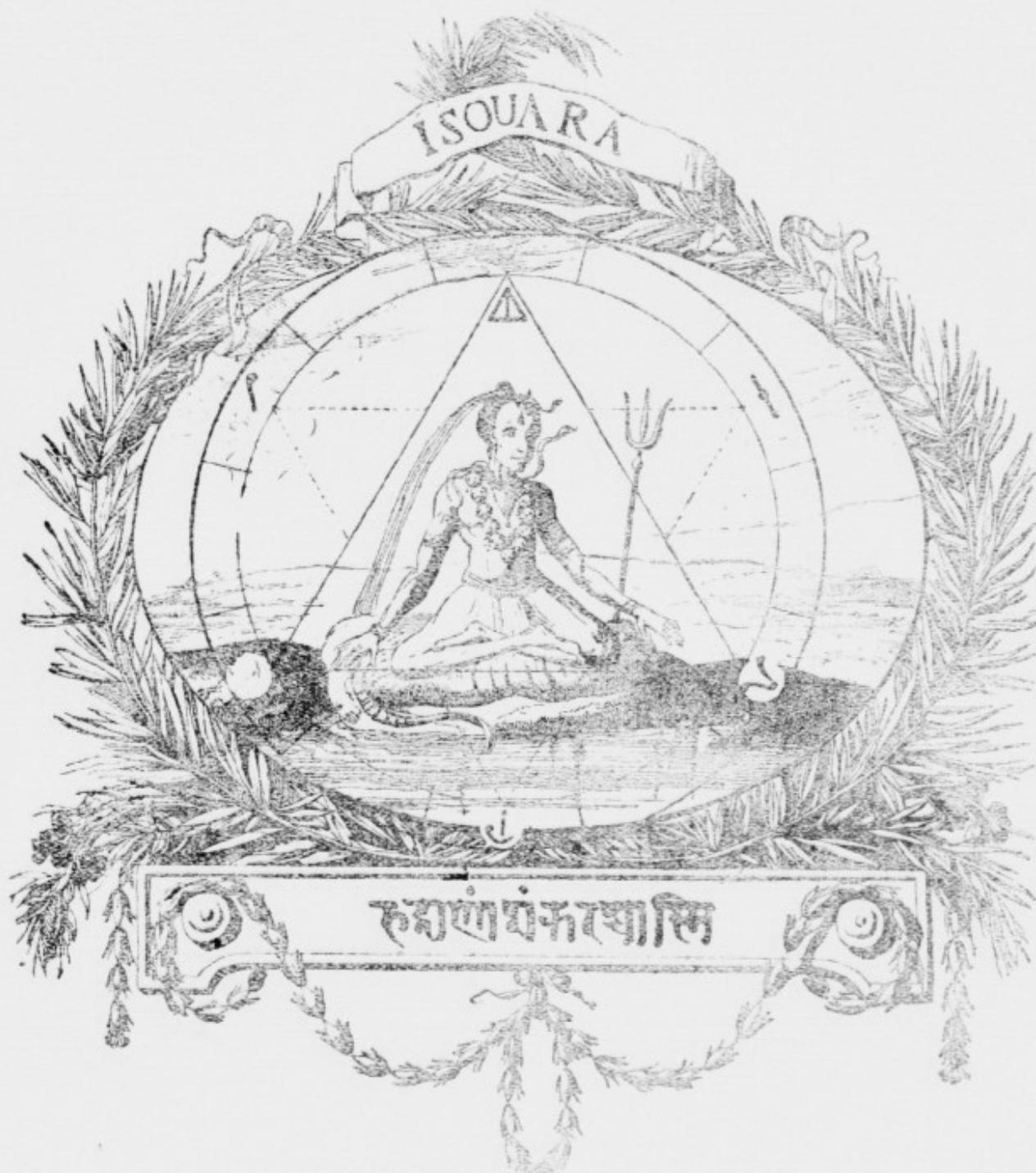
The Vattan alphabet uses Ma as a consonant, representing it by a horizontal line threaded through a small black circle.
The Vedic alphabet, in its table of eighty signs, initiates all
its verbal theodicy from the same letter. But here, as a starting point, it is merely a small black circle devoid of the bar or straight line. Thus this letter—instead of being pronounced Ma—remains indefinite. It is now but a mute cerebral M—neither vowel nor consonant, neither Word nor Utterance, neither defined thought nor action. It is not articulated by vocal organs. It listens to itself in the workings of mysteries. Here is how:
When one experiments with this point of the AUM, both hands are placed on the face—each with fingers extended, assuming the form of the Assyrian Shin.
The thumbs close the ears, the little fingers close the nostrils, while the ring, middle, and index fingers—spread like palm fronds—press the temples. The mouth is shut. The rest of the body, seated in the Eastern manner but with a particular ritual posture, must likewise assume the form of a certain letter—a hierogram unknown to most members of the secret Assembly designated by the hierarchical names: Yogâ, Yoga, Yogî, Yogî, Yoginâ, Yogin.
The ancient name of this assembly, prior to the Brahmanic constitution, was Yogis havarra—a contraction of Yogâ-Ishva-Ra: union in Jesus-King.
Though all prescribed conditions are met, it must nevertheless be observed that what was religious science and consciousness in the practice of mysteries under Ishva-Ra’s reign gradually became formula and routine—as the subversion of Y by M erased the Memory of supreme wisdom, supreme reason, and their Sovereign Lord, leaving only their reflections in the Trigone of Living Waters.
Here is how the first letter of the latter is experimented with: When the Yogî has assumed the aforementioned posture after purifying himself—inwardly through penance and contrition, outwardly through prescribed rites involving water, air, etc.—and concentrates his physical vision through the nervous system of sight upon the chiasma of the optic nerves, he gazes inward toward the median part of his forehead, above the midpoint of the brow ridge, between it and the center of the frontal eminence. This is the third eye of ancient mysteries—that of direct vision and contemplation.
All bodily openings being closed as described, the entire internal energy—both psychic and physiological—must concentrate upon itself and its vertical axis of symmetry, projecting from chest to brain. The vibrational reverberation of this synergetic effort culminates in the asymmetrical cerebral organ known as the pineal gland.
To this gland, the soul—that is, life—remains attached through its fluidic body for several days after what men call death.
When the vibration reaches the aforementioned cerebral point and corresponding cranial angle, it resonates outward, expanding until it shakes the tympanic membrane, then rolls through all organic cavities.
This internal, indefinite sound has no discernible quality whatsoever. The only French word that can remotely express it is “murmur”—if one strips away all letters
except the M, devoid of vowels or consonants. A still more precise comparison would be this: when pressing both ears tightly against certain seashells, one hears something like the aerial roar of the sea. Such is the internal perception of the cerebral letter M—the first of the Trigone of the Sea of Living Waters, intra-etheric and supra-etheric.
The foregoing sheds sufficient light on the Mystagogy of the verbal Powers of the Utterance. The practice of these mysteries is real, effective—but excessively dangerous for any man unprepared intellectually, morally, and physically according to the rules of the ancient Patriarchs.
For Europeans more than all others, I emphasize these dangers—to which they are exposed by their divided faculties, mental and cardiac anarchy, inadequate instruction, and nearly nonexistent internal or religious education.
I speak here of teaching methods, of their faculties lacking synthetic unity, of the derisory space university curricula grant to religious instruction, and of the true ineptitude with which they mark atrophied, regressed, and nearly nullified internal senses.
Thus I address myself solely to the religious here, lifting for them a corner of the veil that hides the Soul of Eastern collectivities—rendering it impenetrable to their Greco-Latin, dialectical, and philosophical ways of commenting on the Gospel.
Even for these religious practitioners, these methods—bordering on those of cloistered mystics—remain highly dangerous without absolute faith and boundless charity. I shall advance one step further to demonstrate their gravity, then halt.
Here we merely cite, clarifying what is obscure in the Mysteries of the Utterance as practiced by the highest and rarest Epoptes of the ancient Brahmanic Church and its Chaldean branch from which Abraham emerged. It concerns the mystery of the first letter joined to the twenty-second: ATh.
According to the Sastras—called the Flaming Glories of Archangels—the first hierogram (whose pronunciation I do not reveal) envelops the Heaven of Living Waters: that of the spiritual Lymph from the Limbos of Mary’s Triangle, the Heaven of Abraham and Brahma. It applies to all Souls that have lived on earth since the beginning of the present Kalpa.
The Soul is designated by the hierogamme HAMSHIN, whose inversion in Hebrew is NISHAMH.
Literally, the conscious fullness of existence’s two movements. Here I beg the reader to carefully follow all these letters and words upon the Archeometer.
The first of these two movements is ShaPhaN. Its Hebrew inversion is NePheSh—signifying pulsations, palpitations, the vital systole and diastole.
In NISHAMaH, the solar center Na radiates upon Jesus’ letter Sh, then moves Mary’s first letter M, followed by the Father’s vital H.
This is the glorified and glorifiable soul, converted or convertible to the Heaven of glory
SheMaH, upon the nodal letter of the Power that naturalizes in one world or the other: Na.
In NiShaMah’s first movement, the glorified and glorifiable, converted or convertible soul contains NePhSeh itself—the divine Nodal Na supporting NePheSh; yet only Jesus’ two letters sound beneath this support: PheSh, PhoSh—the manifesting power of life. Ph + Sh = 80 + 300 = SheMaM, the Sign of signs.
NiShaMah’s second movement is HOR—whose Hebrew inversion is ROuH: ascending light in the first case, continuous breath in the second. This is psychology’s correspondence to psychogony occurring, following the universal archeometric movement, within human similitude.
HOR and ROuaH correspond to the Holy Spirit—and before Him, before the tribunal of the ALHIM and beyond them, to the depths of Mary’s Trigone marked by power H, whose astral correspondence is the sign of Cancer and, in ultra-zodiacal correspondence, the star Sirius—assigned to the depths of spiritual and principial Water, just as the seven stars of the North Pole were assigned to the Patriarchs assessing the Creative Word, to the Richis and Arshis of IShO in the Proto-Synthesis of the Word.
Thus there existed a typological Humanity that had not left the World of Glory nor fallen into that of the astral Heavens. Moses speaks of this in veiled or sealed terms.
Hamshin (pronounced Hanshin according to the euphonious table of the Ramayana) contains three literal correspondences of Death conceived as inversion upon the node of proportional reversals: HA—antiphon of HE (the expansive vital of the Father’s Name, corresponding to the equinoctial and verbal sign of Aries). The physiological act of this letter or psychic faculty, corresponding to its cosmogonic power’s identity, is a vehement pulmonary exhalation through the nostrils.
The hierogrammatic correspondence of this physiological act with direct biological existence is written UShNa.
In anatomical analysis of the vocal organism, this word signifies “nasal”—mixed with vital heat, half moist, half dry.
The foregoing is practiced in the work of AUM.
At the highest point of these mysteries—wearing nothing but a peculiar shroud-like garment resembling a Sanbenito—the Epopt, devoid of all metal, lies supine to pass through the Gate of Mysteries that is Death.
He then contemplates the three aforementioned hierogammes: HaMSHiN NiShaMaH; HOR-ROH; ShaPhaN-NePheSh.
With forceful exhalation, he expels air from all cavities of the pulmonary tree—the sign of He and Ha, of Life and Death unto the last breath. The Epopt immediately seals his lips, allows internal air to fill his closed mouth, then inhales powerfully through the nostrils. Thereupon—and instantly—he internally pronounces the thirteenth letter as described, then plugs his nostrils with his hood’s plugs.
The eyes remain open until he feels heat surge into them and perspiration begin. The moment cold enters and rises through the soles with sharp tingling, the eyes shut; celestial Light spreads around the Letter, and vital breath begins circulating through the cerebral cavity—up to the angular point of resonance we have described.The sole power remaining in the frozen body is represented by the sound M, accompanied by a faint echo: M. The Epopte remains fully conscious. The ShaPhan NiShaMaH is anchored in his head at the pineal gland, and the sweat of death flows outward from his skull.
This is the moment to pronounce the archangelic hierogram, which need not be recorded here. Now one stands beyond mortal earth, at the first station corresponding simultaneously to the Sea of Living Waters and the Land of Immortal Living Ones.
Inner vision and consciousness, celestial light before one—this is the first degree of operative mystagogy, that of the letters of the Utterance, in the ancient Vedic-Brahmanic school which succeeded the antediluvian Church of the Word-King.
We have begun subjecting the foregoing to the touchstone of the Archeometer. We must now examine the Vattan letter which, according to its position, is pronounced Me or Ma.
Just as we verify Ezra’s Jewish School through the Sanskrit University, so may we verify the latter through those of Zoroaster and Pho-Y. These two Patriarchs reacted against the Vedic doctrine which supplanted the sovereignty of the first trigone with the predominance of the second. This fact is undeniable when measuring upon the Archeometer the inspiration and doctrine of the first Zoroaster and that of the Lawgiver of the peoples of Hoang-Ty.
In the first case, we see the Zend word A-Pa-M inscribing itself archeometrically at the position of letter M. Apan signifies the Waters. But a man of the first Zoroaster’s stature does not trouble to write mere tautologies as M. Jourdain and his philosophy professor might,
Zoroaster’s word must be analyzed as we have done. Here, A is privative; Pa is power; M signifies both the letter M and the letter O.
Thus Zoroaster responds to the Vedic schism: “No power resides in the Me.”
Moreover—to complicate this meaning—he attributes no Amesha Spenta (that is, no archangelic power) to it.
We deliberately render the Zend letters into their archeometric equivalents.
The first verification is already irrefutable. Let us now examine that of Pho-Y.
In the lexicon of five hundred forty signs—among the most ancient of them—the Vattan letter Ma or Me becomes the letter I. The bar or straight line represents unity. The point or black circle threaded by the bar represents zero. Together, these express 10—a number equivalent to the letter Y—while letter M equals 40. The Vedic school thus reworked the twenty-two-letter alphabet to favor its system, whose character grants M preeminence over Ya. This is the key to the crucial position we address
—necessarily mastered to restore the Word’s Sovereignty over the Universality of the human Spirit across all religious Universities.
Observing the Archeometer, one notes that the Vattan Y and M are the sole letters lacking morphology directly corresponding to their respective astral signs.
Hence their reconstruction.
But Samaritan letters abundantly compensate, demonstrating—not for absolute Truth (which needs no proof)—but experimentally vindicating the astral correspondences we’ve established.
Will the Vedic-Brahmanic school recant these pivotal points? Clearly not—it would merely return to its own Proto-Synthesis: that of Ishava-Ra.
Zoroaster perhaps went too far denying all power to Me while preserving the HOM tradition in its proper place. Yet he acted from pure inspiration seeking to deliver Iran from Deva worship.
Moreover, the operative mystology of the Me leads to that perilous subjugation endangering souls’ salvation—when Me ceases to be subordinate to Ya, whether in the YM of the ALHIM or in the sacred names of the Father HOH and the son IPhO-ISHO.
Now for centuries—indeed, since Krishna’s time by our reckoning—this subordination has lapsed in the Brahmanic school. Today its highest masters teach concerning letter M (called the AUM point) in their most secret doctrines: “It is the germ and matrix, containing within the two eternal Principles—Tahhanas and Krishna; white and black; strong and weak; good and evil; pure and impure; masculine and feminine. It is God, the Golden Egg. Within it lie essence, soul, and matter—all in rudimentary germinal state, beyond act or work. This work must be fashioned by an agent; hence the formation and existence of mortal man, male and female.”
Commentary here is needless—the foregoing metaphysics suffices in clarity. Its confessional diarchy attributes to M’s symbolic power a complexity of irreconcilably opposing qualities.
It is a chaotic kernel wherein the unaided human mind seeks to explain the embryonic origin of natural and temporal sequences.
Here lies everything—even the ovule’s evolution into the Golden Egg, bathed in protoplastic lymph, systematically unfolding to give birth to Brahma. This protoplastic lymph belongs to the limbos of Brahma and Abraham.
If we remove from this the dangerous confusion of good and evil in the chaotic embryonic point—rejecting both Manichaean dualism and the equation of masculine/feminine with white/black, good/evil, pure/impure—what remains is the true, exact—albeit subordinate—idea expressing scientifically Brahma’s trigone, Abraham’s, Mary’s, and the degeneration of the Divine Circle into the astral ovoid.
Yet though corresponding inversely proportional, between them lies
the difference between Biology and Physiology; eternal Life and temporal Existence; resting Principle in finality and ever-moving Origin ceaselessly becoming through uninterrupted Death.
These perilous aspects of Vedic-Brahmanic doctrine have influenced other races variably throughout epochs of disbelief or uncertainty.
Jacob Bœhme stands as the Western mystagogue most profoundly affected—or as he says himself, “stained by this tincture mixed of white and black.”
His transmission came via Paracelsus’ Eastern travels. I speak not of Cabalists—among whom such confusion persists unbroken from Babylon until today.
I come now to the most modern fact: Darwin’s work.
One would say he was hallucinated and possessed by the very essence of Vedic-Brahmanism—to the point of affirming the purported role of force in the so-called law of evolution and alleged selection.
The ties between England and India are too close for the Protestant Darwin not to have been influenced by Brahmanic thought, whether directly or indirectly.
Returning to the point of AUM and the Vedas’ embryogenic system: by closing themselves to the Principle to enclose themselves within Origin, the masters of this School left themselves but one possible outcome. They were compelled to infinitely extend temporal cycles—for having made all things dependent on astral physiology, they could no longer graft anything onto the biology of the Living God, His Word, or His Holy Spirit.
Hence Brahma’s bosom—like Abraham’s—is the Limbo of Limbos of Extinction. Buddhism itself drew a most logical conclusion from Brahmanism’s naturalistic and pantheistic philosophical conception (its master) by ascribing to Nirvana the meaning all know.
However much one might quibble here, the physiology of disembodied Souls has no other outcome than extinction across time—however prolonged—or else a new embryogenesis within a maternal matrix, contingent upon Me and Ma.
Even Brahma is mortal according to this doctrine. Billions of zeros added to his lifespan change nothing and cannot avert his ultimate Pralaya—wherein lies the reclamation of Ya.
As for Buddha, regent of the planet Mercury, his position at the feet of the astral Virgin indicates a possible resumption of the primordial tradition whose imprint Brahmanism has loyally preserved.
We shall continue tracing this imprint regarding letter M and its archeometric resonance through Sanskrit. A brief word on the correspondence subordinating letter M to letter Y:
Y or I—as power of the Word’s Utterance—represents divine wisdom affirming itself in Creation and in the conservation of the divine world: that of eternal Biology and the incorruptible substances which are the element and sustenance of these immortal powers. Hence in most human languages Ya is the pronominal affir-
mation of the Word—that of essence entering into act. It is simultaneously Yes and I, proclaiming active life and its beneficent manifestation for others.
M. —the cerebral reflex of the preceding cardiac impulse—corresponds solely to its reflection within a plastic medium. It is the Etruscan Minerva, the Law reflecting the Principle. Thus it exists in the universal soul of astral heavens and in man’s soul; it is the focal point of reflection, its local enfolding within pure mentation and the matrix (or imagination) of this mentation.
Its danger lies in believing itself autonomous—attributing to itself the value of incidence when it possesses only the reflexive value of appropriation.
This danger becomes clearer through practical demonstration: the words Me and Moi (I in French) are faithful echoes of this power.
An infant’s first affirmation is this appropriative syllable— Ma, Man, Mama —holiest of syllables upon a child’s lips as he thus affirms gratitude toward the Mother who grants him both existence and life’s sustenance.
But the letter grows less holy in man when it becomes merely the assertion of his Self —a Wordless assertion acknowledging no debt to the Divinity from whom all flows.
L. Na. —Here again, in the Adamic language, the point is not separated from the circle or semicircle.
In Vedic and Sanskrit, this consonant expresses the knot, the navel, the interconnection of parts around a common center—Gnosis in the archeometric sense.
I. Na signifies the Sun, the Master, the Lord—index of the Proto-Synthesis.
Here primordial archeometry is evident, as is the central (solar) position of letter Na. We have restored this position to letter Na and the Sun—a position lost since the division of tongues under the lunar system. Placing the Sun at the Hexad’s center lifts the seven Seals obscuring that of the living God. (Saint John.)
Lastly, this letter’s curved line derives neither from a parabola nor a multifocal ovoid—but from a perfect circle with a single center.
LX. Sa. —In Vedic and Sanskrit, this signifies: bond, fastening, that which assembles and assimilates; hence Synthesis, sympathy, succor. Sa also expresses the idea of sap, extraction, essence, and similar engenderment.
It is dedicated to Vishnu in the Brahmanic Trinity. Vishnu contains three letters from the first inverted archeometric Trigone and the central letter Ná.
This name means “The Penetrator,” applying not only to the aforementioned Trinity’s person but also to Agni and Sûrya.
At this rather distant level, Sa would suit the positive meaning of its two Adamic points—uniting the center of general Involution and Evolution with every particular center.
These two points appear in Chaldean Ashurith script upon the first letter: Aleph—one at the upper right, the other at the lower left of the vertical stroke or
bar—so that in the Patriarchs’ morphological alphabet, this Aleph reads AS in Sanskrit: “To Be,” and also “to author or create a fact.”
In the same language, ASThA means “that which assembles and unites”—assemblage, reunion; and ATh, “the Spirit animating and uniting the whole.”
The foregoing explains the hidden meaning of Jesus’ words: “I am the Aleph and the Tau”—the Ray and the Circumference—uniting every point to the divine center.
LXXX. Pha. —In Vedic and Sanskrit, this expresses the Power behind all manifestation. Hence its meanings: virility, fecundity, fertility, flowering—of which Pha is the vital breath and potential.
In Greek, light, voice, and all phenomenality spring from this root. In Latin—through weakened correspondence—Fa begets, speaks, and acts; while in most Northern languages, Fa expresses Paternity.
Pa—lacking Pha’s creative breath—simply signifies in Vedic and Sanskrit the governing and manifesting Power or Potency.
In both languages, Phala B’umi means “Land of Reward,” and Phala B’uvi, “the Living Land”—that of Eternal Life, Immanation, and Immanence within the living God.”We shall drink no more of this wine, we shall eat no more of this bread except with my Father,” says Jesus. And these Words are Spirit for the Wine, and Life for the Bread of the Land of Glory.
On the Archeometer, one may read the letter Pha at the summit of the Trigone of Jesus’ Living Land. It stands at the zenithal angular point—“the Stone which the builders rejected.” This Land emerges from the receptive Trigone of Living Waters, below its horizontal line, upon a surface marked by these two letters: RáMa (Divine Grace) and aMRa (Immortality and Eternal Love).
XG. Tsa. —Exists in Adamic, but not directly in Sanskrit.
Its weakened analogue Ta denotes rapid motion—Sound, for instance, vibrating from grave to acute: Tsatsava, tattava—any musical instrument, hence Latin Tantara. Here it is the supreme Trumpet as Resurrection and Judgment, yet the Lyre and Harp as Creation and Glorification.
Tsa’s correspondence in primordial Archeometry is obscured in Sanskrit—as must be, since the I of theogonic Wisdom was dethroned by M, which is but its receptive Image: the cosmogonic Minerva.
Yet through the Archeometer’s power and Tsa’s preserved Vedic attribute of Sound, the connection shall be restored.
Tsa fulfills the verbal function of Thrice-Great Hermes at the feet of the Virgin-Mother Queen: I. Here it resides in its diurnal domicile and Throne. The verbal Power in question thus presides over all evolutionary emission—not least the fundamental theogonic Sound: the divine Trumpet; the Sonometry of the World of Glory; the Lyre and Harp of the divine Universe.
In Sanskrit, this Power is Budha; likewise in Vedic. In these templar tongues—as in Orpheus’ Slavonic—he is the Son of Maya.
The celestial Lyre and its constellation are Orpheus’ Hermayê Luré, recalled in
Aratus’ poem. A Lyre lost by the Greeks, then distorted by Pythagoras and all philosophers since the division of tongues.
Saint John gives the key to this Lyre of the Word, which we reconstruct through the Arithmology of Powers.
C. Kha. —In Vedic and Sanskrit, this denotes the summit of universal Containment, enclosing Beings and things: Heaven—that which covers and protects.
At a lesser degree, it is the atmosphere, containing Waters and their vapors, and visible and invisible Beings. From these ideas, the same root extends to security, contentment, pleasure, happiness, and fortunate destiny.
Among its simplest compounds is Kai—expressing power, purity, purification, and also the manifestation of an invisible Being in the visible World.
Save for Heaven, this letter’s archeometry is obscured in both languages. Yet among compounds we find Kumbha—a ewer, a Water-Bearer.
CC. Ra. —As a vowel, R is pronounced Ri and signifies any determined movement reaching its goal directly. In Vedic, Ri means “to descend, to die,” and Rij “to resurge, to revive, to govern.” In Rita, Ri expresses all that is receptive of direct Incidence—Living Water, atmospheric Clarity, Purity, Virtue, Truth.
In Ri-Shi (inversion of Ish-Ra)—the Saint ascending to one of the seven celestial Rishayas—Ri becomes aR and Rishi, Arshi. “Patriarch” finds its equivalent in Pitriarshi.
Like all Universities deriving more or less directly from archeometric Utterance, the primitive Vedic-Brahmanic—though lunar-subversive—retains the imprint of what Saint John calls “the Seal of the living God.”
Grafting wildling civilizations onto the lost model of the divine City has been the aim of all successors—more or less orthodox or heterodox—of the first Patriarchs. I have shown this in greater detail regarding the Archeometry of ancient and modern Societies. Here I shall merely note that India’s seven celestial Rishayas are not wholly extinct, despite their prolonged decrepitude and the “pessima corruptio” bred by even the noblest decomposing bodies.
As a consonant, Ra expresses reflection and refraction as well as the ray’s absorption—hence light and heat, swiftness and ardor, all radiance; Royalty and Riches (Vedic Raj).
Among simplest compounds: Ri (consonant in Vedic) means “to flow”; in Vedic and Sanskrit, Rahasa signifies the Sea—celestial or terrestrial. Râhu is the ascending Daitya Node, with fish- or serpent-tail.
The serpent plays a major role in esoteric and exoteric Vedic-Brahmanism. Through it—as through the Dove, though to a lesser degree—the two Spirits: Nahashism and Ionism, Adamism and the Fall’s subversive period, are entangled with Noachism as nowhere else.
Thus would the primordial Archeometry of letter Ra be erased from this University’s languages and ideas, were it not for the Archeometer of the Word and Jesus drawing our attention to its references.
The lunar Zodiac—whose reproduction we provide—has likewise effaced, if not
from language, at least from thought, Archeometry as Science in the modern and exact sense.
I find only the word Ravata linking letter Ra to the lunar Zodiac’s Drum[*], leaving but to discover said Drum’s position. It is the Zeta of Pisces—hence Ra’s astral correspondence.
CCC. Sha. —This letter substitutes in Vedic and Sanskrit as Sa and Ca, following euphonic customs.
Sha signifies Paradise.
Si the divine Earth.
Sû the Lord.
Su the Son, the Begotten, the supreme True, Beautiful, and Good.
Shana the eternal Year, Ever, Eternity.
Shani Glory, Power, Honor.
Shah Reign, Authority.
Shaha the Land of this Reign.
Shânu the Heavens.
Shahas the Summit-month (Nov-Dec)—Agra-Hayana.
Ça for Sha: Çiva, inversion of ISh-Va.
Shu-Ra, Saturn.
No commentary is needed here—the meanings’ clarity reveals, unclouded, letter Sha’s most ancient divine correspondences on the Archeometer of the Word.
CD. Tha. —The same applies to Tha, Tâ, and Ta as to Sha, Sa, and Ca. Tha expresses Conservation itself, Preservation in the broadest sense.
Tat that which unfolds in full amplitude.
Tathâ perfect Conformity.
Tathya complete Truth.
Titha Fire, Time, Love—in their totality.
Tatva, the supreme Essence, absolute Reality and Realization; Spirit and Intelligence in their full power of manifestation.
Tat is one of the three initial formulas of Brahmanic prayer: Om! Sas! Tat! Brahma Hamo!
The primordial Archeometry of That is veiled in what precedes. The original scientific meaning was that recalled by the incarnate Word when saying: “I am the Aleph and the Tav”—the Unity and Universality, the universal Ray and Circumference.
The solar System of the divine Principle, the Seal of Glory, the Schema of the creative Word has its perfect Circle defined by the Trigone and Hexagon. It regulates all Beings and all things through its XXII Powers and their Equivalents.
It applies to the dual Universe—that of fluid Heavens and that of astral Heavens—from top to bottom of the harmonic and organic hierarchy of Facts.
The lunar System—that of temporal origins rather than the eternal Principle—is
an Ellipse with double foci which Brahmanism’s founder took for a diarchy of principles, amounting to pure Anarchy.
ORIENTAL ZODIAC.
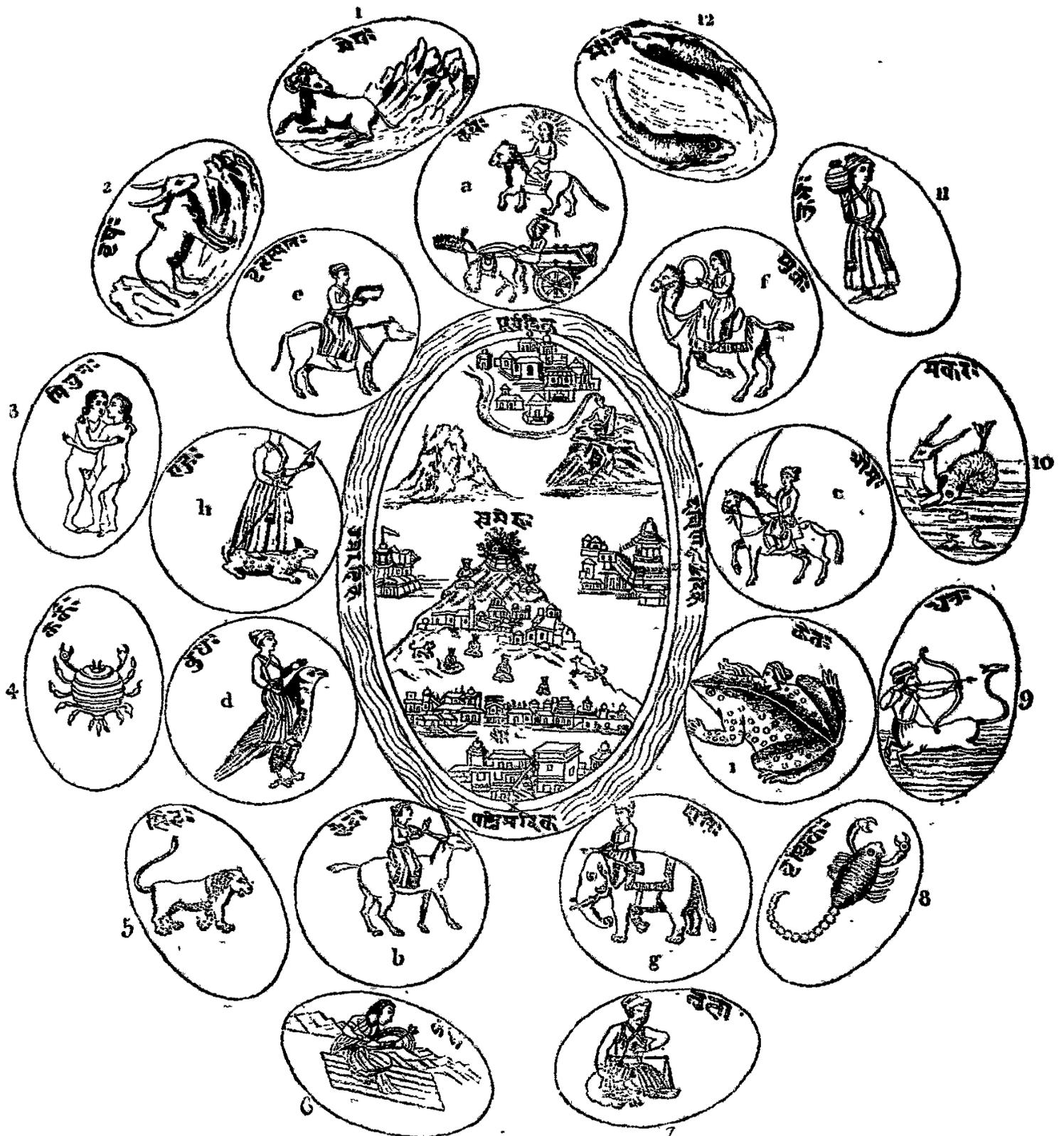
N os 1 — 12, the Zodiac Signs. a. the Sun. b. the Moon c. Mars d. Mercury. e. Jupiter. f. Venus.
g. Saturn. h. Head of the Dragon or ascending Node. i. Tail of the Dragon or descending Node.
At the center is the Earth, surrounded by Ether. The four cardinal points are marked E O N S.
Living Waters, the plastic Lymph in all things—the ovum, ovary, and ovoid—were the indicated Morphology. Hence the Adamic letter Tha has lost its verbal correspondences, though manifest traces remain in what precedes. —
T-44 — Translator’s Note: A jar for washing the hands. ↩