Musical string of the Marquis de Saint-Yves. Its application to Architecture and all decorative, graphic, and plastic Arts.
Such as: Decoration, ceramics, mosaics, stained glass, lacework, furniture, ironwork, etc.
by M. Ch. GOUGY, government-licensed architect.
In the various branches of human knowledge, empirical systems—those based solely on experience—are numerous. Every rigorously demonstrated rational system is Unique. Such is today’s Theory of light in physics.
Count Camille DURUTTE, of Ypres (elementary summary of harmonic Technics).
Such shall be the Theory of proportions and forms in Architecture, decoration… etc.
The application of the musical Verbal Principle or musical string to the arts described above being purely technical and requiring for its comprehension and importance a lengthy development and numerous diagrams, we shall provide in this exposition only a very brief summary and a few figures merely to explain the Principle—which is above all the rigorous and exact application of musical harmony’s laws to all aesthetic arts and crafts.
The sonometry established by the Marquis de Saint-Yves makes immediately practical, in all cases, the adaptation of music—or the Laws of harmony—to proportions and forms. (To proportions, through strings armed with their chosen intervals and chords. To forms through the vibrations of these same strings, intervals, and chords.)
These laws are numbers—the same as those of music and harmony; but it is well understood that what is string for measuring sounds is line for measuring proportions and forms.
This application constitutes a new science, and armed with this science, all arts may thus be consummated in an architechnic unity that no civilization has likely known, practiced, or perhaps even suspected.
The resources this Principle can provide are inexhaustible, deriving not only from music’s numerous chords and intervals, but also from the octaves that divide the string into an indefinite number of small intervals—which can themselves always be further divided and subdivided.
The musician is far from possessing this infinite wealth of resources and combinations that the architect will command, for he has at his disposal only a very small number of these Octaves (about 8 or 9) within which he can practically operate.
Yet these laws of musical harmony, though relatively limited for the musician compared to what the Verbal Principle can give the architect, have never been for music’s great inspirations a constraint upon their freedom nor an obstacle to developing all their works. How numerous, then, are the works their geniuses have begotten, and how numerous too the very different Schools these same geniuses have formed.
Faced with such a fact, why should it not be so for the architect, and why should his freedom be more hindered, paralyzed, or constrained than the musician’s ever was?
The answer lies in the fact itself, and is this future worth less for architects and other arts than the total absence of resources they now face regarding Laws and combinations of these Laws? For it must be said: perfection in proportions and forms cannot be achieved through the eye’s judgment alone, however trained it may be. This precious but perhaps less refined organ than the ear will always waver uncertainly, and thus can produce only uncertainties—not the perfection which is One. In exchange, however, while the ear can perceive sounds pleasantly across only about 8 Octaves, the eye in our system can behold an infinity of them just as agreeably.
For Architecture it must be so, for a limited number of Octaves would be insufficient and render the system inapplicable to all combinations.
Let us take a facade as an example. It will first divide into large intervals, precisely determining the placement of entablatures, cornices, friezes, bands, etc. Then into smaller ones that will fix the exact dimensions of solids and voids. Finally, these entablatures, cornices, and bands will subdivide into even smaller intervals to generate the moldings.
Thanks to the infinite number of Octaves provided by the Principle, we certify this is possible and that the problem is solved.
Moreover, all projections on this facade can be regulated according to the same laws, so as to cast shadows—first upon themselves, then upon one another—whose dimensions will maintain harmonic ratios both among themselves and with the overall chosen mode and chord.
As we stated earlier, the harmonic Laws of Proportions (i.e., string lengths), those of Forms (i.e., vibrations), and the harmonic Laws of music (i.e., sounds) are identical. Consequently, the music of proportions and forms and the music of sounds are inseparable and directly united, since in this system the former are consequences of the latter.
Since strings produce sounds corresponding to their lengths through vibrations, we may conclude that the former are the cause and the latter the effect. Thus, if harmony exists among several sounds, the same harmonic ratios must exist among the lengths of the strings producing them—assuming, of course, strings that are precisely and theoretically identical: of the same composition, material, thickness, equal tension, etc. In other words, a single string where the smaller ones would be considered as segments of the largest. This being said, we proceed to the musical rule.
Musical Rule of the Marquis[*] de Saint-Yves
This musical rule differs from others already known in that it satisfies the following conditions:
It is arithmological through its Numbers and gives the Proportions. It is morphological through its Vibrations and gives the Forms. It is metrological, for it corresponds precisely with the meter. Finally, it is archeometric through its correspondences with the Archeometer. This Standard fulfills all the above conditions—something no musical rule currently used in physics laboratories can accomplish.

STANDARD
| 240-600 | 144,000 | G | 21,600 | 36-600 |
| 240-576 | 138,240 | G# | 22,500 | 36-625 |
| 216-625 | 135,000 | A | 23,040 | 40-576 |
| 216-600 | 129,600 | A# | 24,000 | 40-600 |
| 216-576 | 124,416 | B | 25,000 | 40-625 |
| 192-625 | 120,000 | B# | 25,920 | 45-576 |
| 192-600 | 115,200 | C | 27,000 | 45-600 |
| 180-625 | 112,500 | C# | 27,648 | 48-576 |
| 192-576 | 110,592 | B | 28,125 | 45-625 |
| 180-600 | 108,000 | C | 28,800 | 48-600 |
| 180-576 | 103,680 | C# | 30,000 | 48-625 |
| 160-625 | 100,000 | D | 31,104 | 54-576 |
| 160-600 | 96,000 | D# | 32,400 | 54-600 |
| 160-576 | 92,160 | D# | 33,750 | 54-625 |
| 144-625 | 90,000 | E | 34,560 | 60-576 |
| 144-600 | 86,400 | E# | 36,000 | 60-600 |
| 135-625 | 84,375 | A | 38,864 | 64-576 |
| 144-576 | 82,944 | E | 37,500 | 60-625 |
| 135-600 | 81,000 | A | 38,400 | 64-600 |
| 135-576 | 77,760 | A# | 40,000 | 64-625 |
| 120-625 | 75,000 | G | 41,472 | 72-576 |
| 120-600 | 72,000 | G | 43,200 | 72-600 |
54,000 C 57,600
48,000 D 64,800
36,000 G 86,400
18,000 G 172,800
9,000 G 345,600
4,500 G 691,200
1,125 G 2,764,800
VERBAL SERIES · VIBRAL SERIES — Scale of 1/60
It is armed with a double series of numbers forming a double proportional rule. On the left rule, each note is marked by a transverse division corresponding to the number for that note. This rule is intended for calculating aesthetic proportions—the one that interests us for this application.
On the right rule are indicated the vibration numbers corresponding to each note.
We shall not dwell further on the construction of this rule; but we certify that it is scientifically exact and in perfect correspondence with those of physicists. It is based on the Sol string divided into 144,000 rather than the Ut string as in physics cabinets.
Application of the Musical Rule to Architecture and Forms
For all architechnic or decorative combinations to be developed within the Principle, one must first choose the chord suited to the combination and closest to its proportions.
This done, the first diagram to establish is that of the musical carpentry or figure of proportions.
The two diagrams (plates 2 and 4) represent two types of musical carpentry in different styles, upon which were constructed the two small chapels—one treated in Greek style and the other in Romanesque or rounded-arch style.
Both proceed from the Sol string divided by 96, the number of the first triangle or Triangle of Jesus (Archeometer).
The first of these two figures contains no vibrations, whereas the second is armed with several of these vibrations that directly give the form and style of the small monument.
With the exception of these two figures, all others are based on the Sol string divided by 240, the number of the second Triangle of Mary (Archeometer).
For our demonstration, we shall adopt the first example of this second series—that is, the rounded-arch style, whose chosen and adopted chord is La Ut Mi, the perfect minor chord of La fundamental.
The La string, or AB in the figure, is the longest and adopted in this example as the height string. It is armed with its intervals Ut Mi precisely marked on the musical rule. Its direction proceeds from top to bottom, from low to high pitch, from largest to smallest intervals. In this manner, the multiplication of octaves at the high end brings intervals ever closer, allowing all necessary moldings and small intervals to be detached for the composition.
The second vertical string CD, on the opposite side of the figure, is the same as the above but inverted upon itself. It is armed with the same intervals and proceeds inversely—that is, from high to low pitch, from smallest to largest intervals.
With height proportions thus regulated, let us proceed to width proportions to form the complete rectangle ABCD.
Here again we shall use a single string for both sides, and for greater simplicity, we shall adopt the La2 string—half and octave of the first.
The BC string, armed with the same intervals as above but at the Octave, proceeds from left to right, from largest to smallest intervals. The AC string, opposite at the summit, is the inversion of this BC string and proceeds inversely—that is, from right to left.
Finally, the horizontal and vertical lines passing through the harmonic divisions of these four principal strings will constitute this first diagram of musical carpentry.
By this simple procedure, any work of art may be established in accordance with the scientific Laws of harmony.
This diagram determines a genre—that of lines or strings at rest.
To obtain forms, one must animate the strings or lines constituting the musical carpentry by vibrating all that movement must animate without compromising stability. The vibrational amplitudes will yield their laws like all facts of the musical verbal system.
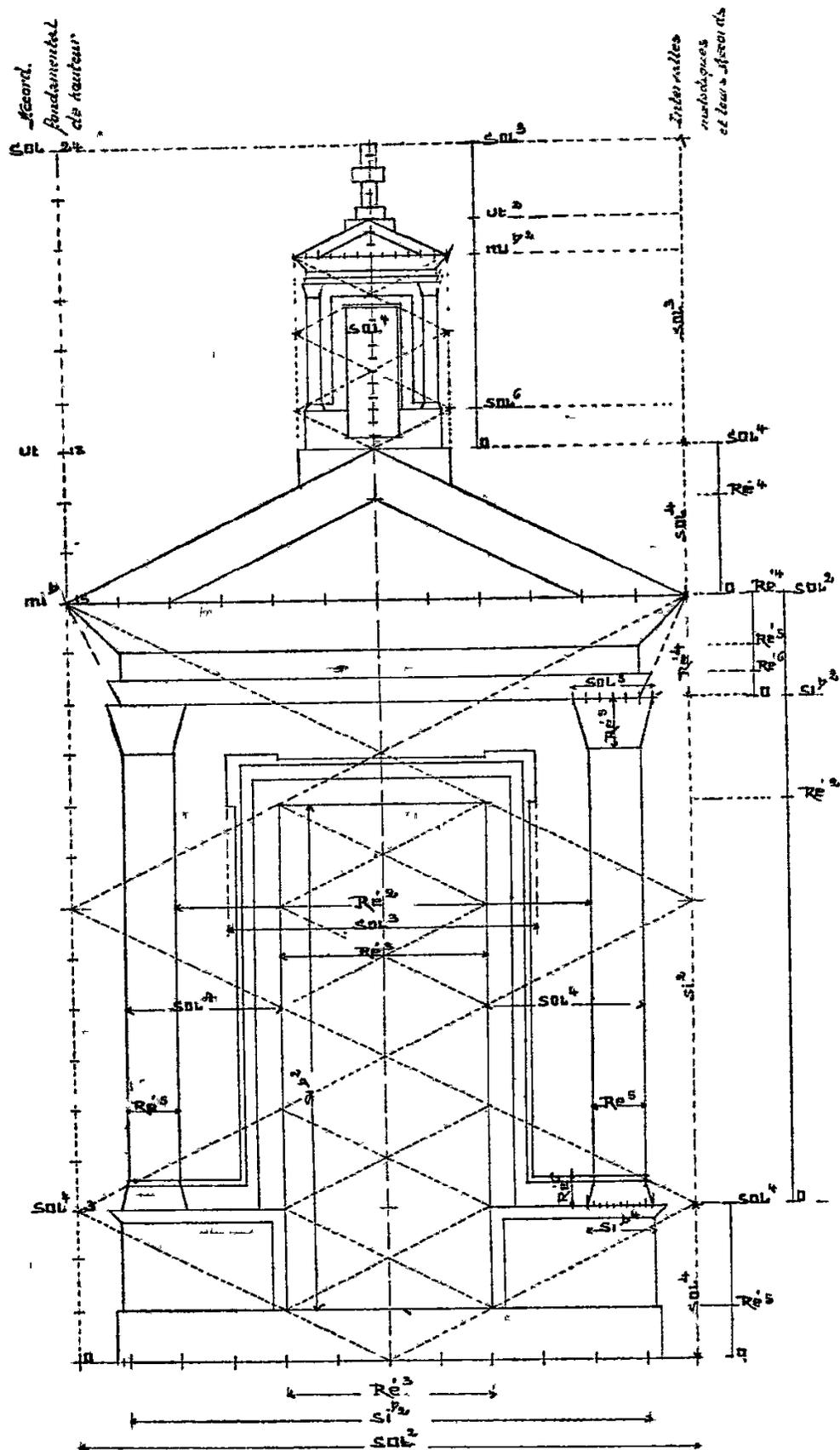
Type of Musical Carpentry — Greek Style
Musical Divisions and Intervals based on the Sol string divided (by 96)
Number of the Triangle of JESUS (Archeometer)
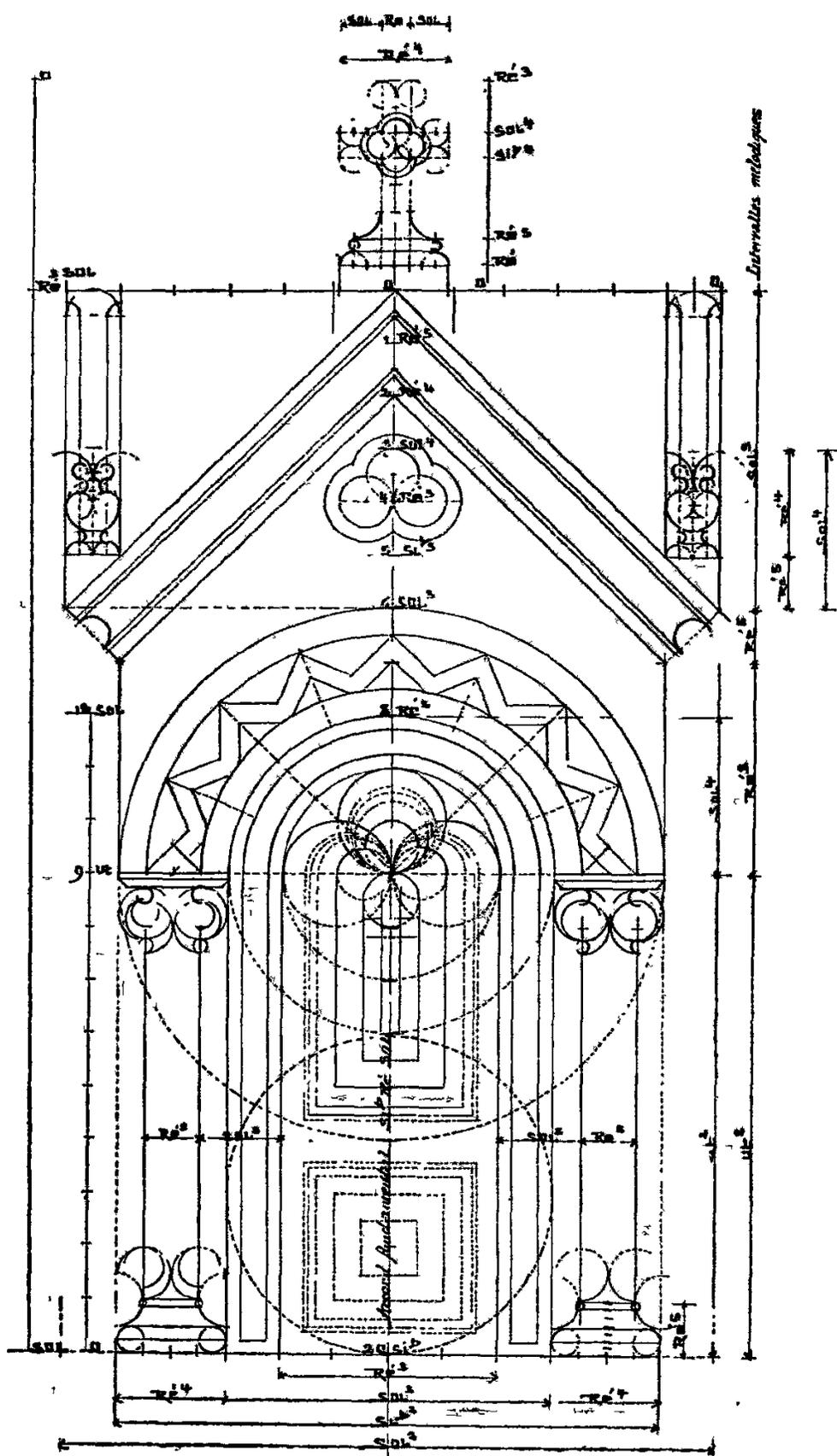
Type of Musical Carpentry armed with its principal vibrations
Musical divisions and intervals based on the Sol string divided by 96
Number of the Triangle of JESUS (Archeometer) — Rounded-arch style
In this example, the style being rounded-arch, the vibrational amplitudes will be circles—hence each string or string segment corresponding to each interval becomes the diameter of its vibration circle. And since all these strings and string segments constitute harmonic ratios among themselves through their lengths, it follows that all these circles will be constructed according to the same harmonic ratios among themselves.
The musical carpentry or figure of proportions, animated by its vibrations, constitutes the figure of forms.
Armed with these two figures indicated as one in this example, the Artist may compose directly within the Principle, choosing for both proportions and forms those best suited to his inspiration and composition.
This simple figure of proportions can generate infinite vibrations, intersecting and combining among themselves, allowing the composition of infinite forms.
Wishing to be as clear as possible in our demonstration, we have indicated in this figure only the vibrations necessary for constructing our example (the rounded-arch stela).
✳ ✳ ✳
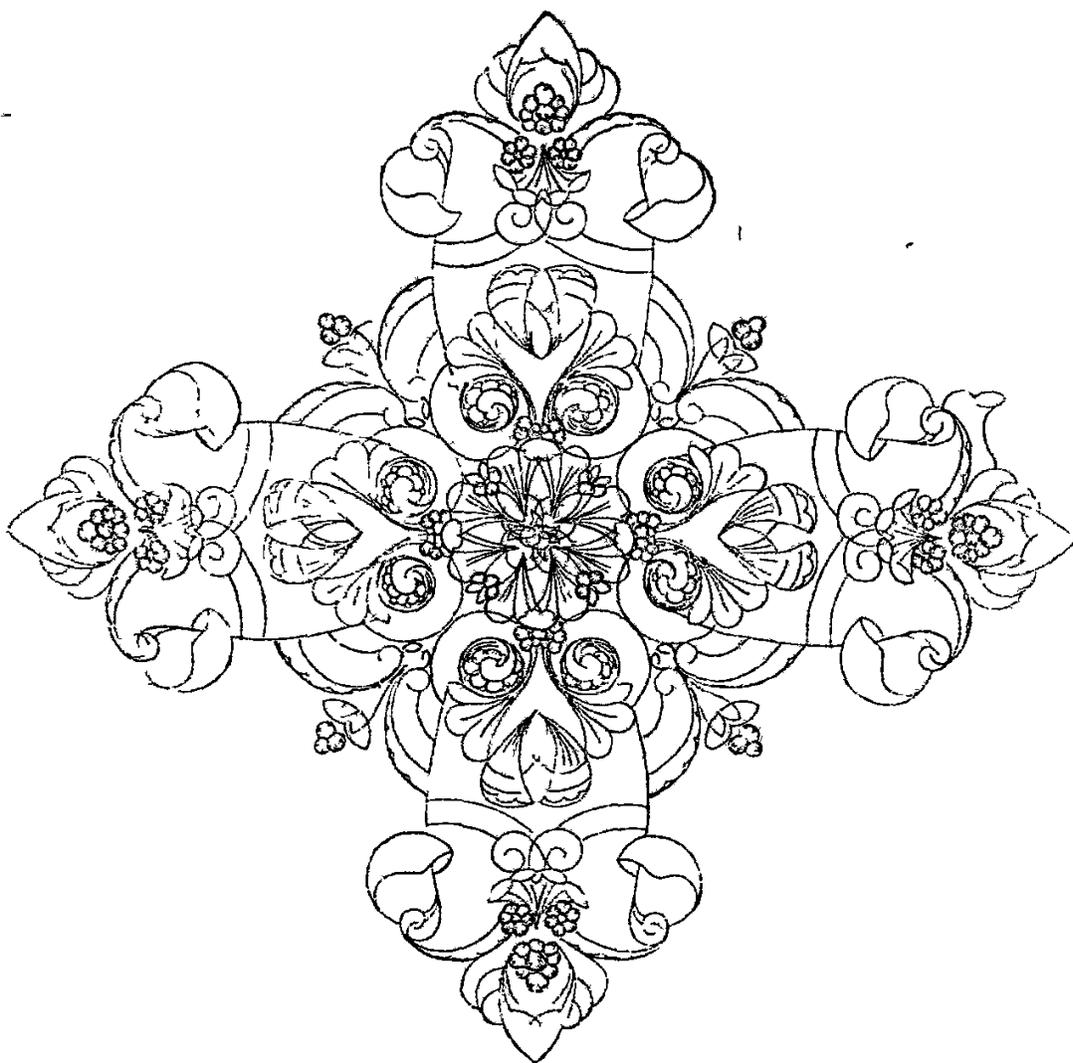
The following examples are constructed upon the same figure of proportions but in different styles—some treated in rounded-arch style, others in Gothic style—and each figure of proportions is armed with vibrations corresponding to its style.
Through these few examples, one may easily grasp the infinite resources contained within this Principle. For through the infinite number of strings and their multiple arrangements, through their numerous divisions of chords and intervals, through their infinite octaves, through all these lines and curves combining among themselves—finally through all these differing styles—the artist may establish as many distinct diagrams as he requires, working upon them with complete assurance.
Whatever chords and styles may be employed, all these diagrams are constructed in the same manner and are applicable not only to Architecture but to all arts described above without exception.
To simply demonstrate the Principle, to prove its application possible and practical—such is the aim of this work. We hope that through these few examples, our readers will see clearly and beyond doubt that this concerns neither imagination nor vain magic, but a pure and simple scientific truth applied to the arts.
Moreover, the following passages from the Bible emphatically confirm that this application of music to Architecture is not only possible but must always remain the rule to follow for constructing our edifices—and above all for erecting our tombs, chapels, churches, objects of worship, etc.
We shall observe that all dimensions are indicated according to a single measure—the cubit—and that this common measure functioned as a module, the basis of all proportional systems. If we relate all these cubit numbers to the Sol string divided by 96 (the number of the first Triangle or Triangle of Jesus in the Archeometer), we shall see they maintain perfectly harmonic ratios among themselves. We shall likewise confirm these numbers arise not by chance but by God’s express will, imposed by Him as commandments.
This cubit is indeed that described by Chateaubriand in his documentary evidence. It is the sacred Hebrew cubit used specifically for temple construction.
It was divided into six equal parts or minor palms, each subdivided into four further parts. The total number of divisions and subdivisions was thus twenty-four.
The number six, when related to the Sol string divided by 96, yields the following correspondences:
| 1 | 2 | 3 | 4 | 5 | 6 |
| Ré3 | Ré2 | Sol | Ré | Si♭ | Sol |
or the perfect minor chord of Sol fundamental. Here we clearly encounter a musical meter identical to that which serves us today for demonstrations.
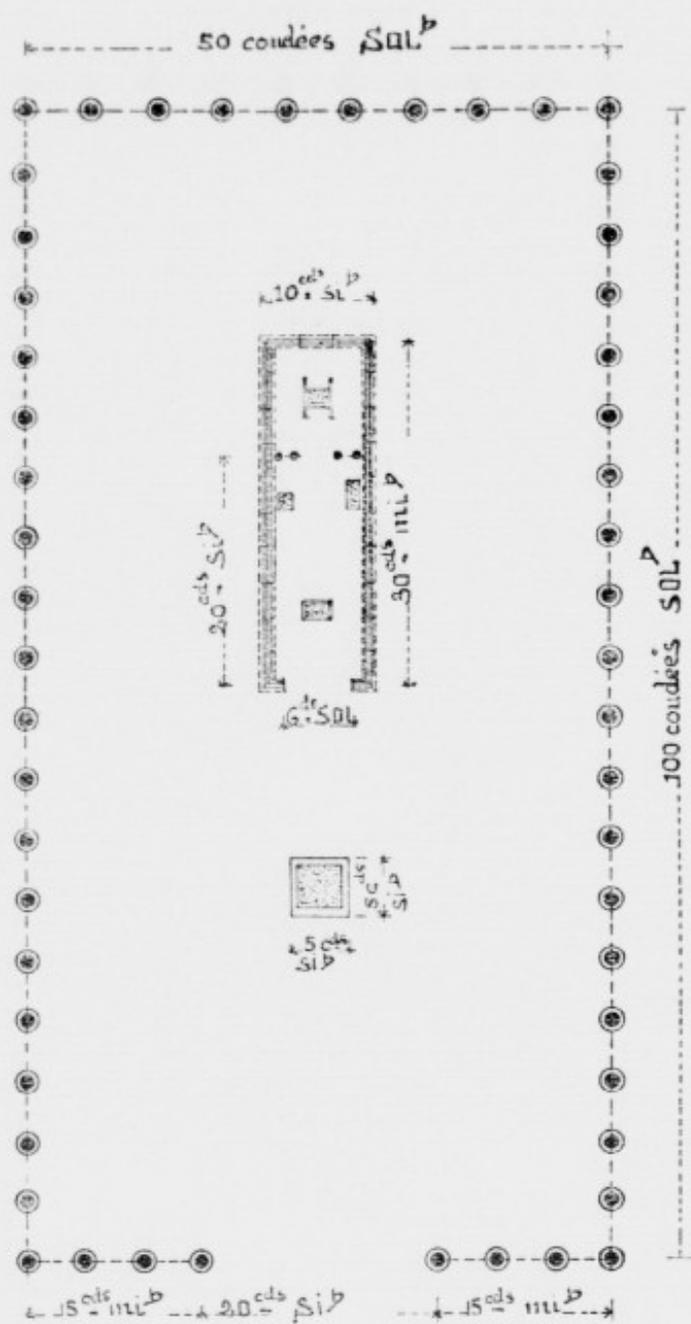
EXODUS — Chapters XXV, XXVI, XXVII — Tabernacle.
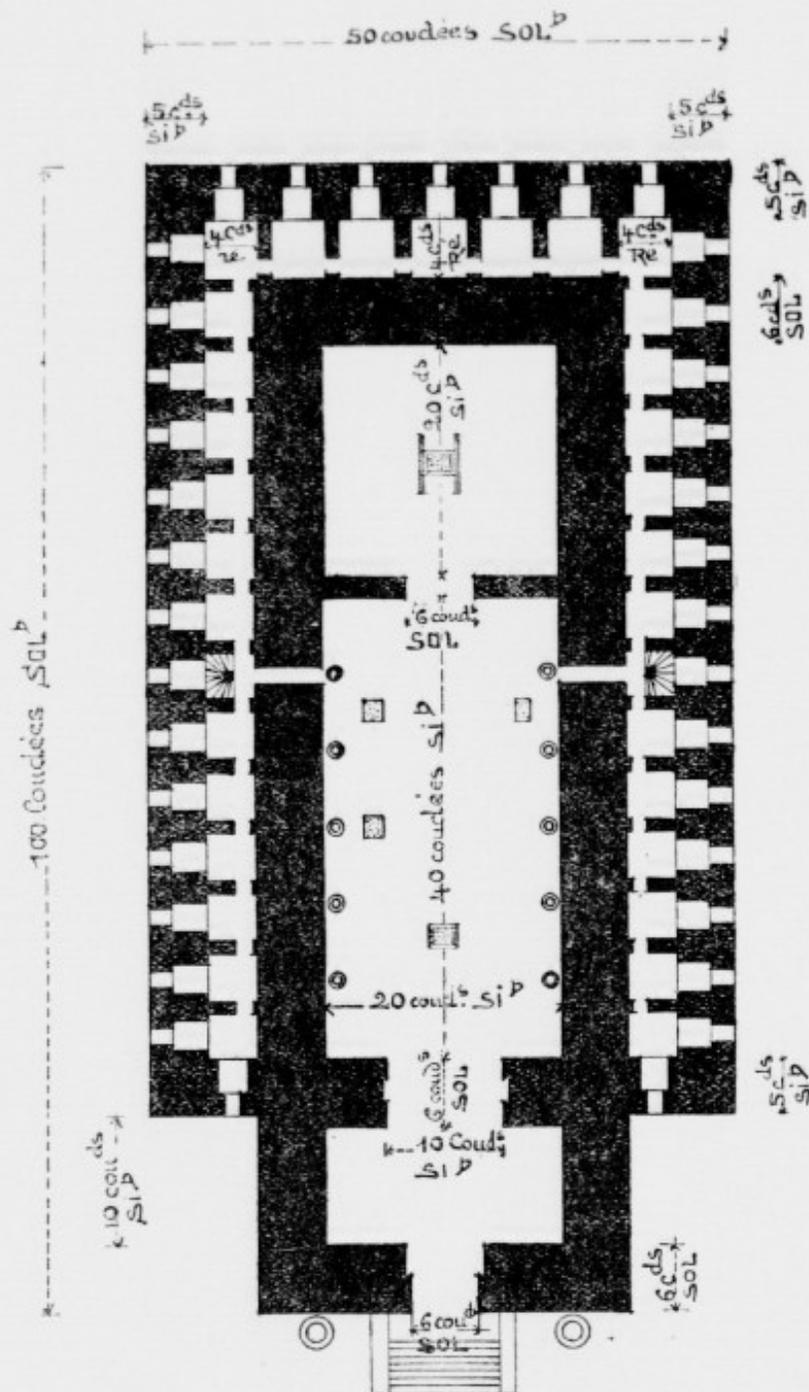
32 cubits — Ré — EZEKIEL. Chapter XLI. Temple.
Biblical References
Exodus
Chapter XXV
Verse 8. And let them make me a sanctuary; that I may dwell among them.
Verse 9. According to all that I shew thee, after the pattern of the tabernacle, and the pattern of all the instruments thereof, even so shall ye make it.
Verse 10. And they shall make an ark of shittim wood:
Two cubits and a half shall be the length thereof … . . Si♭.
And a cubit and a half the breadth thereof … . . Sol.
And a cubit and a half the height thereof … . . Sol.
And thou shalt make a mercy seat of pure gold:
Two cubits and a half shall be the length thereof … . . Si♭.
And a cubit and a half the breadth thereof … . . Sol.
Verse 23. Thou shalt also make a table of shittim wood:
Two cubits shall be the length thereof … . . Ré.
And a cubit the breadth thereof … . . Ré.
And a cubit and a half the height thereof … . . Sol.
Chapter XXVII
Verse 1. And thou shalt make an altar of shittim wood:
Five cubits shall be the length thereof … . . Si♭.
And five cubits the breadth thereof … . . Si♭.
And the height thereof shall be three cubits … . . Sol.
Verse 9. And thou shalt make the court of the tabernacle. The court shall have:
Fifty cubits … . . Sol♭.
Verse 18. The length of the court shall be a hundred cubits… . . Sol♭.
Chapter XXX
Verse 1. Thou shalt make also an altar of shittim wood to burn incense upon.
Verse 2. It shall have: One cubit in length… . . Ré.
— One cubit in breadth … . . Ré.
— Two cubits in height … . . Ré.
Kings
Chapter VI. — Description of the Temple
Verse 2. The house which King Solomon built unto the Lord had:
Sixty cubits in length … . . Mi♭.
Twenty cubits in breadth … . . Si♭.
Thirty cubits in height … . . Mi♭.
Verse 3. There was a Porch in the Temple of:
Twenty cubits in length … . . Si♭.
Ten cubits in breadth … . . Si♭.
Verse 6. The nethermost chamber had:
Five cubits in height … . . Si♭.
The middle one was six cubits in breadth… . . Sol.
Etc…
Ezekiel
Chapter XL
Verse 2. In visions of God brought he me into the land of Israel, and set me upon a very high mountain, by which was as the frame of a city on the south.
Verse 3. And he brought me thither, and, behold, there was a man, whose appearance was like the appearance of brass, with a measuring reed.
Chapter XLI
Verse 1. Afterward he brought me to the temple, and measured the posts of the entrance which were each:
Six cubits in breadth … . . Sol.
Verse 2. He measured the breadth of the door opening which was:
Ten cubits… . . Si♭.
And both sides of the door had each:
Five cubits … . . Si♭.
Verse 3. He measured a post of the door which was:
Two cubits … . . Ré.
Verse 4. Then he measured along the front of the temple a length of:
Twenty cubits … . . Si♭.
and a breadth of: twenty cubits … . . Si♭.
Verse 5. Then he measured the thickness of the wall which was:
Six cubits… . . Sol.
and the breadth of the chambers built outside the temple, each being:
Four cubits… . . Ré.
Verse 8. I considered the upper chambers round about this building, and their measure at the bottom was a full reed of:
Six cubits… . . Sol.
Verse 9. The thickness of the outer walls was:
Five cubits … . . Si♭.
Verse 10. Between the building of these small chambers and that of the Temple there was a space of:
Twenty cubits … . . Si♭.
Verse 13. He measured the length of the house which was:
A hundred cubits … . . Sol♭.
Verse 14. The space before the face of the Temple had:
A hundred cubits … . . Sol♭.
Verse 22. The altar which was of wood had:
Three cubits in height … . . Sol.
Two in breadth … . . Ré.
With the exception of the courts which had fifty or a hundred cubits—numbers corresponding to the note Sol♭ divided by 96—all other dimensions correspond precisely with the notes Sol, Si♭, Ré, forming the perfect minor chord of Sol, being musical divisions and correspondences of the Hebrew cubit.
Chapter XLII
Verse 15. Now when the angel had made an end of measuring the inner house, he brought me forth toward the gate which looketh toward the east, and measured it round about.
He measured the east side with the measuring reed, five hundred reeds round about … . . Sol.
Ezekiel indicates in Chapter XLI Verse 8 that the measuring reed used by the angel to measure the temple was six cubits.
Moreover, we have indicated above that the total number of divisions and subdivisions of the cubit was twenty-four.
6 × 24 = 144 or measure of the reed.
144 × 500 = 72,000.
72,000 when related to the Musical Standard of the Marquis de Saint-Yves corresponds to Sol 22 or the octave of this Standard divided by 144,000.
Here again there is musical correspondence.
We conclude these references by citing the following passages from the Prophet Ezekiel.
Chapter XLIII
Verse 10. Thou, son of man, shew the house to the house of Israel, that they may measure the whole structure thereof.
Verse 11. Show them the form thereof, etc.
Verse 12. This is the law of the house to be observed in building it upon the mountain.
These passages overwhelmingly prove the paramount importance God placed upon all these numbers for constructing His Temples—numbers which were, without doubt, so many musical Utterances constituting in their totality a perfect harmony.
Yet we must add that despite all we have expounded, this entire work cannot be judged by these simple data alone. On this subject, here was the thought of the Marquis de Saint-Yves: “The Archeometric System and its derivatives do not demand faith. They provide technical certainty to Study of like nature. Not proceeding from philosophy but from science grounded in Religion, they pertain not to opinion but to observation and experience. Fragments may astonish, but one must not expect them to convince. Conviction can only arise through study—whether of the Whole or of one complete series within the System.”
When the application of this System to the arts becomes well known and understood, we have no doubt that all artists eager to know this pure truth will feel boundless gratitude toward the Marquis de Saint-Yves. And were we here to render him all the homage he merits, he would reply as he often told us: “Glory to the Incarnate Word, to Our Lord Jesus Christ in His Principle.”
We add but one word more: to present to him beyond the grave this supreme and heartfelt gratitude, and the sincerest expression of our respect for his memory.
Ch. Gougy,
Government-licensed Architect.
T-45 — Translator’s Note: Segments. ↩